

Sudanese authorities close door on support for Hamas

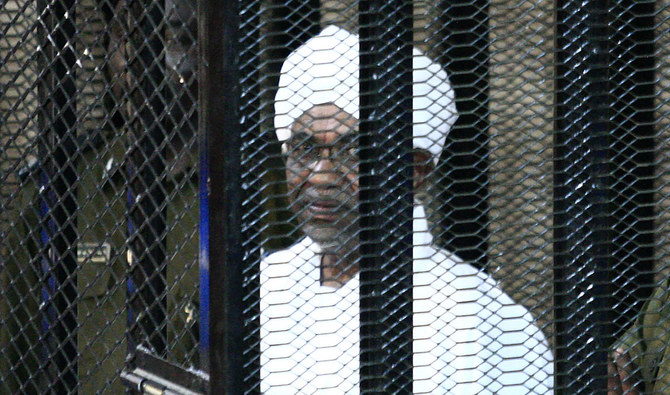
Former leader Omar Bashir openly supported Hamas, and was friendly with its leaders. (AFP/File)
Short Url
Updated 23 September 2021
Follow

Sudanese authorities close door on support for Hamas

  • Takeover of companies linked to Hamas helped accelerate Khartoum’s realignment with West

KHARTOUM: Sudanese authorities have taken control of lucrative assets that for years provided backing for Hamas, shedding light on how the country served as a haven for the Palestinian militant group under former leader Omar Bashir.
The takeover of at least a dozen companies that officials say were linked to Hamas has helped accelerate Sudan’s realignment with the West since Bashir’s overthrow in 2019.
Over the past year, Khartoum has won removal from the US state sponsors of terrorism list and is on course for relief of more than $50 billion in debt.
Hamas has lost a foreign base where members and supporters could live, raise money, and channel Iranian weapons and funds to the Gaza Strip, Sudanese and Palestinian analysts said.
Seized assets detailed by Sudanese official sources and a Western intelligence source show the reach of those networks.
According to officials from a task force set up to dismantle the Bashir regime, they include real estate, company shares, a hotel in a prime Khartoum location, an exchange bureau, a TV station, and more than a million acres of farmland. Sudan became a center for money laundering and terrorism financing, said Wagdi Salih, a leading member of the task force — the Committee to Dismantle the June 30, 1989 Regime and Retrieve Public Funds.
The system was “a big cover, a big umbrella, internally and externally,” he said.
A Western intelligence source said techniques were used in Sudan that are common to organized crime: Companies were headed by trustee shareholders, rents collected in cash, and transfers made through exchange bureaux.
Bashir openly supported Hamas, and was friendly with its leaders.
“They got preferential treatment in tenders, tax forgiveness, and they were allowed to transfer to Hamas and Gaza with no limits,” said a task force member, speaking on condition of anonymity.
Sudan’s journey from pariah state to US ally has been gradual. In the decade after Bashir took power in 1989 the country became a hub for radicals, sheltered Osama bin Laden for several years, and was sanctioned by the US over links to Palestinian militants.

BACKGROUND

Hamas has lost a foreign base where members and supporters could live, raise money, and channel Iranian weapons and funds to the Gaza Strip, Sudanese and Palestinian analysts said.

Bashir later tried to distance himself from radicalism, stepping up security cooperation with Washington. In 2016 Sudan cut ties with Iran and the following year US trade sanctions against Khartoum were dropped after Washington accepted that state support for Hamas had ceased.
But until Bashir’s fall, networks that had supported Hamas remained in place.
Hamas investments in Sudan began with small-scale ventures such as fast food restaurants before venturing into real estate and construction, according to an official on the task force.
An example was Hassan and Alabed, which started as a cement company and expanded into large real estate developments.
The task force says it was in a network with about 10 other large companies with interlinking share ownership connected to Bashir ally Abdelbasit Hamza that moved large sums through foreign bank accounts.
The biggest was Alrowad Real Estate Development, established in 2007 and listed on Khartoum’s stock exchange, with subsidiaries that the Western intelligence source said laundered money and traded in currency to finance Hamas.
Hamza was jailed in April for 10 years on corruption charges and sent to the Khartoum prison where Bashir is being held. The task force said he had assets worth up to $1.2 billion in his name. Hamza’s lawyer, who also represents Bashir, could not be reached for comment.
A second network, worth up to $20 million, revolved around the broadcaster Tayba and an associated charity named Almishkat. It was run by two Hamas members who got citizenship and amassed businesses and real estate, according to Maher Abouljokh, the caretaker brought in to manage Tayba. The TV channel was funneling money from the Gulf, laundered millions of dollars, and had clear links to Hamas, said Abouljokh.
Contacted by Reuters, Hamas official Sami Abu Zuhri denied the group had investments in Sudan, but acknowledged an impact from Sudan’s political shift: “Unfortunately, there were several measures that weakened the presence of the movement (Hamas) in the country (Sudan) and limited political ties with it,” he said.
By last year, Sudan was desperate to escape the SST list, a prerequisite for debt relief and support from international lenders.
It joined the UAE, Bahrain and Morocco in agreeing to normalize ties with Israel — though it has moved slowly to implement the deal.
A former US diplomat who worked on Sudan under the Trump administration said shutting down the Hamas network was a focus in negotiations with Khartoum. “We were pushing on an open door,” he said.
The US gave Sudan a list of companies to shut down, according to one Sudanese source and the Western intelligence source. The State Department refused to comment.
Many Hamas-affiliated figures went to Turkey with some liquid assets but left behind about 80 percent of their investments, the task force official said.
Sudan’s transitional leaders “consider themselves the exact antithesis of Bashir in regional terms,” said Sudanese analyst Magdi El-Gazouli. “They want to sell themselves as a component of the new security order in the region.”
“The coup against Bashir caused real problems for Hamas and Iran,” said Palestinian analyst Adnan Abu Amer. “Hamas and Iran had to look for alternatives — alternatives that had not been in place because the coup against Bashir was a sudden one.”


MPs, parties welcome Lebanon’s decision to ban Hezbollah’s military wing

Updated 43 min 43 sec ago
Follow

MPs, parties welcome Lebanon’s decision to ban Hezbollah’s military wing

  • Lebanese judiciary issues arrest warrants to pursue those who fired rockets at Haifa
  • Bilal Al-Houshaymi: It (Lebanon) is either a fully sovereign state with a single decision-making authority, or it will continue its downward slide into greater danger and collapse

BEIRUT: Lebanon’s Cabinet decisions were described by political parties and parliamentarians as the boldest measures taken against Hezbollah to date, with ministers from the Amal Movement, the group’s key ally, joining in a show of government solidarity.

In an unprecedented move, Lebanon’s Cabinet on Monday declared Hezbollah’s military activities illegal and demanded the immediate handover of its weapons, following Israeli strikes that killed more than 40 people and wounded dozens across Beirut’s southern suburbs, southern Lebanon and the Bekaa Valley.

The Israeli strikes came after rockets and drones were fired from Lebanese territory toward northern Israel — an assault Hezbollah said was carried out in retaliation for the killing of Iran’s Supreme Leader Ayatollah Ali Khamenei. Among those killed were several Hezbollah officials.

Independent MP Ibrahim Mneimneh affirmed his support for the government’s decisions “at this sensitive stage” as he said they consolidate the sovereignty of the state and the confinement of security and military decision-making to its legitimate institutions.

“The protection of Lebanon requires the firm application of the law, without making any exceptions, and providing support for the army and security forces in carrying out their duties in order to safeguard stability and civil peace,” he added.

Beqaa MP Bilal Al-Houshaymi said Lebanon cannot withstand new experiments or further adventures. “It is either a fully sovereign state with a single decision-making authority, or it will continue its downward slide into greater danger and collapse.”

Lebanese Forces party leader Samir Geagea said in a statement that the cabinet had taken an additional step toward the establishment of a functioning state.

“The ball is now in the court of the Lebanese Armed Forces, the Internal Security Forces, General Security, State Security and the competent judicial authorities. It is their chance to begin implementing the government’s decision seriously and decisively as of this moment,” he added.

The party’s two ministers remained alone in their defense of what they called the “resistance.” This stance was articulated by Health Minister Rakan Nassereddine, whom Hezbollah named to represent it in the government, as he said after the session that “no one holds their resistance accountable as we have held ours accountable.” He questioned whether “the Israelis can be trusted.”

Lebanese President Joseph Aoun held those who launched the rockets responsible for their actions, noting that the Lebanese people should not bear responsibility “for a reckless operation.”

Aoun said Hezbollah’s morning strike was “not a defense of Lebanon nor a protection of the Lebanese; it is not acceptable in any way whatsoever, and it gives Israel a pretext to destroy what is left.”

The cabinet asked the Lebanese Army Command to immediately and firmly begin implementing the plan to restrict weapons north of the Litani River, announcing that Lebanon is ready to resume negotiations with Israel.

The cabinet decisions, read out by Prime Minister Nawaf Salam in an address, announced that the government had formally rejected any military or security operations carried out from Lebanese territory outside the authority of the state, reaffirming that the decision of war and peace rests solely with the government.

The measures include an immediate ban on all Hezbollah military and security activities deemed unlawful, a requirement that the group hand over its weapons to the state, and a restriction of its role to political activity within constitutional and legal frameworks — a step aimed at ensuring the monopoly of arms remains exclusively with the state and reinforcing full sovereignty over Lebanese territory.

Salam said that the government does not seek confrontation with Hezbollah. “But we cannot in any way accept the launching of rockets from Lebanon nor the threat of civil war.”

In parallel with the political move, the Lebanese judiciary moved to pursue those who fired rockets at Haifa from Lebanese territory. The military judiciary issued warrants to arrest all those responsible for launching rockets at the Israeli city.

Government Commissioner to the Military Court Claude Ghanem requested that the security agencies identify those who took part in directing the rockets, arrest them immediately and refer them to the military public prosecution.

A judicial source confirmed that the security agencies verified that the rocket-launching operation took place from an area of valleys and forests located north of the Litani River.

A statement bearing the signature of Hezbollah’s Military Media had been issued at dawn claiming responsibility for the operation of bombarding the Mishmar site south of the city of Haifa with a salvo of rockets and drones, as “revenge for the blood of the Iranian Supreme Leader Ali Khamenei.”

While Hezbollah has not issued any official statement tallying its human losses as a result of direct Israeli strikes, Lebanese and Israeli field reports cited the assassination of Mohammad Raad, head of Hezbollah’s parliamentary bloc, who in recent months had coordinated between the state and the party on the issue of restricting weapons; Sheikh Ali Daamoush, the head of Hezbollah’s Executive Council; and Hussein Moukalled, the head of Hezbollah’s intelligence services in the southern suburb.

The reports also mentioned the killing of Mohammad Rida Fadlallah, brother of the late scholar Sayyed Mohammad Hussein Fadlallah, along with his wife; and Sheikh Abdullah Shaito, a Ja‘fari Sharia judge, with his son and daughter.

Amid the strikes, citizens evacuated Beirut’s southern suburb, more than 53 southern villages and dozens of villages in the Beqaa region.

Many fled at night, remaining in their cars or along the roadsides in Beirut, amid successive warnings issued by the Israeli army urging civilians to leave their villages and homes ahead of strikes on Hezbollah targets, according to its claims.

As hotels reached full capacity, many turned to furnished apartments. Although the state opened a number of public schools to shelter the displaced, the hastily opened and prepared facilities were insufficient to accommodate tens of thousands of people.

Meanwhile, a military source suggested that the evacuation of the villages could be a prelude to a ground invasion.

Israel announced the mobilization of about 100,000 reservists along the border with Lebanon in preparation for expanding the war. Israeli army spokesperson Avichay Adraee posted on social media that “all options are on the table,” adding that “Hezbollah chose to launch this campaign, and will pay a heavy price for it.”

Israeli Chief of Staff Eyal Zamir warned of “many days of fighting ahead,” while Israeli Defense Minister Israel Katz said that “Hezbollah chief Naim Qassem is now a ‘target for elimination,’ and Hezbollah will pay a heavy price for launching missiles toward Israel.”