


Snapchat launches first-of-kind activation for Saudi National Day

1 / 3
2 / 3
3 / 3
AlUla in Saudi Arabia's desert.
Short Url
Updated 23 September 2021
Follow

Snapchat launches first-of-kind activation for Saudi National Day

  • Messaging app celebrates Saudi heritage with world-first national Snap Map, other augmented reality activations

DUBAI: To mark this year’s Saudi National Day, Snap is launching a first-of-its-kind activation in the region using augmented reality.

In Saudi Arabia, nearly 90 percent of Snapchat daily users already interact with AR Lenses experiences, on average at least 30 times each day.

Now, the messaging app’s 19.5 million monthly active users in the Kingdom, as well as its global audiences, will have the opportunity to celebrate National Day on the platform through AR.

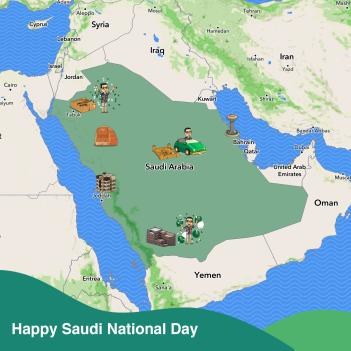
Launched on Sept. 22, the activation sees the Snap Map of Saudi Arabia appearing in a bright green to represent the national flag and the Kingdom highlighted from other countries, the first time Snap has ever recolored a Middle East territory on the map.

Along with the distinctive color change, Snap will also mark cultural and heritage sites — such as AlUla, Tabuk Castle, Alkhobar Water Tower, Rijal Almaa, Masmak Fort, and Nassif House — on the map allowing users to explore the Kingdom.

The markers for the sites include a Face Lens experience, whereby Snapchatters in Saudi Arabia will find themselves on a virtual balcony with all of the national landmarks behind them.

A celebratory atmosphere filled with fireworks and accompanied by the national anthem of Saudi Arabia will be recreated in AR, with users able to put themselves in the thick of the action and flip the camera to see the monuments in front of them.

Additionally, a series of customized Actionmojis, exclusive to Snapchatters in the Kingdom, are also being unveiled for a limited time on National Day only.

Abdulla Alhammadi, regional business lead at Snap Inc., said: “Snapchatters in Saudi Arabia are one of the most active communities on the platform anywhere in the world.

“We wanted to bring even larger, more engaging experiences to this community on Saudi National Day as a sign of gratitude for their contribution to Snap’s creative ecosystem, while together celebrating the rich legacy of visual storytelling that exists in the Kingdom.”

Diriyah, past, present and future
On Saudi Arabia’s 91st National Day, the birthplace of the Kingdom continues to make history

Enter


keywords

Gabon cuts off Facebook, TikTok after protests

Updated 33 sec ago
Follow

Gabon cuts off Facebook, TikTok after protests

Libreville, Gabon: Facebook and TikTok were no longer available in Gabon on Wednesday, AFP journalists said, after regulators said they were suspending social media over national security concerns amid anti-government protests.
Gabon’s media regulator on Tuesday announced the suspension of social media platforms until further notice, saying that online posts were stoking conflict.
The High Authority for Communication imposed “the immediate suspension of social media platforms in Gabon,” its spokesman Jean-Claude Mendome said in a televised statement.
He said “inappropriate, defamatory, hateful, and insulting content” was undermining “human dignity, public morality, the honor of citizens, social cohesion, the stability of the Republic’s institutions, and national security.”
The communications body spokesman also cited the “spread of false information,” “cyberbullying” and “unauthorized disclosure of personal data” as reasons for the decision.
“These actions are likely, in the case of Gabon, to generate social conflict, destabilize the institutions of the Republic, and seriously jeopardize national unity, democratic progress, and achievements,” he added.
The regulator did not specify any social media platforms that would be included in the ban.
But it said “freedom of expression, including freedom of comment and criticism,” remained “a fundamental right enshrined in Gabon.”

‘Climate of fear’

Less than a year after being elected, Gabonese President Brice Oligui Nguema has faced his first wave of social unrest, with teachers on strike and other civil servants threatening to do the same.
School teachers began striking over pay and conditions in December and protests over similar demands have since spread to other public sectors — health, higher education and broadcasting.
Opposition leader Alain-Claude Billie-By-Nze said the social media crackdown imposed “a climate of fear and repression” in the central African state.
In an overnight post on Facebook, he called on civil groups “and all Gabonese people dedicated to freedom to mobilize and block this liberty-destroying excess.”
The last action by teachers took place in 2022 under then president Ali Bongo, whose family ruled the small central African country for 55 years.
Oligui overthrew Bongo in a military coup a few months later and acted on some of the teachers’ concerns, buying calm during the two-year transition period that led up to the presidential election in April 2025.
He won that election with a huge majority, generating high expectations with promises that he would turn the country around and improve living standards.
A wage freeze decided a decade ago by the Bongo government has left teachers struggling to cope with the rising cost of living.
Authorities last month arrested two prominent figures from the teachers’ protest movement, leaving teachers and parents afraid to discuss the strike in public.