

China asks Pakistan to improve security of its workers as ‘precondition’ for CPEC progress

Chinese official virtually addresses the meeting of the CPEC Joint Cooperation Committee (JCC) held in Islamabad, Pakistan, on September 23, 2021. (Photo courtesy: CPEC Authority)
Short Url
Updated 23 September 2021
Follow

China asks Pakistan to improve security of its workers as ‘precondition’ for CPEC progress

  • Demand came during meeting of CPEC Joint Cooperation Committee, held after two-year hiatus
  • At least nine Chinese nationals have been killed in recent attacks in Pakistan

ISLAMABAD: China on Thursday asked Islamabad to improve security conditions for its workers in Pakistan as a “precondition” for progress on the multi-billion-dollar China-Pakistan Economic Corridor projects. 
The demand came during a meeting of the CPEC Joint Cooperation Committee (JCC), the apex decision-making body for the economic corridor projects.
The meeting, held after a hiatus of almost two years, was co-chaired by Pakistan’s Planning Minister Asad Umar and Chinese National Development and Reform Commission (NDRC) deputy chief Ning Jizhe. 
“Recently, we have seen the unfortunate increase in tragic incidents happening to Chinese people and Chinese companies in Pakistan,” Ning said. 
“We hope that Pakistan will take effective measures to strengthen protection of Chinese people and Chinese employees in Pakistan so they can work in [a] safe environment.” 
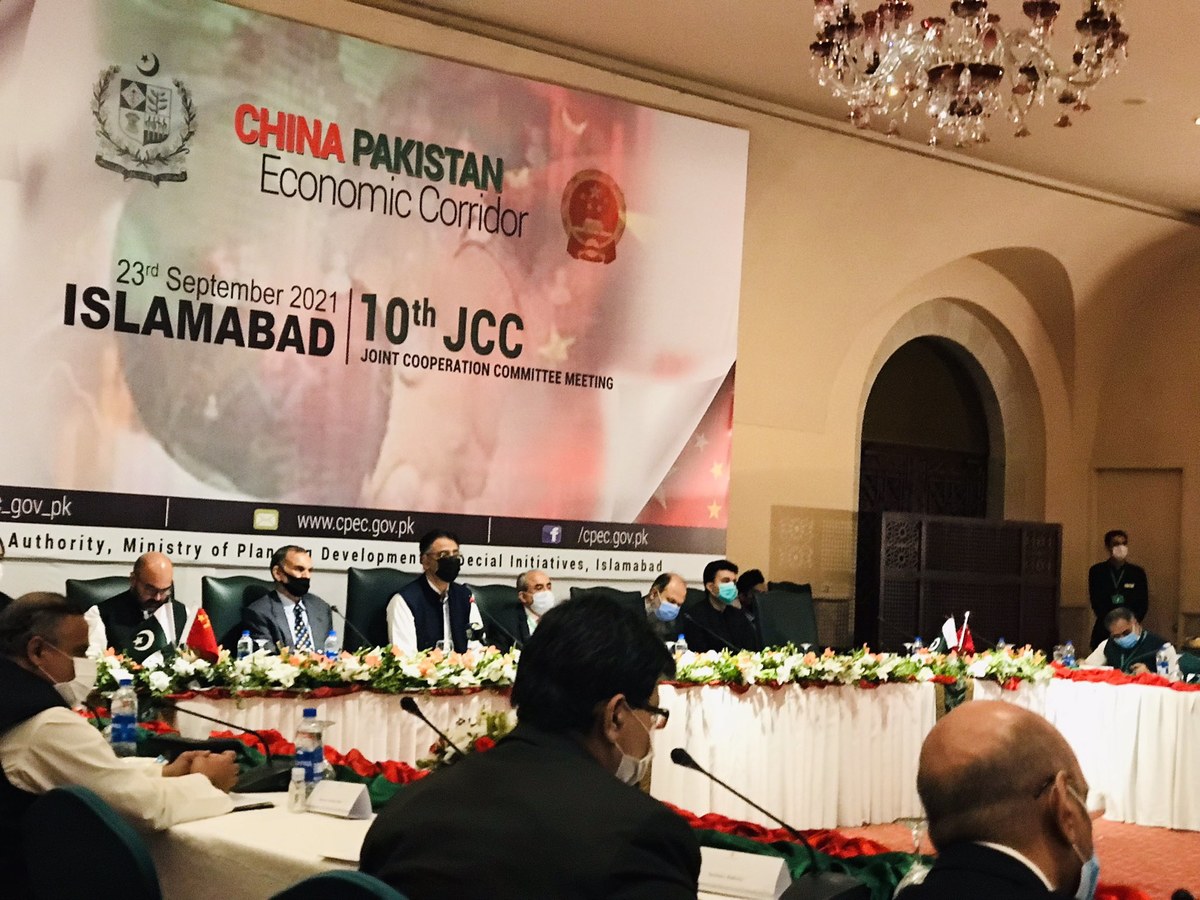


Pakistani government offiicials attend the meeting of the CPEC Joint Cooperation Committee (JCC) held in Islamabad, Pakistan, on September 23, 2021. (Photo courtesy: CPEC Authority) 

Last month, a suicide bomb attack on a motorcade carrying Chinese personnel injured one Chinese national and killed two local children in Pakistan’s southwestern Balochistan province. The incident took place on the East Bay Expressway in the port city of Gwadar, which lies at the heart of CPEC. 
The Gwadar attack followed the 14 July bombing that killed nine Chinese nationals among 13 people, who were en route to a dam construction site in northern Pakistan. 
Planning Minister Umar noted that Prime Minister Imran Khan himself led security reviews after the recent attacks targeting Chinese nationals in Pakistan. 
“[An] expanded security system has been designed, it has been shared with the Chinese,” Umar said at Thursday’s meeting, adding that he was confident of a secure environment for workers on the joint projects. 
CPEC has seen Beijing pledge over $60 billion for infrastructure projects in Pakistan, central to China’s wider Belt and Road Initiative (BRI) to develop land and sea trade routes in Asia and beyond. 
Umar said the Pakistani government was fully committed to CPEC and considered it critical for the country’s growth and development. 
In a Twitter post earlier, he expressed hopes that the “JCC will lay the foundation for further acceleration and broadening of CPEC.” 



Pakistan seeks wider access to Canadian market as both sides want deeper agricultural cooperation

Updated 4 sec ago
Follow

Pakistan seeks wider access to Canadian market as both sides want deeper agricultural cooperation

  • Islamabad urges faster certification for canola and halal products in a bid to expand agricultural exports
  • Canada pledges collaboration on pest management, invites Pakistan to the Canada Crops Convention

ISLAMABAD: Pakistan on Wednesday pressed for improved access to Canadian agricultural markets and faster certification procedures for key exports as Islamabad looks to modernize its climate-strained farm sector and resolve long-standing barriers to trade, according to an official statement.

The push comes as Pakistan, a largely agricultural economy, faces mounting challenges from erratic weather patterns, including floods, droughts and heatwaves, which have hurt crop yields and raised food security concerns. Islamabad has increasingly sought foreign partnerships and training to upgrade farm technology, while pursuing export-oriented growth to diversify markets for mangoes, rice, kinnow, dates and halal meat.

Federal Minister for National Food Security Rana Tanveer Hussain and Canadian High Commissioner Tarik Ali Khan met to discuss “strengthening bilateral collaboration in agriculture, enhancing market access for key commodities, and advancing ongoing phytosanitary and technical cooperation,” according to the statement.

“Minister Rana Tanveer Hussain stressed the importance of resolving market access challenges to ensure uninterrupted trade in priority commodities, particularly canola, which constitutes Pakistan’s major agricultural import from Canada," it continued. "He highlighted that Pakistan seeks robust and timely certification and registration processes to facilitate predictable canola imports."

"The Minister emphasized that Pakistan is eager to strengthen its halal export footprint in Canada and sought CFIA’s [Canadian Food Inspection Agency’s] support in accelerating certification procedures for halal gelatin, casings, and value-added poultry," it added.

High Commissioner Khan  acknowledged Pakistan’s concerns, the statement said, and assured Hussain of Ottawa’s readiness to deepen technical collaboration.

He also briefed the minister on Canada’s pest management systems and grain supply chain controls, adding that his country looked forward to facilitating Pakistan’s plant protection team during an upcoming systems-verification visit.

Khan also invited Pakistani officials to the Canada Crops Convention in April 2026 and confirmed participation in the Pakistan Edible Oil Conference, reaffirming that “Canada views Pakistan as a priority partner in the region.”

Hussain proposed forming a joint working group to maintain momentum on technical discussions and regulatory issues as both officials agreed to strengthen agricultural cooperation.