Saudi Falcons Club launches second auction on Oct. 1

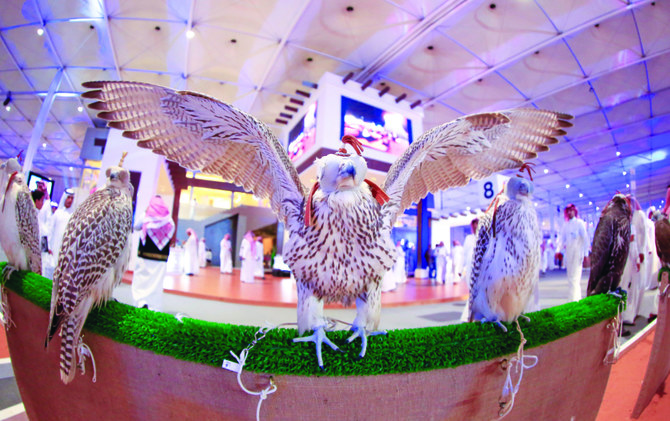
The 45-day event will see the sale of rare and distinctive falcons that have been hunted during their annual migration. (Shutterstock)
Short Url
Updated 23 September 2021
Follow

Saudi Falcons Club launches second auction on Oct. 1

  • The 45-day event will see the sale of rare and distinctive falcons that have been hunted during their annual migration

JEDDAH: The second International Falcon Hunters Auction will run from Oct.1-Nov.15, with the event being organized by the Saudi Falcons Club.
The club’s official spokesman, Walid Al-Taweel, said the auction reflected the organization’s keenness to strengthen falconry heritage and to serve falcon hunters and breeders in the Kingdom and the region.
“It also reaffirms the Kingdom’s leading role in supporting cultural and economic activities associated with falconry, where the auction aims to support investment in the field of falconry, the development of falcon auctions and the organization of the mechanism for buying and selling,” he said.
“The club’s teams in the central, western, eastern and northern areas will receive the owner of the falcon that has been hunted, using bait or a net to examine it (the bird), and document the process. The club will provide housing and transportation for the owners of falcons (hunters) to the auction site. The falcon will be put on sale during a live, competitive and fast auction broadcast on television and various club accounts on social media platforms. The sale and purchase process will be free of charge.”
He explained that, once a falcon was sold, the buyer would receive an export certificate and an electronic chip would be inserted into the falcon, in addition to official documents being issued to complete the sale.

HIGHLIGHT

The club’s first official auction, which was held last year, had sales exceeding SR10 million ($2.6 million). Its success and large turnout paved the way for the International Falcon Breeders Auction. The auction concluded on Sept. 5, with record sales achieved over 32 days, amounting to SR8 million for 443 falcons.

The 45-day event will see the sale of rare and distinctive falcons that have been hunted during their annual migration.
It coincides with the International Saudi Falcons and Hunting Exhibition, which runs from Oct. 1-10 at the club’s headquarters.
The exhibition is the largest of its kind for falcons, hunting and falcon accessories. It will have display areas, weapon pavilions, art and family interaction sections, shooting fields, a falconer of the future area, as well as a digital museum and heritage events.
The club’s first official auction, which was held last year, had sales exceeding SR10 million ($2.6 million).
Its success and large turnout paved the way for the International Falcon Breeders Auction. The auction concluded on Sept. 5, with record sales achieved over 32 days, amounting to SR8 million for 443 falcons.
Only vaccinated people can take part in the second auction. A range of precautionary measures will be applied to prevent the spread of COVID-19.


Prince William’s visit signals ‘importance of relationship with Saudi Arabia to UK,’ ex-envoy tells Arab News

Updated 4 sec ago
Follow

Prince William’s visit signals ‘importance of relationship with Saudi Arabia to UK,’ ex-envoy tells Arab News

  • Simon Collis: ‘Saudi Arabia is the most significant Arab country, the most significant regional country, but it’s also a global power’
  • Ties between the royal families are ‘almost 100 years old’ and run at a ‘longer wavelength than the day-to-day politics’

LONDON: Prince William’s three-day visit to Saudi Arabia this week reflects deep British interest in the “expectation of an important future” with the Kingdom, a former ambassador told Arab News on Monday.

Ties between the two royal families are “almost 100 years old, and it’s the kind of relationship that runs at a sort of deeper and longer wavelength than the day-to-day politics,” said Simon Collis, ambassador to Saudi Arabia from 2015 to 2020.

“Prince William’s grandmother, the late Queen Elizabeth, visited Saudi Arabia and hosted several of the kings of Saudi Arabia on their state visits to the UK.

“King Charles, as prince of Wales, visited Saudi Arabia many times — over a dozen times — and actually his last visit came shortly after I arrived in Riyadh as ambassador.

“When Crown Prince Mohammed bin Salman visited London in 2018, he had lunch with the queen, the late queen, and dinner, and that was at Buckingham Palace. He had dinner at Clarence House with Charles as prince of Wales, and William was there at that dinner.”

Similarities between the two heirs apparent on a personal level could also spur deeper diplomatic ties, Collis said.

“They have a lot in common: environmental interests, green energy interests, a lot of the things that have expanded in Saudi Arabia over the last 10 years in particular … as the economic transformation has moved forward under Vision 2030,” he added.

“So, areas like the core (interests), which were always there — these issues like defense, security, and energy — but what has opened up as a result of the changes in Saudi Arabia much more are other areas like education, culture, healthcare, environmental issues, heritage, sports ... all of these kind of soft power issues.”

Since King Salman assumed the throne in 2015, more than a dozen UK prime ministers and foreign secretaries have come and gone, Collis said, highlighting the “continuity” that William’s royal status can bring to the bilateral relationship.

“Links between the royal families are something special, and the fact that the prince of Wales is now visiting at the request of the British government clearly sends a signal of the importance of the relationship with Saudi Arabia to the UK,” he added.

Through a little-known government body, the Royal Visits Committee, William will have been briefed on the nature of the British-Saudi relationship, and how he can use his royal leverage to develop ties with a “priority” partner, Collis said.

“All official visits by members of the British royal family involve advice from the government about the priorities.”

The RVC meets and brings together No. 10, the Foreign Office and other relevant government departments with the staff at Buckingham Palace and the other royal households.

“They review together the countries that have been visited recently, both inward and outward visits: What are the countries that are a priority for a visit? Prince William hasn’t made a lot of these visits yet … King Charles was taking the lead on that for a long time,” Collis said.

“It’s not surprising that Saudi Arabia was seen as a priority for an early visit by Prince William as prince of Wales,” he added.

“The decision to prioritize the Kingdom for a visit reflects the overall bilateral importance to each other, the regional significance of Saudi Arabia and its position as a global player, increasingly so as Vision 2030 moves forward and as the country opens up,” Collis said.

“Saudi Arabia is the most significant Arab country, the most significant regional country, but it’s also a global power; it’s one of what people call the middle powers.

“Its views — not just on regional issues but on the global agenda, climate change, security, all of these global issues — matter.”

The pace of change in Saudi Arabia is so fast that Western observers are still playing catch-up, Collis said.

The direction of travel between the two countries means that although differences in traditions may exist, “values have certainly become closer than they were historically,” he added.

“When I arrived here (in 2015), there were religious police still on the streets, music in public places was banned and women were under the guardianship system ... The Western headline was always ‘they can’t drive.’ Women couldn’t travel, they couldn’t get a job, they couldn’t even access healthcare without the approval of a male guardian.

“Under the leadership of King Salman and of the crown prince, all of that has changed; it’s been completely transformed.”

The individual and personal nature of the visit presents an opportunity to help the two peoples develop their mutual interests, Collis said, highlighting the popularity of the UK as a destination for Saudi university students.

“You (also) see that in the growing number of British companies entering Riyadh, putting their regional headquarters in Riyadh,” he added.

“You can see that movement happening in so many ways across so many sectors. I think this visit is an opportunity to recognize, celebrate and draw attention to all of that.”