ISTANBUL: When President Tayyip Erdogan opened a new court complex this month, Turkey’s senior cleric sealed the ceremony with a Muslim prayer, triggering protests from critics who said his actions contravened the secular constitution.
“Make this wonderful work beneficial and blessed for our nation, my God,” Ali Erbas said in his address, adding that many judges had “worked to bring the justice which (God) ordered.”
Erbas’s appearance at the Sept. 1 ceremony in Ankara, and the wave of opposition criticism over his comments, reflect his rising profile at the head of a state-run religious organization and the growing influence it has attained under Erdogan.
The president, whose ruling AK Party is rooted in political Islam, has overturned decades-old restrictions imposed on religion by modern Turkey’s founder Mustafa Kemal Ataturk, placing Islam center-stage in political life.
Last year Erbas delivered the first sermon in Istanbul’s Hagia Sophia after the Byzantine church-turned-museum was reconverted into a mosque. He did so while clutching a sword, saying this was traditional for preachers in mosques taken by conquest. The church was captured by Ottoman forces in 1453.
His state-run Diyanet organization, or Religious Affairs Directorate, has its own television channel which is recruiting 30 new staff. Its budget, which already matches that of an average ministry, will rise by a quarter next year to 16.1 billion lira ($1.86 billion), government data shows.
Erdogan further endorsed Erbas last week by extending his term at the Diyanet. He was with Erdogan again on Monday in New York, reciting a prayer at the opening of a skyscraper that will house Turkish diplomats based there.
Erdogan’s political foes says Erbas’s growing profile is at odds with the Turkish Republic’s secular constitution, and shows the president is using religion to boost his waning ratings ahead of an election scheduled for 2023.
“It is completely unacceptable for the Religious Affairs Directorate to be used politically by the AKP,” said Bahadir Erdem, deputy chairman of the opposition Iyi Party.
“The reason for Ali Erbas repeatedly making statements that polarize the nation is very clearly the government using religious sensitivities of those whose votes it thinks it can win,” he said.
Apart from the Diyanet’s growing prominence, secularists also fret over a sharp increase in religious ‘Imam Hatip’ schools, a 10 percent rise in mosque numbers in the last decade, the lifting of a ban on Muslim headscarves in state institutions and the taming of Turkey’s powerful military, once a bastion of secularism, all during Erdogan’s rule.
Responding to the criticism over the Diyanet, the presidency shared a picture of Ataturk standing in prayer beside a Muslim cleric at a ceremony outside Turkey’s new parliament 100 years ago, suggesting that even the founder of the secular republic gave space to religion alongside politics.
The secularist main opposition Republican People’s Party (CHP) accuse Erdogan of deliberately using Erbas to distract public attention from Turkey’s mounting economic woes.
“He has put the Religious Affairs Directorate chairman on the field like a pawn,” CHP spokesman Faik Oztrak said.
Turkey’s constitution says the Diyanet must act in line with the principles of secularism, without expressing political views.
Erbas, a former theology professor who took office in 2017, has not addressed the criticism directly but says his role is limited to religious guidance.
“In line with the duty set out in the constitution to ‘enlighten society regarding religion’, our directorate is working to convey to our people in the most correct way the principles of Islam,” he said in a speech last week.
That message does not reassure secularist critics.
Erbas’s frequent presence at Erdogan’s side reveals a “very significant elevation of the role of Sunni Islam in government in Turkey,” said Soner Cagaptay, a director at the Washington Institute for Near East Policy.
“The secularist firewall of the 20th century, established by Ataturk and guarded by his successors, that has separated religion and government, and religion and education, has completely collapsed,” he said.
Erbas has courted controversy in the past. Last year his suggestion that homosexuality causes illness triggered a clash between Erdogan’s AKP and Turkey’s lawyers’ associations over freedom of expression.
But he has won support from Erdogan’s nationalist ally Devlet Bahceli.
“Turkey is a Muslim country,” he said. “The allergy against the Islamic religion of those wicked people who have broken off ties with our national and spiritual values is an incurable clinical case.”


![]()

Turkey’s top Islamic cleric moves center stage, irking secularists
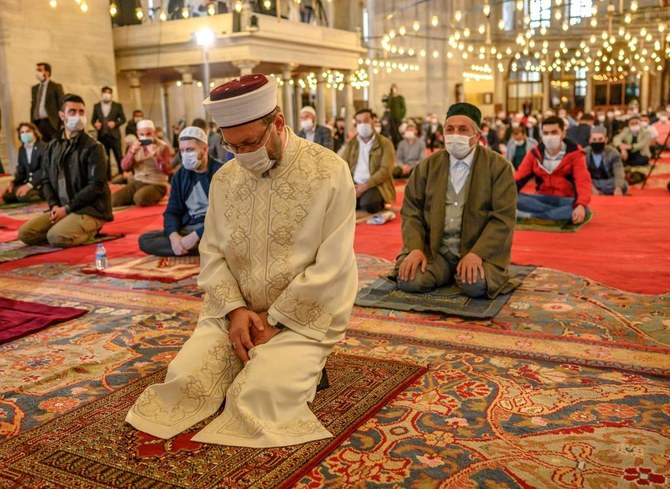
Turkey’s top Islamic cleric moves center stage, irking secularists
- Political foes says Ali Erbas’s growing profile is at odds with the Turkish Republic’s secular constitution
Latest updates


Recommended


© 2026 SAUDI RESEARCH & PUBLISHING COMPANY, All Rights Reserved And subject to Terms of Use Agreement.