



CHICAGO: There is a growing belief among Lebanese political analysts that the investigation into the Beirut blast of Aug. 4, 2020, will meet the same fate as the probe into the Feb. 14, 2005, explosion that killed Rafik Hariri, the former Lebanese prime minister, and 21 others.
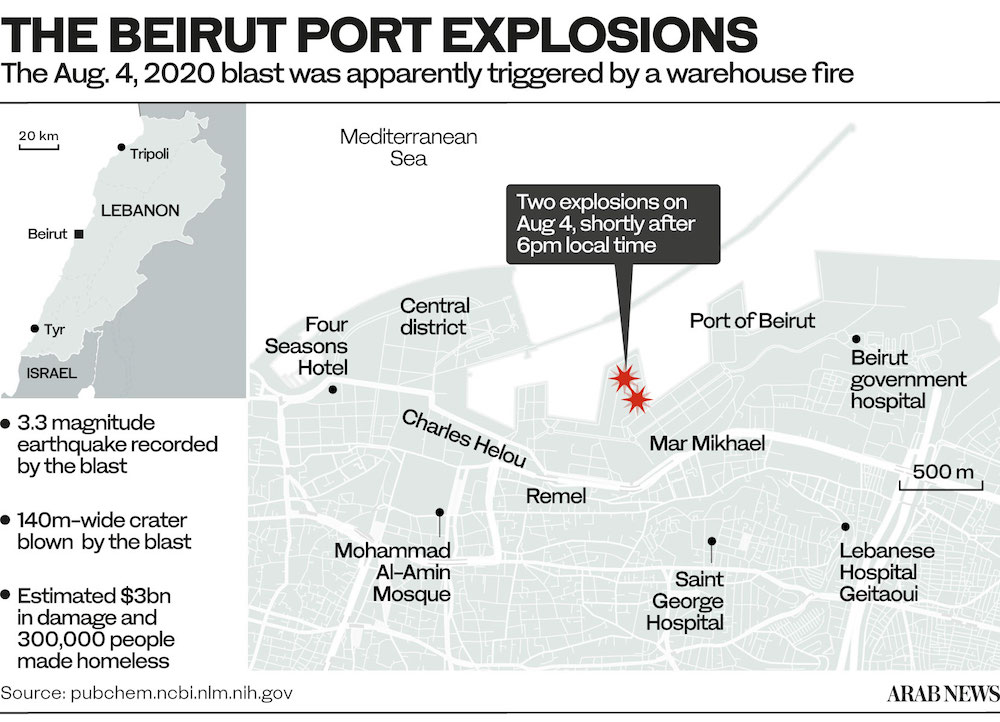
Two explosions at the government-owned Port of Beirut claimed the lives of 218 people, injured more than 6,500 and left 300,000 homeless. The explosions resulted from a fire in a warehouse containing ammonium nitrate and caused damage worth an estimated $3 billion.
Meanwhile, 12 years after it was officially established, the Hariri investigation is in limbo. The sole individual indicted in absentia by the UN’s Special Tribunal for Lebanon (STL), a low-level Hezbollah operative called Salim Ayyash, has not been brought to justice.
Lebanese analysts warn the Beirut blast inquiry will also remain in limbo indefinitely unless international organizations and foreign powers put pressure on the government to allow a fully transparent investigation by an independent judicial system.
“The Beirut blast probe is not necessarily a domestic investigation with domestic implications and ramifications. It is also a global public opinion drive that will continue to evolve and involve international actors,” Christophe Abi-Nassif, Lebanon program director at the Middle East Institute, told Arab News. “Back in 2005, all it took was for the Hariri camp, the Future Movement and his son Saad Hariri to be satisfied with the arrangement.”
By contrast, the Beirut port explosion affected many families who have the power to demand the matter be fully investigated, Abi-Nassif said. “The families of the victims are at the heart of this investigation.”
On the first anniversary of the blast, Amnesty International, the international rights advocacy group, accused the Lebanese authorities of “shamelessly obstructing victims’ quest for truth and justice” in the months since the blast, actively shielding officials from scrutiny and hampering the course of the investigation.
In February, Fadi Sawan, the first judge appointed to lead the investigation, was dismissed after he summoned political figures for questioning. So far, the authorities have rejected requests by his replacement, Tarek Bitar, to lift the immunity granted to officials and to allow him question senior members of the security forces.
Leaked official documents indicate that Lebanese customs officials, military and security chiefs, and members of the judiciary warned successive governments about the danger posed by the stockpile of explosive chemicals at the port on at least 10 occasions during the six years it was stored at the port, yet no action was taken.
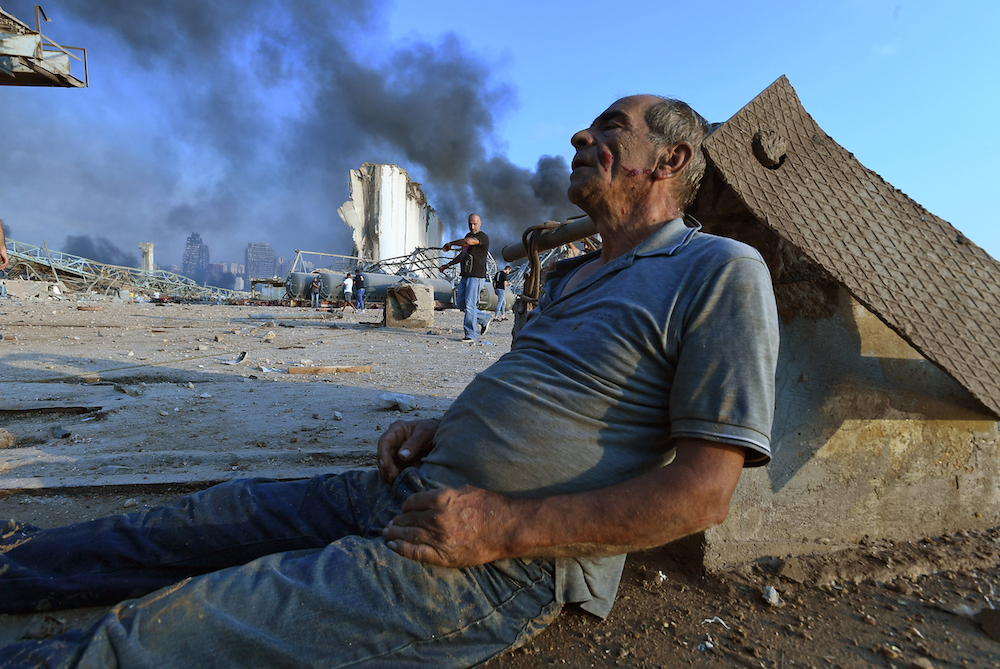
A wounded man sits on the ground waiting for aid at Beirut's port after the explosion. (AFP/File Photo)
MPs and officials are clinging to their right to immunity, effectively shielding suspects whose actions are blamed for causing the explosion, and denying thousands of victims the justice they demand.
Survivors of the blast and a raft of advocacy groups have revived their push for an “international, independent and impartial investigative mission” into the cause of the blast.
“An international investigation would not impede, but rather assist the domestic process,” they said in a joint statement delivered to the UN Human Rights Council on Sept. 15.
Although government interference in the investigation has been detrimental to its progress, Abi-Nassif believes that taking the matter entirely out of Lebanese hands would only harm its legitimacy.
INNUMBERS
* 300,000 - People left homeless.
* 70,000 - Jobs lost after the explosion.
* 163 - Schools destroyed.
* 6 - Hospitals destroyed.
* 0 - Number of people sentenced over blast.
Source: UN
“On the one hand, you want international involvement because you want a lot of pressure exerted. On the other hand, you do not want to go down this path where you are giving grounds for Lebanese politicians to say this is clearly a plot to incriminate us, regardless of whether they are incriminated or should be incriminated,” he said. “This will be the leeway they use to try to dismantle the integrity of the investigation.”
Prominent among those who are convinced that the blast investigation has been stymied by the Lebanese political elite and that foreign powers have a responsibility to get the probe back on track, is Ed Gabriel, president of the American Task Force on Lebanon.
“Not much has been done. There has been an attempt to investigate the port through transparent judicial means in Lebanon. It has been held up by the parliament. There seems to be no consensus in the government,” Gabriel said.
“The good news is that the government of Prime Minister Najib Mikati has taken the reins of power. The Mikati government seems very interested in a close working relationship with the West and is very tuned in with wanting to meet the immediate, short-term needs of the people.”
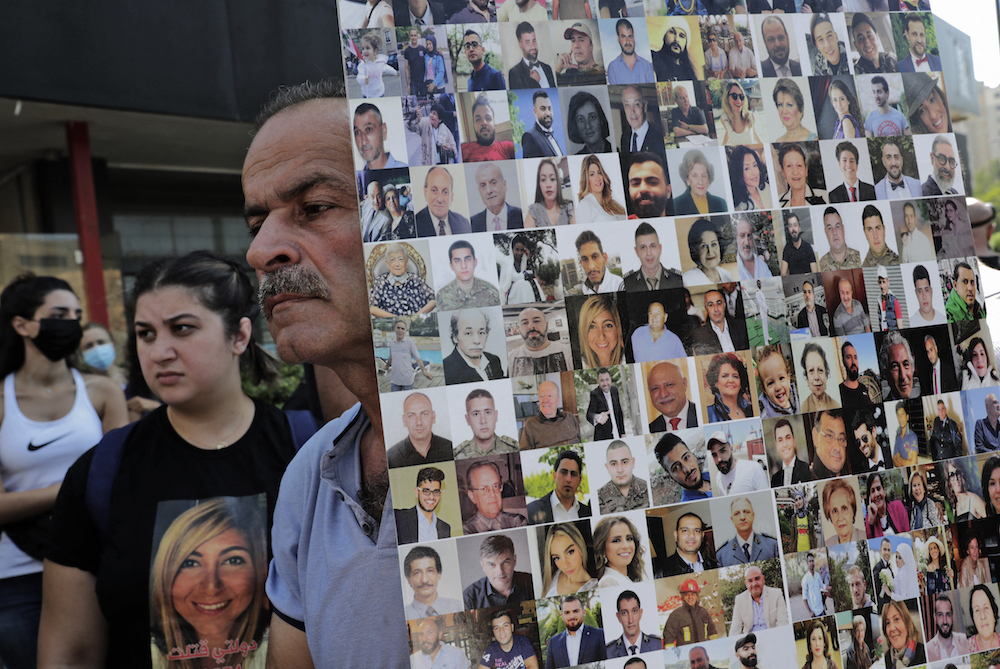
A man holds a sign showing the faces of the 2020 Beirut port blast victims as protesters and victim family members gather for a demonstration near the UNESCO palace in Beirut. (AFP/File Photo)
Like Abi-Nassif, Gabriel is of the opinion that Lebanon should ultimately lead the probe; however, he adds, international pressure in support of the probe’s independence will be critical to its success.
“Without the willpower of the Lebanese people and a government that responds to the needs of the people and the desires of the people, we won’t really get to the bottom of this,” he said.
“So, I think what is important is that the US speaks with a very strong voice, that it is a top priority that they investigate this explosion. If we are going to get anywhere with it, we need the cooperation of the Lebanese government. And they will only cooperate under the duress and pressure of the international community. Otherwise, I don’t think we will see justice in this case anytime soon.”
However, both Gabriel and Abi-Nassif are wary of international pressure being perceived as a deliberate effort to steer the probe toward Hezbollah, which is on the US list of Foreign Terrorist Organizations. Many suspect the cache of ammonium nitrate at the Beirut port warehouse was somehow connected to Hezbollah’s regional activities.
“Domestic law, the domestic judiciary system, at the end of the day, is the most direct, most effective and probably the easiest way that Lebanon has to leverage and effectively reach the truth. And I am not discounting the role that international organizations have to play in this,” Abi-Nassif said.
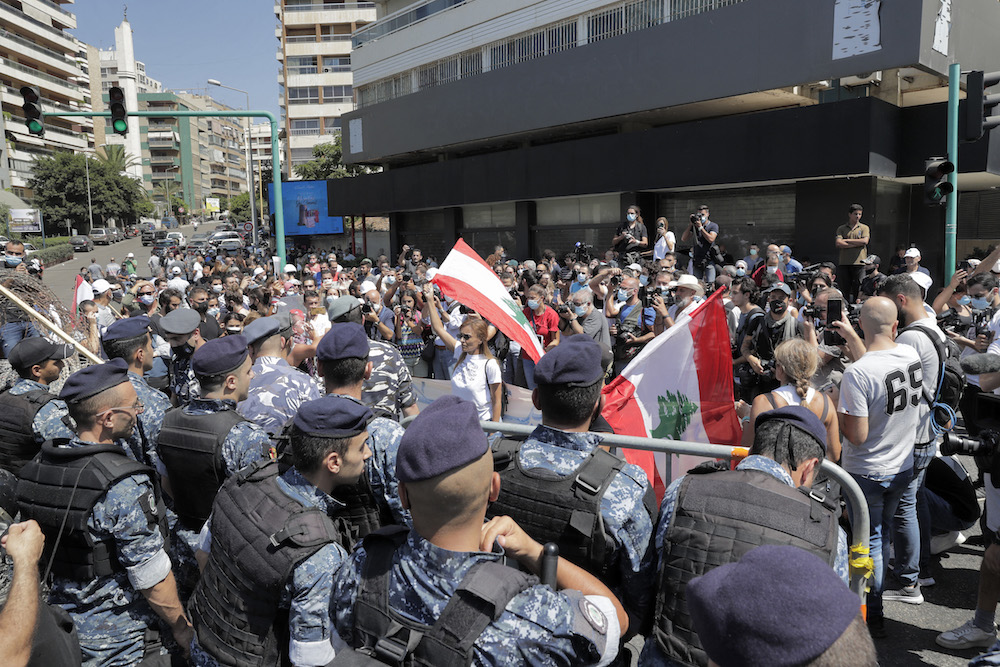
Protesters and family members of the victims of the 2020 Beirut port blast gather ahead of a parliamentary meeting on the blast investigation. (AFP/File Photo)
“The minute that starts happening you will have voices in Lebanon, be it Hezbollah or others, crying wolf and saying that this is effectively just a plot to implicate the group, which is what we saw in the case of the Hariri STL.”
The blast investigation delay is just one of a multitude of problems that bedevil Lebanon, the other ones being political gridlock, economic meltdown, plummeting currency, soaring unemployment, the COVID-19 pandemic and fuel and electricity shortages.
Lebanon has been experiencing a socio-economic implosion since 2019. In the autumn of that year, nationwide protests erupted over rampant corruption among the political class that has ruled the country since the end of the civil war through a sectarian power-sharing system.
Public anger grew when an economic meltdown caused the nation’s currency to lose 90 percent of its value and the banks held depositors’ money hostage. Thousands of young people have fled abroad. Those who remain struggle to get by, often turning for help to a flourishing black market.
------------------
Twitter: @rayhanania


