

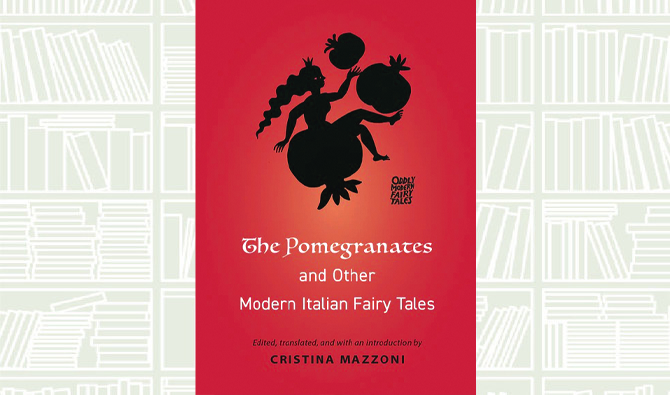
What We Are Reading Today: The Pomegranates and Other Modern Italian Fairy Tales by Cristina Mazzon

Short Url
Updated 21 September 2021
Follow

What We Are Reading Today: The Pomegranates and Other Modern Italian Fairy Tales by Cristina Mazzon

The Pomegranates and Other Modern Italian Fairy Tales presents 20 magical stories published between 1875 and 1914, following Italy’s political unification. In those decades of political and social change, folklorists collected fairy tales from many regions of the country while influential writers invented original narratives in standard Italian, drawing on traditional tales in local dialects, and translated others from France.

This collection features a range of these entertaining jewels from such authors as Carlo Collodi, most celebrated for the novel Pinocchio, and Domenico Comparetti, regarded as the Italian Grimm, to Grazia Deledda, the only Italian woman to have received the Nobel Prize in Literature. With one exception, all of these tales are appearing in English for the first time.

The stories in this volume are linked by themes of metamorphosis: A man turns into a lion, a dove, and an ant; a handsome youth emerges from a pig’s body; and three lovely women rise out of the rinds of pomegranates.


What We Are Reading Today: ‘The Treehouse’

Photo/Supplied
Updated 10 January 2026
Follow

What We Are Reading Today: ‘The Treehouse’

  • Walter excels at building tension and sustaining dread

Author: B P Walter

“The Treehouse” by B P Walter unsettles readers with a story told through the eyes of the perpetrators of a horrible crime. It follows two brothers in their 30s — Robert and Kieran — who are bound by blood, secrets, and a terrible act they committed in their youth. Their inner world is an uneasy position for the reader to inhabit, and at its best, the novel leans into that discomfort. 

This 2025 psychological thriller begins with the broadcast of a television series titled “The Treehouse.” The brothers notice a resemblance between the show and their past that is impossible to ignore.

Someone knows, or seems to know, what they did all those summers ago during a family holiday in Cornwall. Someone has taken their secret and turned it into entertainment. For Robert, especially, the fear of being exposed is suffocating. 

Walter excels at building tension and sustaining dread. The anxiety that coils through Robert’s thoughts is convincing, and the dynamic between the brothers becomes increasingly claustrophobic and toxic as the story unravels. It is clear that this is a family, a household, where love exists alongside something far darker.

The question of what exactly happened in the treehouse in 2004 hums beneath every chapter. Yet, despite a compelling premise and moments of real shock, the novel ultimately fell a little flat for me.

The opening is gripping, but once the story settles into the extended childhood timeline, the pacing begins to falter. The past is important, but it dominates the narrative to the point that the present-day thread, which felt sharper and more urgent with its high stakes, is left wanting. 

The limited presence of secondary characters also makes it ultimately feel more predictable than it should, lacking the external conflicts that made the first act of the book so promising. The twists and turns of the final act arrive in quick succession and are less than satisfying.

This was also a difficult book to emotionally connect with; The characters are flawed, often unlikable, and while that may be intentional, it created distance rather than intrigue. 

“The Treehouse” did not hold my attention in the same way as some of Walter’s previous thrillers. It’s a story that seems to linger more for the atmosphere it creates than for where it takes the reader.