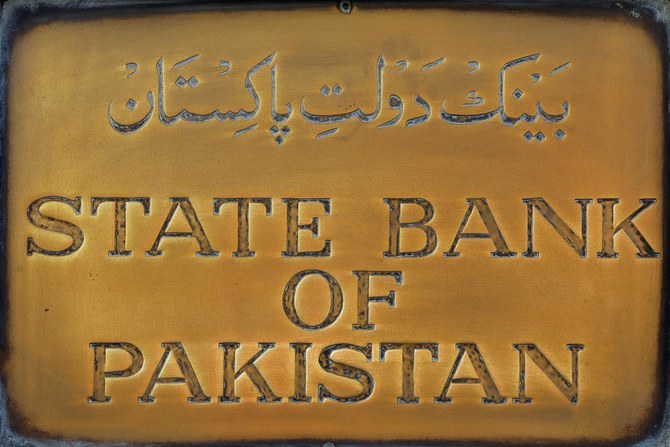
KARACHI: After keeping it unchanged for almost 15 months, Pakistan’s central bank on Monday raised the policy rate by 25 basis points to 7.25 percent, hoping to slow down growth in the current account deficit due to an unexpectedly faster pace of economic recovery.
The State Bank of Pakistan (SBP) had drastically cut the key rate from 13.25 percent to 7 percent between March 17, 2020 and June 25, 2020, to support the COVID-hit economy.
“At this more mature stage of the recovery, a greater emphasis is needed on ensuring the appropriate policy mix to protect the longevity of growth, keep inflation expectations anchored, and slow the growth in the current account deficit,” the SBP said in statement after a meeting of its Monetary Policy Committee (MPC).
Since its last meeting in July, the MPC noted that the pace of economic recovery had exceeded expectations. This robust recovery in domestic demand, coupled with higher international commodity prices, was leading to a strong pick-up in imports and a rise in the current account deficit.
Pakistan’s current account deficit from July to August was recorded at $2.3 billion as compared to a surplus of $838 million during the same period last year.
The central bank said over the last few months, the burden of adjusting to the rising current account deficit had fallen primarily on the exchange rate and it was appropriate for other adjustment tools, including interest rates, to also play their due role.
It said year-on-year inflation had declined since June but rising demand pressures together with higher imported inflation could begin to manifest in inflation readings later this fiscal year.
The SBP said economic recovery now appeared less vulnerable to pandemic-related uncertainty given growing signs that the latest COVID-19 wave in Pakistan had been contained and there is continued progress in the national vaccination campaign and overall management of the pandemic by the government.
The stance of monetary policy was still appropriately supportive of growth, with real interest rates remaining negative on a forward-looking basis, the bank said.
In the absence of unforeseen circumstances, the MPC expected the monetary policy to remain accommodative in the near term, with possible further gradual tapering of stimulus to achieve mildly positive real interest rates over time, the bank said.
Growth in Fiscal Year 2021-22 was now expected to move toward the upper end of the forecast range of 4-5 percent, notwithstanding some greater uncertainty with respect to spillovers from the evolving situation in Afghanistan.
In a report on Monday, Fitch Solutions, a US-based firm that provides credit risk and strategy solutions, predicted the Pakistani economy would grow by 4.2 percent in FY22, up from 3.9 percent in FY21.
It said the risk to growth outlook on the domestic front would be from the delta strain of the coronavirus, while on the external front heightened security threats posed by radical groups, such as the Pakistani Taliban, could lead to social instability and destruction of infrastructure.
“This might weigh on the country’s gross fixed capital outlook and exporting capabilities as businesses become hesitant to invest in capacity-building infrastructure,” the firm said in its statement on Monday.
Pakistan’s central bank said its policy committee felt some macro prudential tightening of consumer finance might also be appropriate to moderate demand growth as part of the move toward gradually normalizing monetary conditions.
The MPC would continue to carefully monitor developments affecting medium-term prospects for inflation, financial stability and growth and was ready to respond appropriately, it added.


![]()

Pakistan raises policy rate to 7.25% in bid to slow growth in current account deficit
Short Url
https://arab.news/44srh
Pakistan raises policy rate to 7.25% in bid to slow growth in current account deficit
- The central bank maintained the key rate for almost 15 months to support economic recovery
- Says robust recovery in domestic demand, higher international commodity prices, leading to strong pick-up in imports
Latest updates


© 2026 SAUDI RESEARCH & PUBLISHING COMPANY, All Rights Reserved And subject to Terms of Use Agreement.