Pakistani Taliban reject amnesty offer unless Islamic law imposed

Pakistani soldiers on patrol. The Tehreek-e-Taliban Pakistan has accepted responsibility for several high-profile attacks in the country. (AFP/File)
Short Url
Updated 19 September 2021
Follow

Pakistani Taliban reject amnesty offer unless Islamic law imposed

  • Islamabad says it could pardon the Tehreek-e-Taliban if it renounced violence

PESHWAR: The Tehreek-e-Taliban Pakistan, a banned militant group, has rejected Islamabad’s amnesty offer unless the government agrees to impose Shariah or Islamic law in the Muslim-majority South Asian nation.

The group is an umbrella organization of various militant groups fighting to overthrow the Pakistan government and is responsible for attacking military and civilian targets, especially along the country’s border with Afghanistan.
Islamabad has been particularly worried about the group’s fighters crossing over from Afghanistan and launching lethal attacks on its territory ever since the Afghan Taliban swept across Afghanistan in a lightning offensive and captured power last month.
Last week, Pakistani President Dr. Arif Alvi and Foreign Minister Shah Mahmood Qureshi said that the government could pardon the group’s members if they laid down arms, abandoned the group’s ideology and adhered to the country’s constitution.
However, in a statement on Friday, the TTP said: “Pardon is usually offered to those who commit crimes, but we are quite proud of our struggle.”
“We can offer conditional amnesty to our enemy if they promise to implement Shariah in the country,” it added.
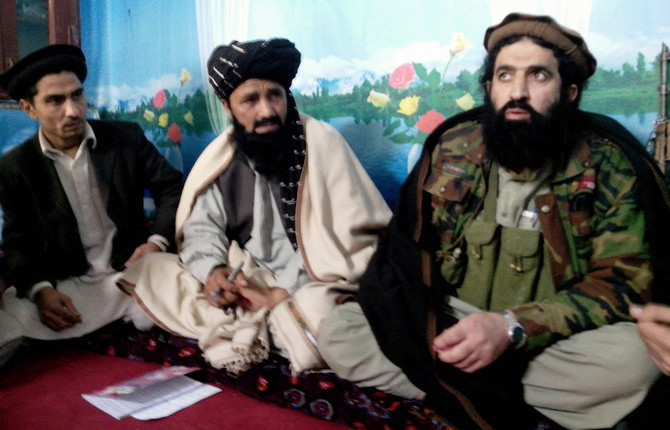


Tehreek-e-Taliban Pakistan spokesman Shahidullah Shahid, right, speaks during a press conference at an undisclosed location in Pakistan on Feb. 21, 2014. (AFP)

Adnan Bhittani, a senior security analyst based in the northwestern Khyber Pakhtunkhwa province, told Arab News that the recent release of the group’s fighters from Afghan prisons after the Taliban’s  capture of Kabul had emboldened the armed faction to increase its attacks in Pakistan.
“TTP has up to 6,000 fighters who can create mayhem in different parts of Pakistan,” he said.
So far, there has been no response from the Pakistan government to the group’s statement.

FASTFACT

The Tehreek-e-Taliban Pakistan is an umbrella organization of various militant groups fighting to overthrow the Pakistan government and is responsible for attacking military and civilian targets, especially along the country’s border with Afghanistan.

However, senior opposition leader, Bilawal Bhutto Zardari, criticized the government’s “policy of appeasement” in a Twitter post, saying it would come to haunt the country in the future.
Since returning to power, the Afghan Taliban has repeatedly assured Pakistan it will not allow its territory to be used by militants to attack any nation.
Thousands of Pakistanis have been killed in violence launched by the militant group in the past two decades.
The group has accepted responsibility for several high-profile attacks in Pakistan, including an attack on an army-run school in Peshawar in which 134 children were killed in 2014 and an assassination attempt on activist and Nobel prize winner Malala Yousafzai when she was a schoolgirl.


Lawsuit challenges Trump administration’s ending of protections for Somalis

Updated 10 March 2026
Follow

Lawsuit challenges Trump administration’s ending of protections for Somalis

  • The lawsuit cites a series of statements Trump has made describing Somalis as “garbage” and “low IQ people” who “contribute nothing.”

BOSTON: Immigrant rights advocates filed a lawsuit on Monday seeking to stop US President Donald Trump’s administration from next ​week ending legal protections that allow nearly 1,100 Somalis to live and work in the United States. The lawsuit, brought by four Somalis and two advocacy groups, challenges the US Department of Homeland Security’s decision to end Temporary Protected Status for Somali immigrants, whom Trump has derided in public remarks. Outgoing Homeland Security Secretary Kristi Noem in January announced that TPS for Somalis would end on March 17, arguing that Somalia’s conditions had improved, despite fighting continuing between Somali forces and Al-Shabab militants. The plaintiffs, who ‌include the groups ‌African Communities Together and Partnership for the Advancement ​of ‌New ⁠Americans, in the ​lawsuit filed ⁠in Boston federal court argue the move was procedurally flawed and driven by a discriminatory, predetermined agenda.
The lawsuit cites a series of statements Trump has made describing Somalis as “garbage” and “low IQ people” who “contribute nothing.”
The plaintiffs said the administration is ending TPS for Somalia and other countries due to unconstitutional bias against non-white immigrants, not based on objective assessments of country conditions.
“The termination of TPS for Somalia is racism masking as immigration policy,” ⁠Omar Farah, executive director at the legal group Muslim Advocates, said ‌in a statement.
DHS did not respond to ‌a request for comment. It has previously said TPS ​was “never intended to be a de ‌facto amnesty program.”
TPS is a form of humanitarian immigration protection that shields eligible migrants ‌from deportation and allows them to work. Under Noem, DHS has moved to end TPS for a dozen countries, sparking legal challenges. The administration on Saturday announced plans to pursue an appeal at the US Supreme Court in order to end TPS for over 350,000 Haitians. It ‌also wants the high court to allow it to end TPS for about 6,000 Syrians.

SOMALI COMMUNITY TARGETED
Somalia was first designated ⁠for TPS in ⁠1991, with its latest extension in 2024. About 1,082 Somalis currently hold TPS, and 1,383 more have pending applications, according to DHS. Somalis in Minnesota in recent months had become a target of Trump’s immigration crackdown, with officials pointing to a fraud scandal in which many people charged come from the state’s large Somali community. The Trump administration cited those fraud allegations as a basis for a months-long immigration enforcement surge in Democratic-led Minnesota, during which about 3,000 immigration agents were deployed, spurring protests and leading to the killing of two US citizens by federal agents.
In November, Trump announced he would end TPS for Somalis in Minnesota, and a month later said ​he wanted them sent “back to where they ​came from.”
The US Department of State advises against traveling to Somalia, citing crime and civil unrest among numerous factors.