

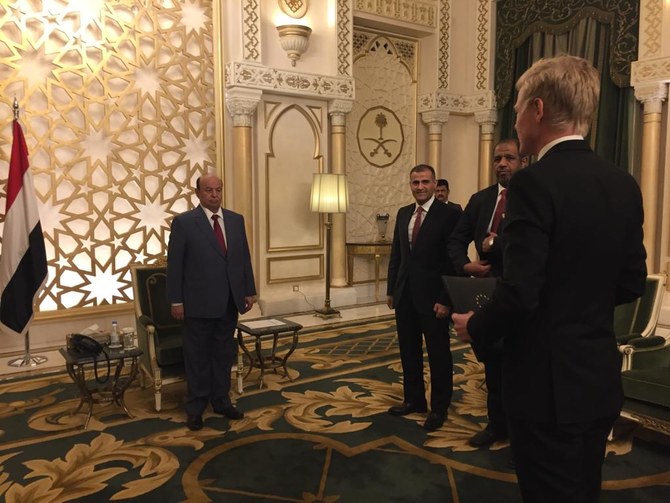

AL-MUKALLA: Yemen’s president reiterated his government’s support to the current UN-led peace efforts to end the war and accused the Iran-backed Houthis and Tehran of intensifying the suffering of the Yemenis through their military escalation.
During his first meeting with the UN’s new special envoy for Yemen Hans Grundberg, President Abed Rabbo Mansour Hadi urged the international community to put an end to the threats to maritime navigation in the Red Sea posed by the Houthis, who have planted naval mines.
The president also urged the militia to cease the shelling of vital civilian facilities such as Mocha port and their resistance to maintaining the floating oil tanker SAFER.
“Peace is our choice and we will always be advocates of peace and harmony as it is a life choice for our people and for humanity as a whole,” Hadi told the UN envoy, according to the official news agency SABA.
Grundberg’s push to revive peace efforts comes as dozens of combatants, including a field government military leader, were killed in fierce clashes between Houthis and government troops in Yemen’s central province of Al- Bayda, residents and local military officials told Arab News on Thursday.
The fighting broke out over the last 24 hours when the Houthis renewed their push in the central province, making gains on the ground in Al-Souma district, triggering heavy clashes that left dozens dead.
Col. Ahmed Al- Damani, a government military commander, and many others were killed in an area north of Mukayras as they were fighting off Houthi attacks in Al-Bayda.
As the Houthis were fighting their way into Al-Bayda’s borders with the southern provinces, such as Abyan and Shabwa, the army on Thursday dispatched tanks, armed vehicles and soldiers to the battlefields to stop the Houthi advances.
Flatbed trucks carrying tanks and military vehicles carrying soldiers were seen leaving military bases in Shabwa and Abyan and heading to flashpoint sites north of Lowder town in Abyan. Warplanes from the Arab coalition carried out several air raids, targeting Houthi military gatherings in Al-Bayda.
Residents in Lowder said on Thursday that a large explosion shook the town after a missile fired by the Houthis exploded inside a military base, causing damage to buildings.
No one was reportedly hurt in the missile strike.
The Houthi escalation in Al-Bayda comes after the militia suffered heavy casualties and a series of defeats during their deadly offensive on the central city of Marib.
Yemen’s Defense Ministry on Thursday said that government troops engaged in heavy battles with the Houthis west of Marib.
Yemen army commanders believe that hundreds of Houthis have been killed in deadly clashes in the province of Marib this month.
The Houthis, who militarily took power in Yemen in late 2014, have been aggressively pushing since February to take control of the gas-rich city of Marib, the government’s last stronghold in the north.
Meanwhile, violent protests in southern Yemen on Thursday subsided as local authorities deployed forces and military vehicles around key institutes and opened blocked roads.
At least three people were killed in Aden and Al- Mukalla, the provincial capital of Hadramout, on Tuesday and Wednesday when angry protests over long power cuts, economic meltdown and plunging currency swept over the southern cities.
Protesters blocked roads, burned tires and garbage boxes and hurled stones at security forces seeking to unblock the roads.
Sporadic clashes between security forces and gunmen erupted in the streets of Al-Mukalla as terrified residents stayed indoors to avoid stray bullets.
To contain the unrest, Hadramout Gov. Faraj Salmeen Al-Bahsani on Thursday announced a nighttime curfew that runs from 8p.m. to 6 a.m., and closing schools for one week.
The Yemen riyal on Monday hit a new record low, trading at 1100 against the dollar in the government-controlled areas.
Electricity outages have also intensified in recent months, mainly in the southern coastal cities such as Al-Mukalla and Aden, where scorching heat and humidity reached unbearable levels.
In Al-Mukalla, protesters closed local exchange shops and tried to storm the provincial office of the Ministry of Electricity.


