

Pakistani money management app aims to target Saudi Arabia, UAE to expand international footprint

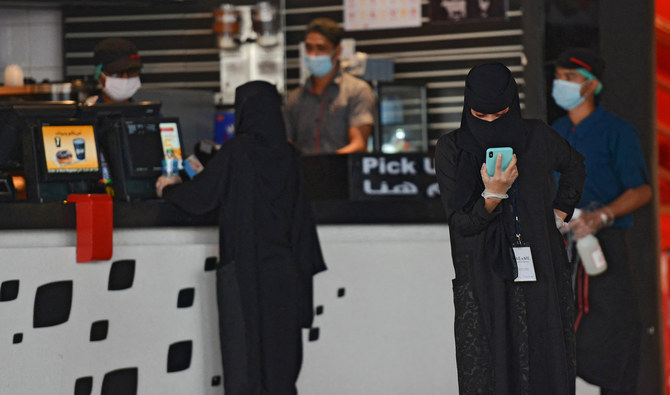
A woman checks her mobile as another orders food from a restaurant in a mall in Riyadh, Saudi Arabia on June 4, 2020. (AFP/File)
Short Url
Updated 17 September 2021
Follow

Pakistani money management app aims to target Saudi Arabia, UAE to expand international footprint

  • Hysab Kytab has established a network of over 15 banks and financial services providers in the Middle East and North Africa region
  • Pakistan has witnessed a massive surge of 53 percent in digital payments since the beginning of the coronavirus pandemic, survey says

KARACHI: A Karachi-based company, which launched a personal finance management mobile app in 2019, has decided to penetrate Saudi Arabia and the United Arab Emirates, along with other markets in the Middle East and North Africa (MENA) region, to expand its international footprint, said the company officials on Thursday.
Hysab Kytab is a fully customizable mobile app that offers a platform to manage the user’s financial activities and budgeting.
The app has over 640,000 users who have clocked in more than 12 million transactions.
About 78 percent of them are from Pakistan.
“For the current year, our first target is the MENA region for going global,” Muhammad Yasir Ilyas, global head of Hysab Kytab, told Arab News. “So far, we have developed a good network of 15-plus channel partners including banks in the region. We are also engaging with banks in Saudi Arabia, the UAE, Qatar, Nigeria and other African countries.”

Ilyas continued that his company was also talking to leading global banking solutions providers, such as Temenos and IBM, since it wanted to partner with them before spreading its tentacles in other markets.
“Our target is to make this Pakistani born product a global reality,” he said, adding that the app also provided research data on consumer spending behavior.
Digital financial solutions have been gaining traction in Pakistan -- traditionally a cash-based economy -- since the outbreak of the coronavirus pandemic.
According to a survey conducted by Visa, the use of digital payments, including contactless cards and mobile wallets, increased by 53 percent since the beginning of the contagion.
“Pakistani consumers are increasingly stepping away from cash and putting their trust in digital payments in both in-store and online environments during the pandemic,” Visa said in a statement issued Wednesday.
The financial services company said consumer feedback reinforced the belief that there is no reversal of this trend, with 20 percent of people saying they were less likely to use cash on delivery and 35 percent mentioning the likelihood of using contactless payment methods in the future.
While e-commerce and contactless payments have increased in popularity, the trend of paying by cash on delivery has declined by 28 percent, according to the Visa survey.
Global trend also shows that 12 out 50 startups from Forbes Fintech 50 belong to the personal finance management category.
According to the magazine, together these 12 startups have secured a total funding of $3.6 billion.


Pakistan to export halal meat worth $14.5 million to Tajikistan

Updated 6 sec ago
Follow

Pakistan to export halal meat worth $14.5 million to Tajikistan

  • Effective trade facilitation can increase bilateral Pakistan-Tajikistan trade to $300 million, says state media
  • PM Shehbaz Sharif approved Pakistan’s halal meat policy earlier this month in bid to boost meat exports

ISLAMABAD: Pakistan will export 143,000 tons of halal meat to Tajikistan worth $14.5 million in the near future, state media reported on Tuesday amid Islamabad’s efforts to bolster trade with Central Asian countries. 

Prime Minister Shehbaz Sharif, earlier this month, approved Pakistan’s halal meat policy that aims to boost Islamabad’s meat exports to Muslim states. 

In a high-level meeting on Dec. 24, Federal Minister for Food Security Rana Tanveer Hussain said Malaysia, Saudi Arabia, Iran and other Gulf countries are ready to import Pakistani fresh meat and rice. The minister said Tajikistan has expressed the demand to import nearly 100,000 tons of meat from Pakistan. 

“According to details, Pakistan will export one hundred and forty-three thousand tons of halal meat to Tajikistan, valued at 14.5 million dollars,” state broadcaster Radio Pakistan reported. 

It did not, however, specify a timeline as to when Islamabad planned to export the halal meat items to the Central Asian nation.

The state media said that effective trade facilitation will increase bilateral trade between Pakistan and Tajikistan to $300 million, strengthening regional economic integration.

Pakistan has recently attempted to increase its halal meat exports to other Muslim countries such as Malaysia. Both countries announced they had agreed to a $200 million halal meat trade quota during Sharif’s visit to Malaysia in October. 

A 2024 report by the Pakistan Bureau of Statistics (PBS) mentioned that the country exported meat worth $512 million in 2024, which included beef, mutton and poultry.

According to the PBS, the UAE remained Pakistan’s top meat export market in 2024 with exports to the Gulf nation reaching $201 million. Meanwhile, meat exports to Saudi Arabia recorded a growth of 65.1 percent last year valued at $141 million.