Cyprus recovers looted 18th century church doors from Japan

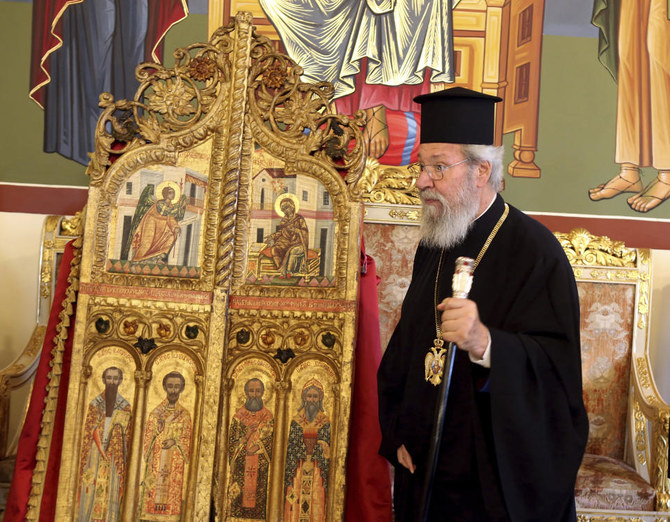
The leader of Cyprus Orthodox Church, Archbishop Chrysostomos II stands next to a pair of ornate, gilded doors that guard the altar of a church, at the Archbishopric in the capital Nicosia, on Thursday. (AP)
Short Url
Updated 16 September 2021
Follow

Cyprus recovers looted 18th century church doors from Japan

  • Communications and Works Minister said the wooden doors were discovered at the Kanazawa Art College more than 20 years ago
  • The doors were stolen after the island’s ethnic split in 1974

NICOSIA, Cyprus: Cyprus’ Orthodox Church formally took charge Thursday of two ornately decorated 18th century doors stolen from a church in the ethnically divided island’s breakaway north and reclaimed from a Japanese art college after a long legal battle.
Communications and Works Minister Yiannis Karousos said the wooden doors — painted with religious scenes, carved and gilded — were discovered at the Kanazawa Art College more than 20 years ago and their return followed “long and intensive efforts.”
No information was provided on how the college acquired them.
The artifacts originally stood in the central gateway of the iconostasis — the ornately decorated screen that separates the sanctuary from the rest of an Orthodox church — of Saint Anastasios in Peristeronopigi village.
Built in 1775, the church sits atop a cave where the saint’s grave is preserved.
The doors were stolen after the island’s ethnic split in 1974, when Turkey invaded in response to a coup aimed at union with Greece. Turkish Cypriots declared independence in the north, that’s recognized only by Turkey.
In what Karousos called “cultural genocide,” hundreds of frescoes, mosaics and other religious works of art were looted from churches in the north after the invasion.
Since 1974, Cypriot government and church authorities have fought long legal battles in the United States, Europe and elsewhere to reclaim them.
Karousos said the doors’ repatriation sends the message to antiquities smugglers and “the international ring of crooks that however many years go by, (Cyprus) will hunt them down, because cultural genocide cannot be tolerated anywhere in the world.”


Arts festival’s decision to exclude Palestinian author spurs boycott

Randa Abdel Fattah. (Photo/Wikipedia)
Updated 12 January 2026
Follow

Arts festival’s decision to exclude Palestinian author spurs boycott

  • A Macquarie University academic who researches Islamophobia and Palestine, Abdel-Fattah responded saying it was “a blatant and shameless act of anti-Palestinian racism and censorship,” with her lawyers issuing a letter to the festival

SYDENY: A top Australian arts festival has seen ​the withdrawal of dozens of writers in a backlash against its decision to bar an Australian Palestinian author after the Bondi Beach mass shooting, as moves to curb antisemitism spur free speech concerns.
The shooting which killed 15 people at a Jewish Hanukkah celebration at Sydney’s Bondi Beach on Dec. 14 sparked nationwide calls to tackle antisemitism. Police say the alleged gunmen were inspired by Daesh.
The Adelaide Festival board said last Thursday it would disinvite Randa ‌Abdel-Fattah from February’s ‌Writers Week in the state of South Australia because “it ‌would not ​be ‌culturally sensitive to continue to program her at this unprecedented time so soon after Bondi.”

FASTFACTS

• Abdel-Fattah responded, saying it was ‘a blatant and shameless act of anti-Palestinian racism and censorship.’

• Around 50 authors have since withdrawn from the festival in protest, leaving it in doubt, local media reported.

A Macquarie University academic who researches Islamophobia and Palestine, Abdel-Fattah responded saying it was “a blatant and shameless act of anti-Palestinian racism and censorship,” with her lawyers issuing a letter to the festival.
Around 50 authors have since withdrawn from the festival in protest, leaving it in doubt, local media reported.
Among the boycotting authors, Kathy Lette wrote on social media the decision to bar Abdel-Fattah “sends a divisive and plainly discriminatory message that platforming Australian Palestinians is ‘culturally insensitive.'”
The Adelaide Festival ‌said in a statement on Monday that three board ‍members and the chairperson had resigned. The ‍festival’s executive director, Julian Hobba, said the arts body was “navigating a complex moment.”

 a complex and ‍unprecedented moment” after the “significant community response” to the board decision.
In the days after the Bondi Beach attack, Jewish community groups and the Israeli government criticized Prime Minister Anthony Albanese for failing to act on a rise in antisemitic attacks and criticized protest marches against Israel’s war in ​Gaza held since 2023.
Albanese said last week a Royal Commission will consider the events of the shooting as well as antisemitism and ⁠social cohesion in Australia. Albanese said on Monday he would recall parliament next week to pass tougher hate speech laws.
On Monday, New South Wales state premier Chris Minns announced new rules that would allow local councils to cut off power and water to illegally operating prayer halls.
Minns said the new rules were prompted by the difficulty in closing a prayer hall in Sydney linked to a cleric found by a court to have made statements intimidating Jewish Australians.
The mayor of the western Sydney suburb of Fairfield said the rules were ill-considered and councils should not be responsible for determining hate speech.
“Freedom ‌of speech is something that should always be allowed, as long as it is done in a peaceful way,” Mayor Frank Carbone told Reuters.