

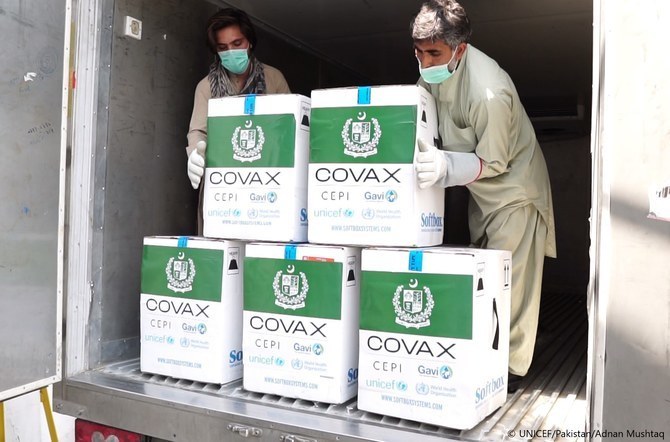
Pakistan receives another shipment of 3.5 million Pfizer vaccines from US 

A man pushing the cart of second batch of coronavirus vaccine "pfizer" given by UNICEF Pakistan on May 28, 2021. (Photo courtesy: UNICEF Pakistan)
Short Url
Updated 15 September 2021
Follow

Pakistan receives another shipment of 3.5 million Pfizer vaccines from US 

  • So far, 22,873,298 Pakistanis have been fully vaccinated against the virus 
  • The South Asian nation, which is battling a fourth wave, recently eased some virus restrictions 

ISLAMABAD: Pakistan received another tranche of 3.5 million Pfizer anti-COVID-19 vaccines from the United States, the US embassy in Islamabad said on Wednesday, as the South Asian nation continues to battle a fourth wave of infections.
Pakistan reported 2,714 new coronavirus cases in the last 24 hours, according to its pandemic response monitor, which took the overall tally to 1,212,809. Seventy-three people died of the virus during this period, taking the death toll to 26,938.
So far, 1,108,339 people have recovered from the virus and a total of 22,873,298 individuals have been fully vaccinated, according to official figures.
“We’re thrilled to announce the arrival of another tranche of 3.5 million Pfizer vaccine doses to Pakistan, bringing the total number of COVID-19 vaccine doses donated by the United States to Pakistan to 15.7 million,” the US embassy said in a Twitter post.

Earlier this month, the US shipped 6.6 million Pfizer doses to Pakistan through COVAX, a global initiative aimed at equitable access to COVID-19 vaccines, to help the country vaccinate its population against the coronavirus.
On September 13, the Sindh government received 320,580 Pfizer doses sent by the US, the US State Department said in a statement.
The Pakistani government has also decided to reopen education institutes across the country from September 16 on the recommendation of the National Command and Operation Center (NCOC), which oversees Pakistan’s pandemic response.
Earlier in September, the NCOC announced strict restrictions for 24 districts where the coronavirus positivity ratio was considered alarmingly high.
The monitor not only reduced the number of these districts to five in a recent meeting, but also relaxed some of the restrictions previously imposed in these vulnerable areas.
“All types of education institutes countrywide will follow staggered opening (50 percent attendance, 3 x days a week) from 16th September, 21, onwards,” it said in a notification.
The decision was made after a “detailed stock of the disease situation in the country, daily hospital admissions and critical care occupancy vis-a-vis requirement of oxygen was carried out.”
The NCOC named Lahore, Faisalabad, Multan, Sargodha and Gujrat in Punjab and Bannu in Khyber Pakhtunkhwa as high disease prevalence districts. According to the notification, market and business activities will only be allowed in these five districts until 8pm, though they will be permitted until 10pm in other parts of the country.
Traders in the vulnerable districts will also be required to shut down their shops on Friday and Saturday, instead of one day a week elsewhere.
The NCOC maintained strict restrictions on indoor dining, weddings and other gatherings in these five districts. All religious shrines remain closed in these cities.
Pakistan began its immunization campaign in February.


Pakistan concludes 60-hour joint military exercise featuring 19 states, including Saudi Arabia, US

Updated 10 February 2026
Follow

Pakistan concludes 60-hour joint military exercise featuring 19 states, including Saudi Arabia, US

  • Exercise also featured participation from Turkiye, Uzbekistan, Bangladesh, Egypt, Jordan and Qatar, says military’s media wing
  • Says exercise is designed to enhance professional military skills through exchange of innovative ideas, tactical experiences

ISLAMABAD: A 60-hour-long joint military exercise organized by Pakistan’s army concluded this week at the eastern city of Kharian, featuring participation from 19 countries including Saudi Arabia and the US, the military’s media wing said. 

The 9th International Pakistan Army Team Spirit (PATS) Competition is a 60-hour-long patrolling exercise, which the Pakistani military says is designed to enhance professional military skills through the exchange of innovative ideas, tactical experiences and best practices among participating teams. 

The exercise was held from Feb. 5-9 in the semi-mountainous terrains of Pakistan’s eastern Punjab province, providing participants a “realistic and challenging operational environment.” Pakistan’s Chief of Defense Forces (CDF) Field Marshal Syed Asim Munir attended the closing ceremony of the exercise on Monday and presented awards to participants.

“Over the years, PATS has evolved into a prestigious and highly competitive military exercise, recognized for promoting professional excellence and mutual learning among participating nations,” the Inter-Services Public Relations (ISPR), the military’s media wing, said in a statement. 

“The forum continues to strengthen military-to-military cooperation and understanding, while fostering camaraderie and team spirit in a demanding operational setting.”

This year’s exercise featured participants from 19 countries including Saudi Arabia, Bahrain, Bangladesh, Belarus, Egypt, Iraq, Jordan, Malaysia, Maldives, Morocco, Nepal, Qatar, Sri Lanka, Turkiye, USA and Uzbekistan, the ISPR said.

Indonesia, Myanmar and Thailand attended the exercise as observers while 16 domestic teams from the Pakistan Army and Pakistan Navy, along with observers from the Pakistan Air Force also participated in the event.

Munir appreciated participating teams for their “exceptional professionalism, physical and mental endurance, operational competence and high morale” displayed during the exercise, the military’s media wing said.

“He emphasized the importance of such multinational engagements in enhancing collective preparedness and adapting to the evolving character of modern warfare,” the ISPR added. 

Pakistan routinely holds joint air, ground and sea exercises with regional countries and traditional allies to foster interoperability to counter threats to global peace.