

King Abdulaziz Public Library acquires rare Islamic medical manuscripts

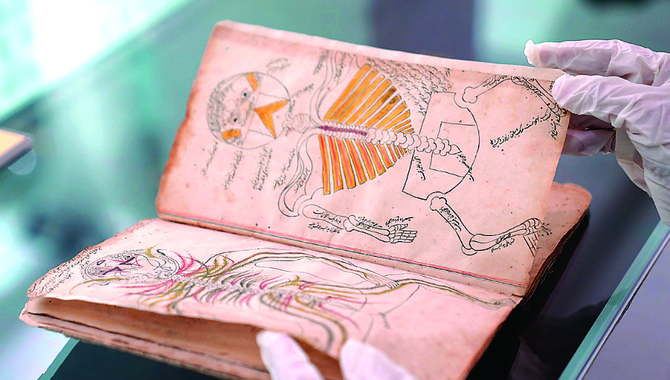
The illustrations, drawn with pen and inks of different colors, present the entire human body, with each drawing taking a whole page. (SPA)
Short Url
Updated 15 September 2021
Follow

King Abdulaziz Public Library acquires rare Islamic medical manuscripts

  • The drawings demonstrate great craftsmanship in their use of lines and colors

RIYADH: One of the rarest human anatomy manuscripts dating from the 14th century has found its way to the King Abdulaziz Public Library in the Kingdom’s capital.
The book, titled “The Anatomy of the Human Body,” is the earliest known book to dissect and draw the inside of the human body. It was written by Mansur bin Mohammed bin Ahmed bin Yusuf bin Ilias Al-Kashmiri between 1380 and 1391.
The book is one of the most precious Islamic medical manuscripts. It preceded the modern anatomy of the Belgian physician Andreas Vesalius and the Italian painter Leonardo da Vinci.
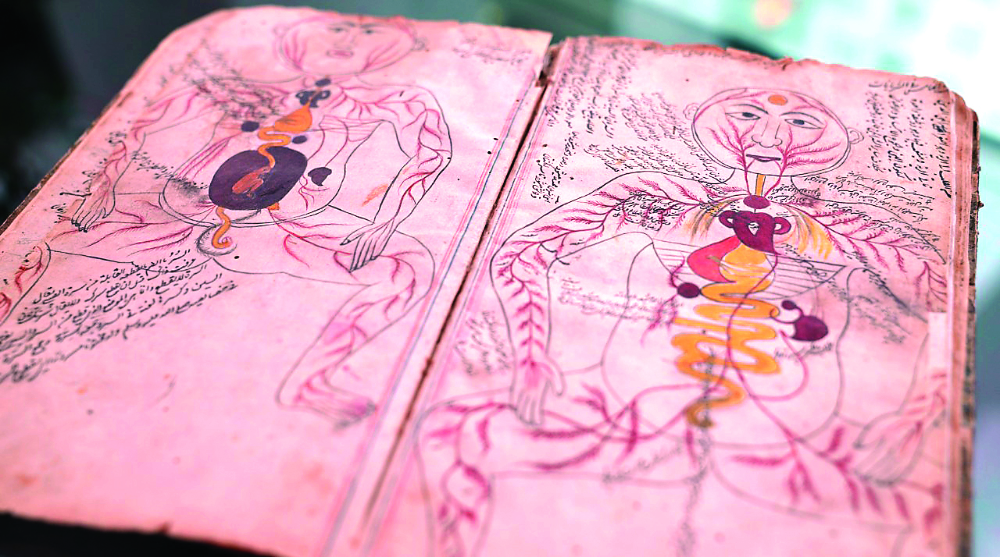
European scientists learnt from the book’s drawings and manuscripts and made anatomy a part of their recognized medical education. The illustrations, drawn with pen and inks of different colors, present the entire human body, with each drawing taking a whole page.

FASTFACT

The book, titled ‘The Anatomy of the Human Body,’ is the earliest known book to draw and dissect the inside of the human body.

The drawings demonstrate great craftsmanship in their use of lines and colors. They utilized the art of the Islamic miniatures, which was standard at the time the book was written, and were drawn with no tools other than pens.
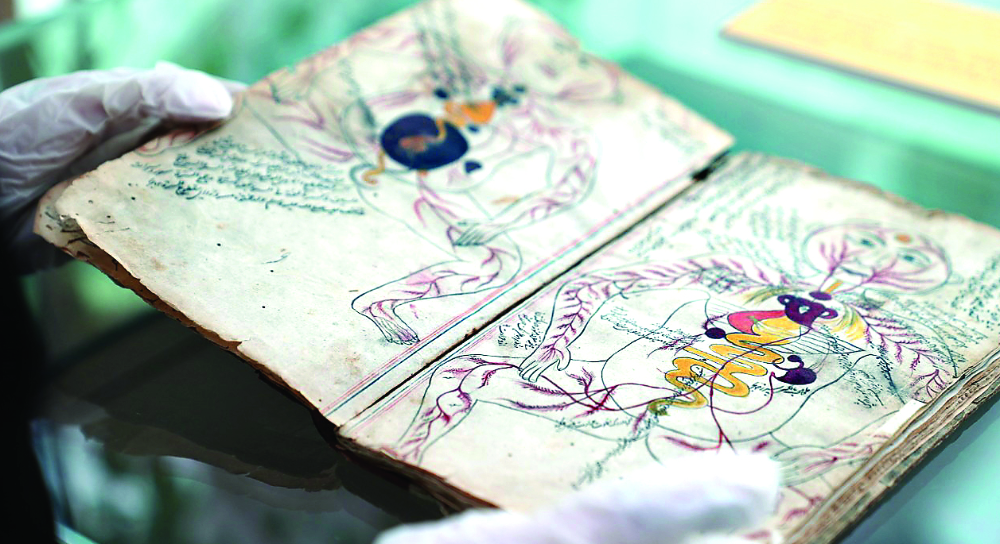
The chapters cover the bones, nerves, muscles, veins, arteries, face, nose, liver and other organs of the human body, with the author writing in detail about the functions of the arteries and describing the veins as mobile veins that emerge from the left and right ventricles of the heart, where the diastole and systole occur.
The book, written in Persian, was transcribed by a scribe named Mohammed Hassan on Dec. 16, 1707.


Riyadh forum to discuss AI impact on education, jobs

The conference aims to redefine work and human capacity building to meet future labor market demands. (SPA)
Updated 12 January 2026
Follow

Riyadh forum to discuss AI impact on education, jobs

  • The exhibition will give young people direct access to educational, training, career, and technological opportunities while enabling them to learn from leading local and international experiences to shape their future careers

RIYADH: Experts from more than 50 international and local organizations in education, employment, and artificial intelligence will gather in Riyadh from Jan. 28-29 for the International Conference on Data and AI Capacity Building to explore the future of education during rapid AI advances.

Discussions will examine how AI is transforming work, its implications for current and future generations, and the new opportunities it creates, the Saudi Press Agency reported on Monday.

Organized by the Saudi Data and AI Authority, the conference aims to redefine work and human capacity building to meet future labor market demands.

Participants will present practical solutions for empowering young people with AI skills, integrating AI into education, and aligning learning outcomes with the most in-demand future skills locally and globally.

By addressing AI’s evolving impact on the job market, the conference offers academics, AI and data professionals, policymakers, and students a platform to exchange insights and explore the latest innovations for societal benefit and national development.

An accompanying exhibition will highlight cutting-edge educational and digital transformation solutions from public and private sector organizations.

The exhibition will give young people direct access to educational, training, career, and technological opportunities while enabling them to learn from leading local and international experiences to shape their future careers.