

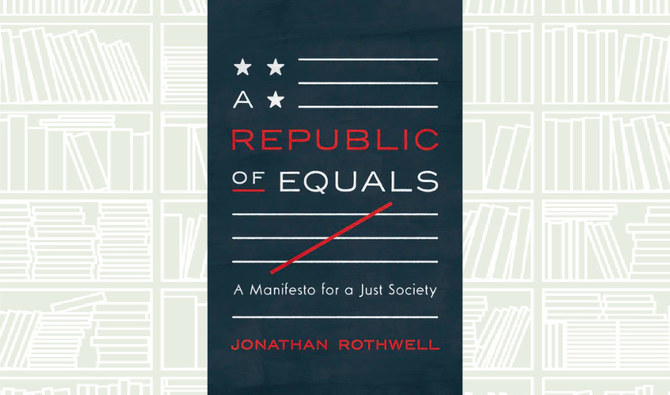
What We Are Reading Today: A Republic of Equals: A Manifesto for a Just Society

Short Url
Updated 14 September 2021
Follow

What We Are Reading Today: A Republic of Equals: A Manifesto for a Just Society

Author: Jonathan Rothwell

Political equality is the most basic tenet of democracy. Yet in America and other democratic nations, those with political power have special access to markets and public services. A Republic of Equals traces the massive income inequality observed in the US and other rich democracies to politicized markets and avoidable gaps in opportunity—and explains why they are the root cause of what ails democracy today.
In this provocative book, economist Jonathan Rothwell draws on the latest empirical evidence from across the social sciences to demonstrate how rich democracies have allowed racial politics and the interests of those at the top to subordinate justice. He looks at the rise of nationalism in Europe and the US, revealing how this trend overlaps with racial prejudice and is related to mounting frustration with a political status quo that thrives on income inequality and inefficient markets. But economic differences are by no means inevitable. Differences in group status by race and ethnicity are dynamic.
and have reversed themselves across continents and within countries. Inequalities persist between races in the US because Black Americans are denied equal access to markets and public services. 


What We Are Reading Today: Shame: The Politics and Power of an Emotion

Updated 23 December 2025
Follow

What We Are Reading Today: Shame: The Politics and Power of an Emotion

Author: David Keen

Today, we are caught in a shame spiral—a vortex of mutual shaming that pervades everything from politics to social media. We are shamed for our looks, our culture, our ethnicity, our sexuality, our poverty, our wrongdoings, our politics. But what is the point of all this shaming and countershaming? Does it work? And if so, for whom?

In Shame, David Keen explores the function of modern shaming, paying particular attention to how shame is instrumentalized and weaponized. Keen points out that there is usually someone who offers an escape from shame—and that many of those who make this offer have been piling on shame in the first place. Self-interested manipulations of shame, Keen argues, are central to understanding phenomena as wide-ranging as consumerism, violent crime, populist politics, and even war and genocide. Shame is political as well as personal. To break out of our current cycle of shame and shaming, and to understand the harm that shame can do, we must recognize the ways that shame is being made to serve political and economic purposes.

Keen also traces the rise of leaders on both sides of the Atlantic who possess a dangerous shamelessness, and he asks how shame and shamelessness can both be damaging.