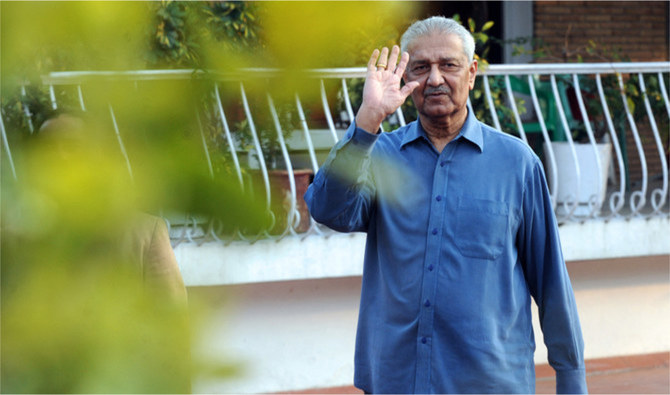
ISLAMABAD: Pakistani nuclear scientist Dr. Abdul Qadeer Khan, often referred to as AQ Khan, said on Sunday his health was improving after he was hospitalized with the coronavirus disease.
Khan is often dubbed the “father of Pakistan’s nuclear program,” having founded the Engineering Research Laboratory to help the South Asian country develop uranium enrichment capability.
It was renamed Khan Research Laboratory in 1981.
Khan was taken to KRL hospital’s COVID-19 ward in Islamabad on Aug. 26 after testing positive for the disease.
His health deteriorated last week, prompting rumors about his passing. “Am better today than yesterday,” Khan said in a message to Arab News. “May God be with you and protect you.”
Born in 1936 in the Indian city of Bhopal, Khan graduated in metallurgy from the University of Karachi in 1960. He pursued higher studies in West Berlin and the Netherlands, and was awarded a doctorate in metallurgical engineering by the Catholic University of Leuven in Belgium in 1972.
Pakistan placed him under house arrest in 2004 after he confessed to selling nuclear secrets to foreign countries. Several of his collaborators in Europe have been arrested in Germany, Switzerland and South Africa. Khan was released in 2009.


![]()


Pakistan nuclear scientist A.Q. Khan says he is recovering from COVID-19
Short Url
https://arab.news/gb7hq
Pakistan nuclear scientist A.Q. Khan says he is recovering from COVID-19
- His health deteriorated last week, prompting rumors about his passing


Spain unveils public investment fund to tackle housing crisis
- The Spanish PM said the fund would raise 120 billion euros ($142 billion)
MADRID: Spanish Prime Minister Pedro Sanchez on Monday presented a new public investment fund that he said would raise 120 billion euros ($142 billion) and help tackle the country’s persistent housing crisis.
Scarce and unaffordable housing is consistently a top concern for Spaniards and represents a stubborn challenge in one of the world’s most dynamic developed economies.
The new “Spain Grows” fund, first announced in January, aims to replace the tens of billions of EU post-Covid recovery aid that helped drive Spain’s strong growth in recent years.
Sanchez said the headline figure — representing seven percent of Spain’s annual economic output — would come through public and private sources, with an initial contribution of 10.5 billion euros of EU money.
The fund would “mobilize up to 23 billion euros in public and private funding to dynamise the housing supply” and help build 15,000 homes per year, Sanchez added, without specifying a timeframe for the planned investment.
Energy, digitalization, artificial intelligence and security industries would also benefit from the money, the Socialist leader said at a presentation in Madrid.
Tourism is a key component of Spain’s economy, with the country welcoming a record 97 million foreign visitors last year, when GDP growth reached 2.8 percent — almost double the eurozone average.
But locals complain that short-term tourist accommodation has driven up housing prices and dried up supply.
The average price of a square meter for rent has doubled in 10 years, according to online real estate portal Idealista.
According to the Bank of Spain, the net creation of new households and a lag in housing construction created a deficit of 700,000 homes between 2021 and 2025.
Scarce and unaffordable housing is consistently a top concern for Spaniards and represents a stubborn challenge in one of the world’s most dynamic developed economies.
The new “Spain Grows” fund, first announced in January, aims to replace the tens of billions of EU post-Covid recovery aid that helped drive Spain’s strong growth in recent years.
Sanchez said the headline figure — representing seven percent of Spain’s annual economic output — would come through public and private sources, with an initial contribution of 10.5 billion euros of EU money.
The fund would “mobilize up to 23 billion euros in public and private funding to dynamise the housing supply” and help build 15,000 homes per year, Sanchez added, without specifying a timeframe for the planned investment.
Energy, digitalization, artificial intelligence and security industries would also benefit from the money, the Socialist leader said at a presentation in Madrid.
Tourism is a key component of Spain’s economy, with the country welcoming a record 97 million foreign visitors last year, when GDP growth reached 2.8 percent — almost double the eurozone average.
But locals complain that short-term tourist accommodation has driven up housing prices and dried up supply.
The average price of a square meter for rent has doubled in 10 years, according to online real estate portal Idealista.
According to the Bank of Spain, the net creation of new households and a lag in housing construction created a deficit of 700,000 homes between 2021 and 2025.
Latest updates


Recommended


© 2026 SAUDI RESEARCH & PUBLISHING COMPANY, All Rights Reserved And subject to Terms of Use Agreement.