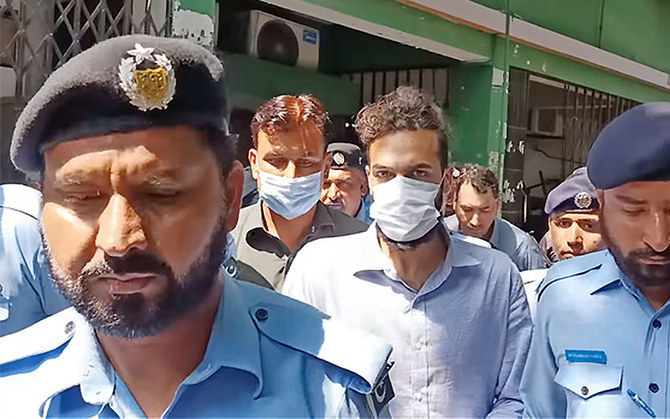

LAHORE: Zahir Jaffer’s confession before police to beheading Noor Mukadam was not enough for a conviction, the victim’s family lawyer has said, after a charge-sheet filed by police showed the prime suspect had admitted to committing the grisly July murder.
Mukadam, the 27-year-old daughter of Shaukat Mukadam, Pakistan’s former ambassador to South Korea and Kazakhstan, was found beheaded at Jaffer’s residence in Islamabad’s upscale F-7/4 sector on July 20 in a case that has sparked public outrage and grabbed media attention unlike any other recent crime against women.
Jaffer was arrested from the crime scene on the day of the murder and has been in Adiala Jail in Rawalpindi on judicial remand since early August. His parents, Zakir Jaffer and Ismat Adamjee, and three members of household staff, are also under arrest for a range of charges, including abetment and concealment of evidence.
Despite the confession to police, there was still a long way to conviction, Shah Khawar, the legal counsel for the Mukadam family, told Arab News.
“This is Zahir’s first confession during interrogation under Section 161 of Criminal Procedure Code (CrPC) which was reduced into writing by the police officer,” Khawar said. “No legal authenticity is attached to this confession as it was more of an inference and it cannot be presented as evidence.”
“A confession before police has no evidentiary value, unless he [accused] volunteers himself before a judicial magistrate to record his confessional statement.”
In accordance with the procedures, Khawar said, the magistrate would ask police to leave the record room, brief the accused about all the consequences of his confession and give him half an hour to decide whether he indeed wants to testify.
“When the magistrate is certain that the accused wants to make a confessional statement voluntarily, the magistrate notes down the confession and gives one copy of the sealed document to police and other to the sessions court,” Khawar said.
Even if an accused makes a judicial confession, he can still retract it in court, although that would more difficult, the lawyer explained.
“In such situations the magistrate appears in the court as a witness and tells the court that he gave the accused all opportunities and fulfilled all legal formalities before he [the accused] had made a confessional statement,” Khawar said.
The first trial in the murder case is scheduled for September 23, involving 12 accused, including Jaffer’s parents, household staff and six members of counselling center Therapy Works where Jaffer had enrolled in a certification course to practice as a psychotherapist.
A 670-page police charge sheet submitted in court in late August quotes Jaffer as telling investigators he had beheaded Mukadam after she refused to marry him.
“He confessed to have invited Noor Mukadam to his house in sector F-7/4 and discussed a marriage proposal. Noor refused to marry him and tried to leave the house,” the document says. “Things got worse and the two got into a spat and he tried to detain her forcibly.”
Mukadam tried to leave the house twice, according to the document, but Jaffer’s staff were ordered not to let anyone out of the residence. Jaffer’s security guard and gardener did not let her open the main gate.
“The suspect had directed his household staff including the security guard not to let anybody inside or go outside the home.”
When Mukadam jumped out of the window and tried to escape, the police record said Jaffer dragged her back to the house and beheaded her.