

Syrian security officials expected in high-profile Jordan visit

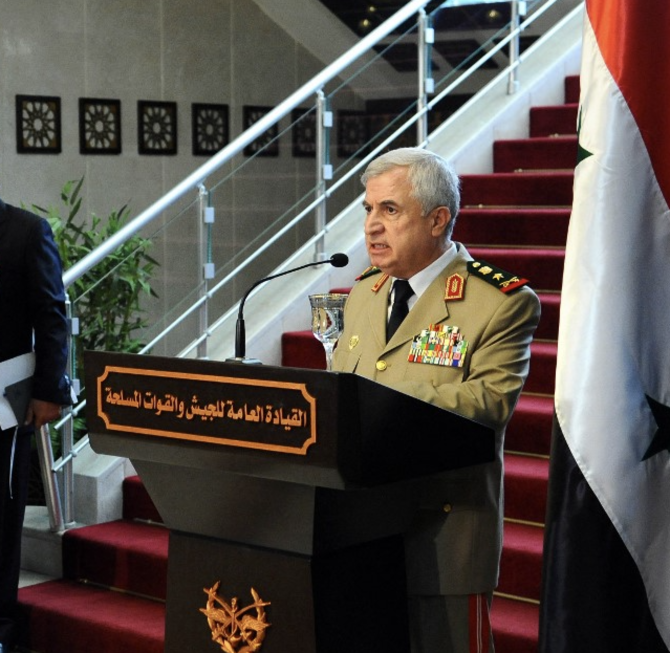
Jordanian news website alsaa.net reported that the delegation will be headed by Syria’s Chief of Staff Gen. Ali Ayoub. (File/AFP)
Short Url
Updated 12 September 2021
Follow

Syrian security officials expected in high-profile Jordan visit

  • Analysts say delegation trip will mark “most significant contact” since civil war began in 2011
  • Jordan looking to build relations in hopes of finding an end to fighting

AMMAN: A high-level Syrian security delegation is scheduled to visit Jordan in the coming days, local media reported on Sunday, marking a historic first high-profile state visit to the kingdom since the eruption of the Syrian conflict in 2011.

Jordanian news website alsaa.net reported that the delegation will be headed by Syria’s Chief of Staff Gen. Ali Ayoub.

Citing unnamed senior government sources, the news website claimed that the Syrian delegation will arrive to Amman during the next few days.

Despite Arab News reaching out for comment, Jordan’s Minister of State for Media Affairs Sakher Dudin was unavailable.

Stopping short from giving exact information on who will be attending, a government source who spoke on condition of anonymity told Arab News, however, that a “high-ranking Syrian delegation is set to visit Jordan soon.”

In past months, Jordan has been viewed as warming to Syria, with observers interpreting the strategy as a sign of the refugee-burdened kingdom’s weariness of international community inaction on Syria.

Jordan recently announced that it would reopen the Jaber-Nassib border crossing with Syria to operate at full capacity, but had to put it off as a result of the security escalation in the Syrian bordering town of Daraa.

Syrian Minister of Oil and Mineral Resources Bassam Tohme was at a meeting with Jordanian Prime Minister Bishr Khasawneh last week in Amman along with counterparts from Egypt and Lebanon, to discuss mechanisms to deliver Egyptian gas through Jordan and Syria to Lebanon.

“Jordan is required to deal with Syria using a different approach, with no one offering solutions to the more than ten years of war,” strategic analyst Amer Sabaileh said.

“Jordan needs to explore new opportunities when it comes to finding a political solution to the Syrian war, Sabaileh told Arab News, citing the security, economic and social consequences of the Syrian conflict on Jordan, primarily the refugee crisis.

According to the UNHCR, Jordan is home to about 650,000 registered Syrian refugees.

Political analyst Awni Dawood said that the proposal to export Egyptian gas to Lebanon through Jordan and Syria was initiated by the kingdom and was among the major topics of Jordanian King Abdullah’s meetings with US President Joe Biden and Russian President Vladimir Putin in July and August.

Dawood said that Jordan has sought an exception from the US Caesar Syria Civilian Protection Act, which imposes sanctions on the Syrian government, including President Bashar Assad, for war crimes against the Syrian population.

“Jordan’s quest for exception from the Caesar law is for humanitarian purposes, seeking better living conditions for people of the region,” Dawood said.


Lebanese finance minister denies any plans for a Kushner-run economic zone in the south

Updated 5 sec ago
Follow

Lebanese finance minister denies any plans for a Kushner-run economic zone in the south

  • Proposal was made by US Envoy Morgan Ortagus but was ‘killed on the spot’
  • Priority is to regain control of state in all aspects, Yassine Jaber tells Arab News

DAVOS: Lebanon’s finance minister dismissed any plans of turning Lebanon’s battered southern region into an economic zone, telling Arab News on the sidelines of the World Economic Forum’s meeting in Davos that the proposal had died “on the spot.”

Yassine Jaber explained that US Envoy to Lebanon Morgan Ortagus had proposed the idea for the region, which has faced daily airstrikes by Israel, and it was immediately dismissed.

Jaber’s comments, made to Arab News on the sidelines of the World Economic Forum in Davos, were in response to reports which appeared in Lebanese media in December which suggested that parts of southern Lebanon would be turned into an economic zone, managed by a plan proposed by Jared Kushner, US President Donald Trump’s son in law.

Meanwhile, Jaber also dismissed information which had surfaced in Davos over the past two days of a bilateral meeting between Lebanese ministers, US Middle East Envoy Steve Witkoff and Kushner.

Jaber said that the meeting on Tuesday was a gathering of “all Arab ministers of finance and foreign affairs, where they (Witkoff and Kushner) came in for a small while, and explained to the audience the idea about deciding the board of peace for Gaza.”

He stressed that it did not develop beyond that.

When asked about attracting investment and boosting the economy, Jaber said: “The reality now is that we need to reach the situation where there is stability that will allow the Lebanese army, so the (Israeli) aggression has to stop.”

Over the past few years, Lebanon has witnessed one catastrophe after another: one of the world’s worst economic meltdowns, the largest non-nuclear explosion in its capital’s port, a paralyzed parliament and a war with Israel.

A formal mechanism was put in place between Lebanon and Israel to maintain a ceasefire and the plan to disarm Hezbollah in areas below the Litani river.

But, the minister said, Israel’s next step is not always so predictable.

“They’re actually putting pressure on the whole region. So, a lot of effort is being put on that issue,” he added.

“There are still attacks in the south of the country also, so stability is a top necessity that will really succeed in pushing the economy forward and making the reforms beneficial,” he said.

Lawmakers had also enacted reforms to overhaul the banking sector, curb the cash economy and abolish bank secrecy, alongside a bank resolution framework.

Jaber also stressed that the government had recently passed a “gap law” intended to help depositors recover funds and restore the banking system’s functionality.

“One of the priorities we have is really to deal with all the losses of the war, basically reconstruction … and we have started to get loans for reconstructing the destroyed infrastructure in the attacked areas.”

As Hezbollah was battered during the war, Lebanon had a political breakthrough as the army’s general, Joseph Aoun, was inaugurated as president. His chosen prime minister was the former president of the International Court of Justice, Nawaf Salam.

This year marks the first time a solid delegation from the country makes its way to Davos, with Salam being joined by Jaber, Economy and Trade Minister Amr Bisat, and Telecoms Minister Charles Al-Hage.

“Our priority is to really regain the role of the state in all aspects, and specifically in rebuilding the institutions,” Jaber said.