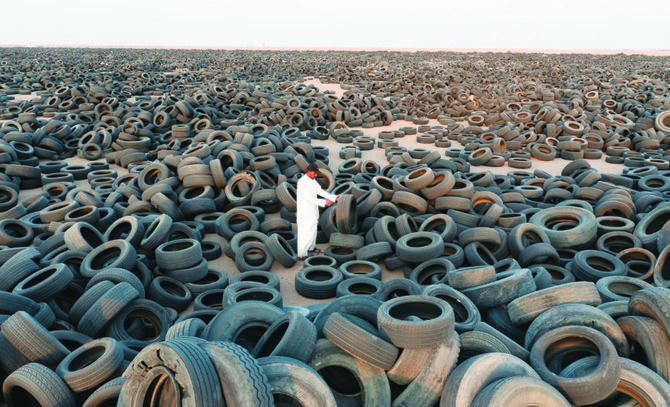
KUWAIT CITY: More than 42 million old vehicle tires dumped in Kuwait’s sands have started to be recycled, as the Gulf state tackles a waste problem that created one of the world’s largest tire graveyards.
The massive dump site was a mere 7 km from a residential suburb. Residents were bothered by periodic large fires releasing noxious black smoke.
But this month Kuwait, which wants to build 25,000 new houses on the site, finished moving all the tires to a new location at Al-Salmi, where recycling efforts have begun.
At a plant run by the EPSCO Global General Trading recycling company, employees sort and shred scrap tires, before pressing the particles into rubbery colored flooring tiles.
“The factory is helping society by cleaning up the dumped old tires and turning them into consumer products,” said EPSCO partner and CEO Alaa Hassan from EPSCO, adding they also export products to neighboring Gulf countries and Asia.
The EPSCO plant, which began operations in January 2021, can recycle up to 3 million tires a year, the company said. Scrap tires are a major environmental problem worldwide due to their bulk and the chemicals they can release.
Kuwait, an OPEC member with a population around 4.5 million, had about 2.4 million vehicles in 2019, Central Statistical Bureau data shows, up from 1.5 million in 2010.
The government hopes Al-Salmi will become a tire recycling hub, with more factories planned.
The Al Khair Group transported more than half of all the tires to the new site using up to 500 trucks a day and is planning to open a factory to burn the tires through a process called pyrolysis, its CEO Hammoud Al-Marri said.
Pyrolysis produces a type of oil which can be sold for use in industrial furnaces such as cement factories, and an ash known as carbon black that can be used in various industries.


![]()

Kuwait starts to recycle massive tire graveyard
Short Url
https://arab.news/wkx6a
Kuwait starts to recycle massive tire graveyard
- The EPSCO plant, which began operations in January 2021, can recycle up to 3 million tires a year, the company said


Latest updates


© 2026 SAUDI RESEARCH & PUBLISHING COMPANY, All Rights Reserved And subject to Terms of Use Agreement.