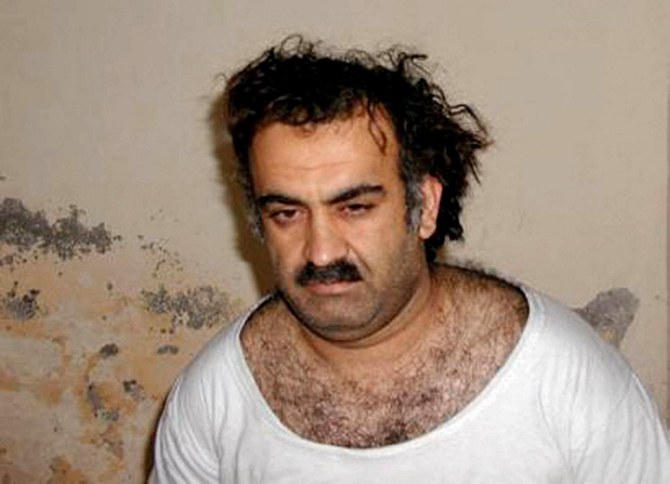
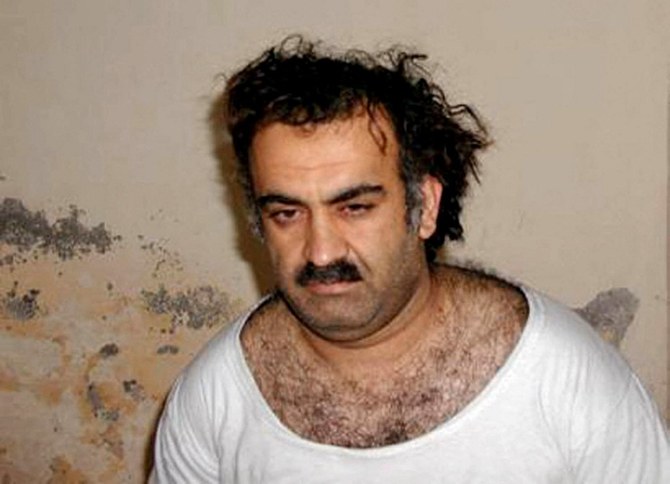
Guantanamo Bay Naval Base, Cuba: Accused September 11 mastermind Khalid Sheikh Mohammed and four others appeared in court for the first time in more than 18 months on Tuesday as US military prosecutors seek justice two decades after the world-shaking terror attacks.
Mohammed — with a dense, graying red beard — strode easily into the courtroom in the US naval base in Guantanamo Bay Cuba, as the nine-year-old trial resumed after a long halt for the COVID-19 pandemic.
The military tribunal courtroom was packed with prosecutors, interpreters, and five defense teams for Mohammed and alleged co-conspirators Ammar Al-Baluchi, Walid bin Attash, Ramzi bin Al-Shibh and Mustafa Al-Hawsawi.
In the audience, behind thick glass, were members of the families of the 2,976 people the defendants are accused of murdering almost exactly 20 years ago.
The accused face possible execution if found guilty.
But, with the pretrial phase now in its ninth year and bogged down over what is now the central issue, that the five were repeatedly tortured by the CIA after their capture, there is no immediate end in sight to the proceedings.
Without a political intervention — President Joe Biden had pledged during his campaign to close down the military prison at Guantanamo Bay — it could be more than a year before a full trial begins, much less a verdict reached.
The trial resumed Tuesday in the highly secure “Camp Justice” courtroom on a hilltop in the US naval base at Guantanamo Bay.
The last time the court met was February 2019, just as the coronavirus began sweeping across the United States.
The site for the trial sits about 10 kilometers (six miles) from the coastline prison camps where the five defendants and 34 other “War on Terror” detainees have been held for 15 years or more.
The hearing opened under a brand new judge, Air Force Col. Matthew McCall, who is the eighth to be named to preside.
McCall opened by asking each of the defendants if they understood the guidelines for the hearing.
Each answered yes, some in English and some in their own languages.
There is little doubt that Mohammed, or KSM as he is known, was intimately involved in the preparations for the September 11 attacks.
He told interrogators he proposed it to Osama bin Laden in 1996, and oversaw the execution of the attack, in which 19 Al-Qaeda members hijacked four American passenger jets and crashed two into New York’s World Trade Center and one into the Pentagon, while a counterattack by passengers on the fourth led the jet to crash into a field in Pennsylvania.
The other four defendants allegedly helped prepare for the attack, training the hijackers, transferring money to them, and coordinating movements.
The five were all captured between 2002 and 2003 and held in CIA black sites around the world for more than two years where they were subjected to waterboarding, physical beatings and stress, and mental pressure — now all banned as torture.
They were all brought to Guantanamo almost exactly 15 years ago.
The defense attorneys maintain that the torture tainted the whole trial, eliminating any standard of due process, and that if the proceedings were held in federal court inside the United States, the entire case could have been thrown out.
Not only is the evidence from the CIA interrogations inadmissible, but so is the evidence from so-called “clean team” interrogations carried out by the FBI in 2007, because the FBI also took part in the CIA operation, the defense argues.


Trial of accused 9/11 mastermind resumes, days before 20th anniversary
https://arab.news/6taaa
Trial of accused 9/11 mastermind resumes, days before 20th anniversary
- Sept. 11 mastermind Khalid Sheikh Mohammed and four others appear in Guantanamo court for first time in 18 months


Trump’s Iran war violates international law, experts say
- Mary Ellen O’Connell, a professor at the University of Notre Dame, said the attack on Iran “had no justification under international law“
- “The US probably could have prevented any Israeli attack on Iran by virtue of the leverage afforded by critical US military support,” said Finucane
WASHINGTON: The United States insists it attacked Iran to curb “direct threats” from the Islamic republic, but legal experts say the dangers cited by Washington do not justify war under international law.
US and Israeli forces launched a massive air campaign against Iran on February 28, with Washington saying it aimed to curb nuclear and missile threats from Tehran. Yet the war has also decapitated the country’s government, and President Donald Trump is now demanding “unconditional surrender.”
The White House laid out Washington’s justification for the war during a news conference this week.
“This decision to launch this operation was based on a cumulative effect of various direct threats that Iran posed to the United States of America, and the president’s feeling, based on fact, that Iran does pose (an) imminent and direct threat,” Press Secretary Karoline Leavitt said Wednesday.
She went on to cite Iranian sponsorship of “terrorism,” its ballistic missile program and its alleged efforts to “create nuclear weapons and nuclear bombs.”
But Mary Ellen O’Connell, a professor at the University of Notre Dame, said the attack on Iran “had no justification under international law.”
“The law is clear that international disputes are to be resolved using peaceful means — negotiation, mediation, the intervention of international organizations,” said O’Connell, an expert in international law on the use of force and international legal theory.
The Trump administration has offered “vague mentions of imminent attacks by Iran and to prevent Iran from acquiring a nuclear weapon,” while the UN Charter “requires, at the least, that evidence of a significant attack by Iran be underway,” she said.
- ‘Even less plausible’ -
“No shred of such evidence has been provided. Nor is there any right whatsoever to start a war over a weapons program.”
While Leavitt cited threats from missiles and militants, US Secretary of State Marco Rubio offered a different justification for the war earlier in the week: fears that an Israeli attack would trigger reprisals against US forces.
Brian Finucane, senior adviser for the International Crisis Group’s US Program, said there were several issues with Rubio’s explanation, including that the Trump administration has since offered other rationales for the war.
“The US probably could have prevented any Israeli attack on Iran by virtue of the leverage afforded by critical US military support,” said Finucane, who previously worked in the Office of the Legal Adviser at the US Department of State.
The Iran war is not the only legally dubious military intervention by the Trump administration.
In early September, the United States began carrying out strikes on alleged drug-smuggling boats in the Caribbean and later the eastern Pacific — a campaign that has killed more than 150 people.
The US government has yet to provide definitive evidence that the vessels it targets are involved in drug trafficking, and legal experts and rights groups say the strikes likely amount to extrajudicial killings.
Trump also ordered strikes on Iranian nuclear sites last year, and sent US forces into Caracas in early January to seize leftist Venezuelan leader Nicolas Maduro, who is now on trial in the United States.
Finucane said Trump’s Friday demand for “unconditional surrender” by Iran “further undercuts prior justifications for US military action.”
“The administration has not even bothered to argue that Operation Epic Fury complies with international law, but certainly statements like this make any such argument even less plausible,” he said, referring to the Iran operation.


