Bahrain approves 3rd booster shot of Sputnik V vaccine

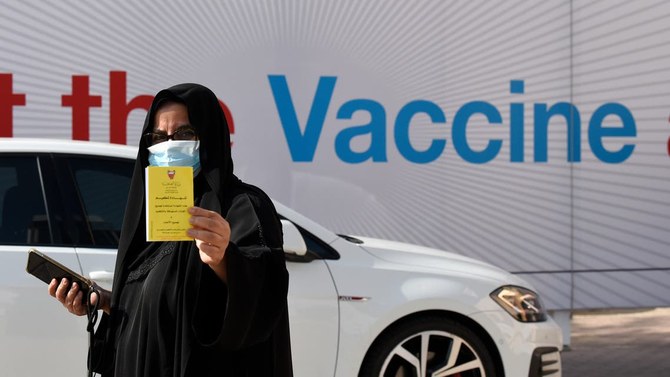
A woman displays her COVID-19 vaccine certificate in front of the Bahrain International Exhibition and Convention Center in the capital Manama, on December 24, 2020. (File photo: AFP)
Short Url
Updated 04 September 2021
Follow

Bahrain approves 3rd booster shot of Sputnik V vaccine

  • Bahrain and the UAE have already approved third booster shots using the Pfizer-BioNTech vaccine

DUBAI, LONDON: Bahraini authorities have authorized the use of a booster dose of the Sputnik V COVID-19 vaccine, the first time the Russian shot has been approved for a third dose, the state-run Bahrain News Agency said on Saturday.
The booster shot was approved for use among all over-18s at least six months after receiving their second dose of the Sputnik V vaccine, the news agency reported.
Bahrain and the UAE have already approved third booster shots using the Pfizer-BioNTech vaccine.
The small island nation’s COVID-19 infections are decreasing, currently at 3 percent of their peak with 95 new infections reported on average each day.
There have been 272,709 infections and 1,388 coronavirus-related deaths reported in Bahrain, which has a population of roughly 1.7 million according to the World Bank.
So far nearly 2.5 million doses of COVID-19 vaccines have been administered, enough to inoculate about 76 percent of the population, assuming each person needs two doses.
Meanwhile, Britain reported 37,578 new cases of COVID-19, government data showed on Saturday, meaning cases reported between Aug. 29 and Sept. 4 were up 2.4 percent compared with the previous seven days.
One of the UK’s largest suppliers of seasonal influenza vaccines has warned that there could be delivery delays of up to two weeks as a result of a shortage of truck drivers.
In a statement that has accentuated concerns about the potential scale of this winter’s flu outbreak, vaccine company Seqirus blamed “unforeseen challenges linked with road freight delays” for the disruption to deliveries in England and Wales.
The company said it “is working hard to resolve the delay to allow customers to reschedule their influenza vaccination clinics.”
Though the severity of flu outbreaks vary each year, there are concerns that past lockdowns put in place to combat the coronavirus pandemic might make UK residents more susceptible to the flu in the coming months.


Morocco pushes to reform social security system amid inflation and economic pressure, PM says

Updated 54 min 35 sec ago
Follow

Morocco pushes to reform social security system amid inflation and economic pressure, PM says

  • Speaking at the World Economic Forum in Davos, Aziz Akhannouch said his government had expanded healthcare to more than 80 percent of its population

DUBAI: Morocco’s prime minister said on Tuesday that the country was pursuing radical social and economic reforms in the wake of inflationary and economic pressures.

Speaking at the World Economic Forum in Davos, Aziz Akhannouch said his government had expanded healthcare to more than 80 percent of its population, up from just 42 percent when he took office three years ago.

He said this also coincided with consistently strong economic growth and headline inflation reducing to below 1 percent. 

“In a world that doubts itself, Morocco has decided to protect its population, reform and look forward,” he told attendees in Davos.

In late 2025, Morocco was rocked by its largest demonstrations in over a decade as youth‑led groups mobilized nationwide against deteriorating public services, deepening social inequality, and chronic unemployment.

Akhannouch said the country was aware of the difficulties facing Moroccans and was determined to ensure the country would remain on a positive trajectory.

Part of this included the provision of financial aid to more than 12 million citizens, and the formation of trusts for orphans to be paid out when they turn 18.

“Health means dignity, if you want to have a decent life you have to have good health,” he said.

Nevertheless, Akhannouch noted that the government had not forgone its budgetary principles — and had in fact balanced the country’s debt payments and achieved successful fiscal reforms. He noted S&P’s decision in 2025 to raise Morocco’s sovereign rating to BBB‑/A‑3 and restore its investment‑grade status.

Speaking on the World Cup, set to be co-hosted with neighbors Spain and Portugal in 2030, he said the project was seen as a nation-building exercise that would help spur Morocco to develop its underlying infrastructure and provide employment opportunities for young Moroccans.

“It will be a growth accelerator,” he said.

“When we build new rail networks and upgrade cities it will have a long-term impact on people.”