

Pakistan to use electronic voting machines in next general election — PM’s aide 

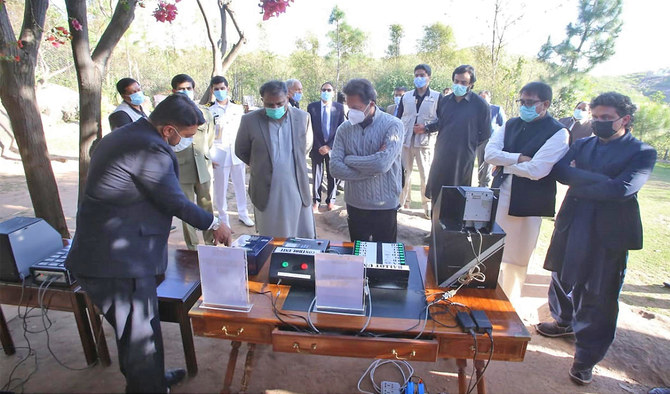
Pakistan's Prime Minister Imran Khan (right in the first row) receives briefing about e-voting in Islamabad, Pakistan, on March 31, 2021. (Photo courtesy: PID)
Short Url
Updated 02 September 2021
Follow

Pakistan to use electronic voting machines in next general election — PM’s aide 

  • Opposition parties have been largely mistrustful of the government’s plans 
  • Experts have warned of large transitional costs and other logistical and technical issues

ISLAMABAD: Pakistan will use electronic voting machines (EVMs) at the next general election in 2023, Prime Minister Imran Khan’s Adviser on Parliamentary Affairs Dr. Babar Awan has said.
Khan’s government has been pushing for the use of EVMs in future elections since it unveiled a prototype at the Parliament House in May. The idea of introducing electronic voting machines (EVMs) — which directly record votes and are believed to prevent the irregularities that may occur during manual counting — also caught the spotlight in March after a government candidate lost a key senate seat to a joint opposition candidate, unleashing accusations of rigging and horse trading from the ruling party. A subsequent election for the post of senate chairman in April also became controversial after eight ballot papers had to be wasted by the presiding officer for breaking rules.
Opposition parties have been largely mistrustful of the government’s plans to introduce EVMs and experts have warned of large transitional costs and other technical and logistical issues. 
“Legislation regarding Internet-voting, EVM, and right to vote for overseas Pakistanis will be completed this year,” Awan told a news conference in Islamabad on Wednesday. “We are ready to arrange a demonstration of EVM anywhere to satisfy the opposition.” 


This undated photo shows electronic voting machines. (Photo courtesy: @MinistryofST/Twitter)

The legislation process necessary to introduce EVMs would be completed after approval from the Senate or a joint session of parliament, English-language newspaper The News reported, quoting the PM’s adviser who said the government would cooperate with the Election Commission of Pakistan (ECP) to hold the 2023 election using the new machines.
Awan urged the opposition to demonstrate “political foresight” and support the government in ensuring transparent elections, the report said. 
“The government, ministers and parliamentary functionaries have invited the opposition several times, but received no encouraging response,” he said.
The EVMs had not been devised by the government, Awan said, and the public would be given demos of the prototype through roadshows being planned by the ministry of science and technology.
ECP former secretary Kanwar Dilshad told Arab News in April it was unlikely EMVs could be introduced by the next general election due to financial, logistical and technical constraints.
“At least an amount of Rs1 trillion is required to replace manual voting with digital voting procedures: Electronic Voting Machines, Biometric Verification Machines or Internet voting for Overseas Pakistani in general elections,” Dilshad said, saying Rs60 billion would be required for the procurement of 350,000 EVMs alone.
“In my opinion this is a futile exercise. The Election Commission of Pakistan pilot projects regarding EVMs have failed in the past,” he said.


Pakistani, Bangladeshi officials discuss trade, investment and aviation as ties thaw

Updated 28 December 2025
Follow

Pakistani, Bangladeshi officials discuss trade, investment and aviation as ties thaw

  • Pakistan and Bangladesh were once one nation, but they split in 1971 as a result of a bloody civil war
  • Ties between Pakistan, Bangladesh have warmed up since last year and both nations have resumed sea trade

ISLAMABAD: Pakistan's High Commissioner to Bangladesh Imran Haider on Sunday met Chief Adviser Muhammad Yunus in Dhaka, the latter's office said on, with the two figures discussing trade, investment and aviation.

Pakistan and Bangladesh were once one nation, but they split in 1971 as a result of a bloody civil war, which saw the part previously referred to as East Pakistan seceding to form the independent nation of Bangladesh.

Ties between Pakistan and Bangladesh have warmed up since former prime minister Sheikh Hasina’s ouster as a result of a student-led uprising in August 2024. Relations remain frosty between Dhaka and New Delhi over India’s decision to grant asylum to Hasina.

Pakistan has attempted to forge closer ties with Bangladesh in recent months and both South Asian nations last year began sea trade, followed by efforts to expand government-to-government commerce.

"During the meeting, both sides discussed ways to expand cooperation in trade, investment, and aviation as well as scaling up cultural, educational and medical exchanges to further strengthen bilateral relations between the two South Asian nations," Yunus's office said in a statement on X.

In 2023-24 Pakistan exported goods worth $661 million to Bangladesh, while its imports were only $57 million, according to the Trade Development Authority of Pakistan. In Aug. this year, the Pakistani and Bangladeshi commerce ministries signed a memorandum of understanding to establish a Joint Working Group on Trade, aiming to raise their bilateral trade volume to $1 billion in the financial year that began in July.

The Pakistani high commissioner noted that bilateral trade has recorded a 20 percent growth compared to last year, with business communities from both countries actively exploring new investment opportunities, according to the statement.

He highlighted a significant increase in cultural exchanges, adding that Bangladeshi students have shown strong interest in higher education opportunities in Pakistan, particularly in medical sciences, nanotechnology, and artificial intelligence. Haider also said that Dhaka-Karachi direct flights are expected to start in January.

"Chief Adviser Professor Muhammad Yunus welcomed the growing interactions between the two countries and emphasized the importance of increased visits as well as cultural, educational and people-to-people exchanges among SAARC (South Asian Association for Regional Cooperation) member states," the statement read.

"Professor Yunus also underscored the need to further boost Bangladesh–Pakistan trade and expressed hope that during Mr. Haider’s tenure, both countries would explore new avenues for investment and joint venture businesses."