

Sri Lanka cracks down on food hoarders as prices soar during economic crisis

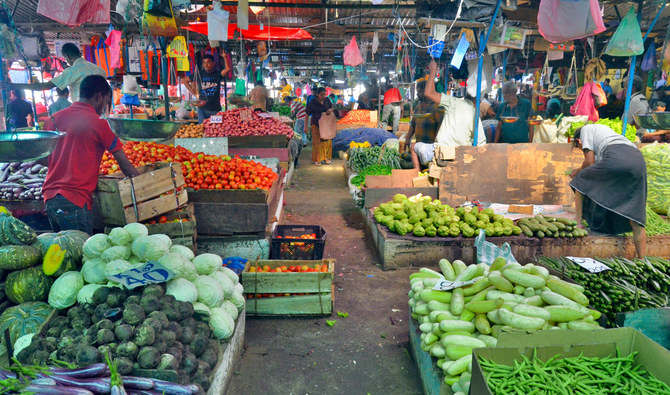
Officials said they have already seized large amounts of sugar and other staple goods from rogue traders. (Shutterstock)
Short Url
Updated 01 September 2021
Follow

Sri Lanka cracks down on food hoarders as prices soar during economic crisis

  • Authorities fix low prices for basic goods, including rice and sugar, in attempt to control inflation; profiteers face six months in jail
  • ‘The government has seized more than 5,000 metric tonnes of hoarded sugar from errant traders,’ minister told Arab News

COLOMBO: Sri Lankan authorities took action on Wednesday to control rapidly rising costs of basic goods by fixing prices and confiscating stocks. It came a day after they declared an economic emergency triggered by a sharp fall in the value of the country’s currency as a result of a foreign-exchange crisis.

President Gotabaya Rajapaksa announced wide-ranging emergency regulations on Tuesday. They apply to the supply, hoarding and pricing of staple foods such as rice and sugar, in an effort to control rising inflation. Private banks are running out of foreign-exchange reserves to finance imports following a steep decline in the value of the Sri Lankan rupee, which has fallen by 7.5 percent against the dollar this year.

Officials said they have already seized large amounts of sugar and other staple goods from rogue traders, and urged all suppliers to comply with the new fixed prices.

“The government has seized more than 5,000 metric tonnes of hoarded sugar from errant traders,” Janaka Wakkumbura, the state minister for small plantation crops, told Arab News.

He added that authorities have “enough stocks for the next five months,” and have capped the price of sugar, for example, at 130 rupees ($0.65) a kilogram, almost half the pre-crisis cost of 240 rupees. There are stiff penalties for those who ignore the new rules and continue to charge higher prices.

“Violators could face up to six months in prison and have their goods taken,” Wakkumbura said.

Rajapaksa appointed a retired army officer, Maj. Gen. M. S. P. Nivunhella, as commissioner general of essential services to coordinate the supply of basic goods and oversee operations.

“The authorized officers will be able to take steps to provide essential food items at a concessionary rate to the public by purchasing stocks of essential food items,” Rajapaksa said on Tuesday before declaring the economic emergency.

“These items will be provided at government-guaranteed prices, or based on the customs value on imported goods, to prevent market irregularities.”

Lasantha Alagiyawanna, the state minister for consumer protection, said legal action will be taken against unregistered traders by next week.

“To control the price of sugar and rice, a special order was issued on June 11, 2021, authorizing the registration of paddy (unprocessed rice), rice and wheat flour stores under the Consumer Affairs Authority Act,” he said. “Still, middlemen were hoarding stocks of rice and creating an artificial shortage.”

His ministry has closed 52 unregistered paddy storage facilities during raids in the past week in the North Central Province, he added.

The shortages have resulted in long queues outside stores in recent days as people scramble to buy food and other commodities. This is despite a strict 16-day curfew, which ends on Monday, to curb a surge in COVID-19 cases, as the country of 21 million struggles to contain an outbreak that is claiming more than 200 lives a day.

Schoolteacher Shaheera Rozmin told Arab News that the prices of food and other items are “fluctuating daily.”

“Some imported medicines are being sold at a 50 percent increase, citing the new dollar rate,” she said. “I hope these new rules will do some good for consumers.”

Retailers said the price increases were solely the result of “artificial demand created by traders who hoard important food stocks.”

Mohammed Fazeel, general manager of the Mutti-Rice Wholesale Center in Colombo, told Arab News: “The hoarders buy the paddy at a higher rate from the farmers than from the government and resell it at exorbitant prices.”

He added that despite the government fixing the price of rice at 98 rupees per kilo and onions and potatoes at 120 rupees, the rules “are not strictly followed.”

In an attempt to ease the financial crisis in Sri Lanka, the International Monetary Fund, the Bank of China and the Bank of Bangladesh on Wednesday pledged more than $1.2 billion in loans to strengthen the island nation’s foreign reserves.


Abduction of Mexican mine workers raises doubts over touted security improvements

Updated 4 sec ago
Follow

Abduction of Mexican mine workers raises doubts over touted security improvements

CONCORDIA: Deep in the coastal mountains above the sparkling Pacific resort of Mazatlan, towns spaced along a twisting road appear nearly deserted, the quiet broken only by the occasional passing truck.
It was near one of these towns, Panuco, that 10 employees of a Canadian-owned silver and gold mine were abducted in late January. The bodies of five were located nearby and five more await identification.
Most residents of these towns have fled out of fear as two factions of the Sinaloa Cartel have been locked in battle since September 2024, said Fermín Labrador, a 68-year-old from the nearby village of Chirimoyos. Others, he said, were “invited” to leave.
The abduction of the mine workers under still unclear circumstances has raised fears locally and more widely generated questions about the security improvements touted by President Claudia Sheinbaum. She signaled her more aggressive stance toward drug cartels in Sinaloa with captures and drug seizures after she took office in late 2024. It has been one year since she sent 10,000 National Guard troops to the northern border to try to head off US tariffs over the cartels’ fentanyl trafficking, much of which comes from Sinaloa.
In January, Sheinbaum held up a sharp decline in homicide rates last year as evidence that her security strategy was working.
“What these kinds of episodes do is demolish the federal government’s narrative that insists that little by little they are getting control of the situation,” said security analyst David Saucedo. He said Sheinbaum had tried to “manage the conflict” while the Sinaloa Cartel’s internal war spread and split the state by obliging people “to take a side with one of the two groups.”
Fleeting security
The mine workers’ disappearance in late January brought more troops into the mountains as they searched by air and on the ground for signs of them.
Mexico’s Security Secretary Omar García Harfuch came to coordinate the operation. Several arrests were made and from information gleaned from suspects, authorities found the clandestine graves.
But the increased security presence has not brought peace of mind to residents.
Roque Vargas, a human rights activist for people displaced by violence in the area, said that “all of the hubbub has scattered the organized crime guys” but he worries they could return. He and others are also concerned about being mistaken for bad guys and attacked by security forces when they leave their town, because it has happened elsewhere in the state.
“We’ve practically been abandoned,” he said.
Cartel infighting triggered violence
Sheinbaum took office in October 2024, when Sinaloa was entering a new spiral of violence following the abduction of Sinaloa Cartel leader Ismael “El Mayo” Zambada by a son of former cartel leader Joaquín “El Chapo” Guzmán. Zambada was handed over to US authorities and his faction of the cartel went to war with the faction led by Guzmán’s sons.
Initially, residents of the state capital, Culiacan, were caught in the crossfire, but the conflict eventually extended statewide. US President Donald Trump took office last year and designated the Sinaloa Cartel, among others, a foreign terrorist organization, upping the pressure on Sheinbaum’s administration to get tough with the cartels.
By last April, Vizsla Silver Corp., the Vancouver, Canada-based mine owner, announced it was halting activities at the mine because of security concerns in the area. The pause lasted a month.
García Harfuch said this month that the suspects arrested were part of the Sinaloa Cartel faction loyal to Guzmán’s sons, known as “los Chapitos,” and had mistaken the workers for belonging to the other faction. There has not been an explanation for how the confusion could have occurred since Vizsla said the workers were taken from their site.
Mines and crime
Mines, along with other businesses like avocado groves and pipelines carrying gasoline, have long attracted organized crime’s attention in Mexico as a source of extortion payments or to steal the extracted material.
Saucedo, who has researched cases in Guanajuato, Sinaloa and Sonora, said he has also seen cases where mines take advantage of armed groups to control mine opponents.
The Mexican government has said it has no reports that Vizsla was extorted. Sheinbaum said that her administration would talk with all mining companies in Mexico “to offer the support they require.”
Vizsla did not respond to questions emailed by The Associated Press, but has said in statements that its focus is on finding the remaining workers and supporting the affected families. Relatives of one of the workers declined to comment.
Search for the missing
In the community of El Verde, in the foothills that rise between the ocean and the mountains, Marisela Carrizales stood beside banners bearing the photographs of missing people. The road leading to a site where clandestine graves were discovered was blocked by a police car. The surrounding town was silent.
“I’m here waiting for answers,” said Carrizales, who belongs to one of the many search collectives that have spread all over Mexico to look for the missing. She has been looking for her son, Alejandro, for 5 ½ years and had come to El Verde with more than 20 others also looking for missing relatives to monitor authorities’ work and demand that they help them look in other places, too. “We have information that there are a lot more graves here … we have to come to look for them.”
It was here in the first week of February that authorities found a clandestine grave and then more in the days that followed. The Attorney General’s office said 10 bodies were found in one location, five of which have been identified as the missing mine workers. But the Sinaloa state prosecutor’s office also said additional remains were found in four other grave sites around the community.
There are many missing. In Mazatlan, a Mexican tourist was taken from a bar in October. In January, a businessman disappeared. In February, six other Mexican tourists were abducted from a ritzy part of the resort city. A woman and a girl who were part of that group were later found alive outside the city, but the men who were with them have not appeared.
While the government has strengthened security in Mazatlan ahead of carnival celebrations, back in the mountains, teachers, doctors or even buses are not coming to many of the communities out of fear, Vargas said.
Labrador, the man from Chirimoyos, said that when he is lucky, he borrows a friend’s motorcycle to go to his job in a highway toll booth. When he can’t borrow it, he has to walk more than 5 miles (8 kilometers) through the mountains, because the person in charge of local public transportation disappeared in December.