

Pakistani FM leaves for Iran, Uzbekistan, other regional powers to consult on Afghanistan

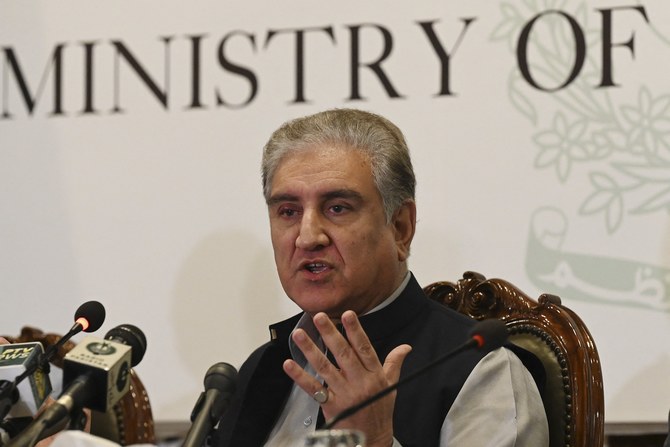
Pakistan's Foreign Minister Shah Mahmood Qureshi speaks during a press conference over the ongoing situation in Afghanistan, at the Foreign Ministry in Islamabad on August 9, 2021. (AFP)
Short Url
Updated 25 August 2021
Follow

Pakistani FM leaves for Iran, Uzbekistan, other regional powers to consult on Afghanistan

  • Qureshi will meet the leadership of Iran, Tajikistan, Uzbekistan and Turkmenistan during three-day trip
  • Neighboring countries have vital stake in the peace, security and stability of Afghanistan, foreign office says

ISLAMABAD: Pakistan’s foreign minister Shah Mahmood Qureshi left on a regional diplomacy tour today, Tuesday, which includes visits to Iran, Tajikistan, Uzbekistan and Turkmenistan, to discuss the unfolding situation in Afghanistan and present Pakistan’s perspective.

As the Taliban takes over in the strategic, landlocked nation, Pakistan, India, China and other regional powers are looking to cement their grip. Pakistan has said it desires an early and inclusive political settlement and a smooth transition of power in Afghanistan.

“Pakistan believes that the neighboring countries have a vital stake in the peace, security and stability of Afghanistan and the region,” Qureshi said in a statement about the visit from August 24-26. “It is important to coordinate closely with the neighbours to address common challenges and advance shared goals of peace, security, stability and regional connectivity.”

The foreign minister said his visit aimed to promote a coordinated regional approach as well as strengthen Pakistan’s engagement with Central and West Asia.

Pakistan has deep ties with the Taliban and has been accused of supporting the group as it battled the US-backed government in Kabul — charges denied by Islamabad. When the Taliban captured Kabul on August 15, Pakistan Prime Minister Imran Khan said Afghans had broken the “shackles of slavery.”

India, Pakistan’s old enemy, was a key supporter of the ousted regime in Kabul, but over the past year, as the Taliban emerged as a dominant force and US-brokered negotiations began in Doha, Indian diplomats have opened a line with the group.

Qureshi, in a statement on Monday, dispelled the idea that Pakistan had a problem with India’s relations with any government in Afghanistan.

“No objection to India’s good relations with Afghanistan,” his statement said, also rejecting Indian media reports that the foreign minister had traveled to Kabul recently.

“Indian media made a fuss about my going to Kabul, Indian media should confirm before speaking,” Qureshi said. “I did not go to Kabul.”


Pakistan reviews austerity measures amid Middle East crisis, urges strict nationwide implementation

Updated 11 March 2026
Follow

Pakistan reviews austerity measures amid Middle East crisis, urges strict nationwide implementation

  • Deputy Prime Minister Ishaq Dar chairs review meeting of austerity steps
  • Officials briefed on salary cuts, school closures, four‑day week, petrol conservation

ISLAMABAD: Pakistan’s government on Wednesday assessed progress on a sweeping set of austerity measures introduced to mitigate the country’s economic strain from sharply rising global oil prices and supply disruptions linked to the ongoing war in the Middle East.

Prime Minister Shehbaz Sharif this week announced a series of austerity steps, including a four‑day work week for government offices, requiring 50  percent of staff to work from home, cutting fuel allowances for official vehicles by half, grounding up to 60  percent of the government fleet and closing all schools for two weeks to conserve fuel amid the global oil crisis.

The measures were unveiled in response to global oil market volatility triggered by the conflict involving the United States, Israel and Iran, which has disrupted supply routes such as the Strait of Hormuz and pushed crude prices sharply higher, straining Pakistan’s heavily import‑dependent energy sector.

“The meeting stressed the importance of strict and transparent adherence to the austerity measures, promoting fiscal responsibility and prudent use of public resources,” Deputy Prime Minister and Foreign Minister Senator Mohammad Ishaq Dar said in a statement.

He was chairing a meeting of the Committee for Monitoring and Implementation of Conservation and Additional Austerity Measures, constituted under the directions of the PM, bringing together federal and provincial officials to review execution of the broad cost‑cutting plan. 

Dar emphasized the government’s commitment to enforcing the PM’s austerity steps nationwide. The committee’s review also covered reductions in departmental expenditure, deductions from salaries of senior officials earning over Rs. 300,000 ($1,120), and coordination with provincial administrations to ensure uniform implementation of the plan.

Participants at the meeting reiterated that all ministries and divisions must continue strict monitoring and reporting, with transparent oversight mechanisms, as Pakistan navigates the economic pressures from the prolonged Middle East crisis and its fallout on global energy and trade markets.