

Hurricane Grace makes a mess of Mexico’s Mayan Riviera

1 / 2
Members of the Mexican National Guard clear a street from fallen trees in Merida, Mexico, after Hurricane Grace made landfall on the Yucatan Peninsula on August 19, 2021. (REUTERS)
2 / 2
A member of the Mexican National Guard walks by a school being used as a temporary shelter after Hurricane Grace blew past Tulum, Quintana Roo state, Mexico, on Aug. 19, 2021. (AP) 
Short Url
Updated 20 August 2021
Follow

Hurricane Grace makes a mess of Mexico’s Mayan Riviera

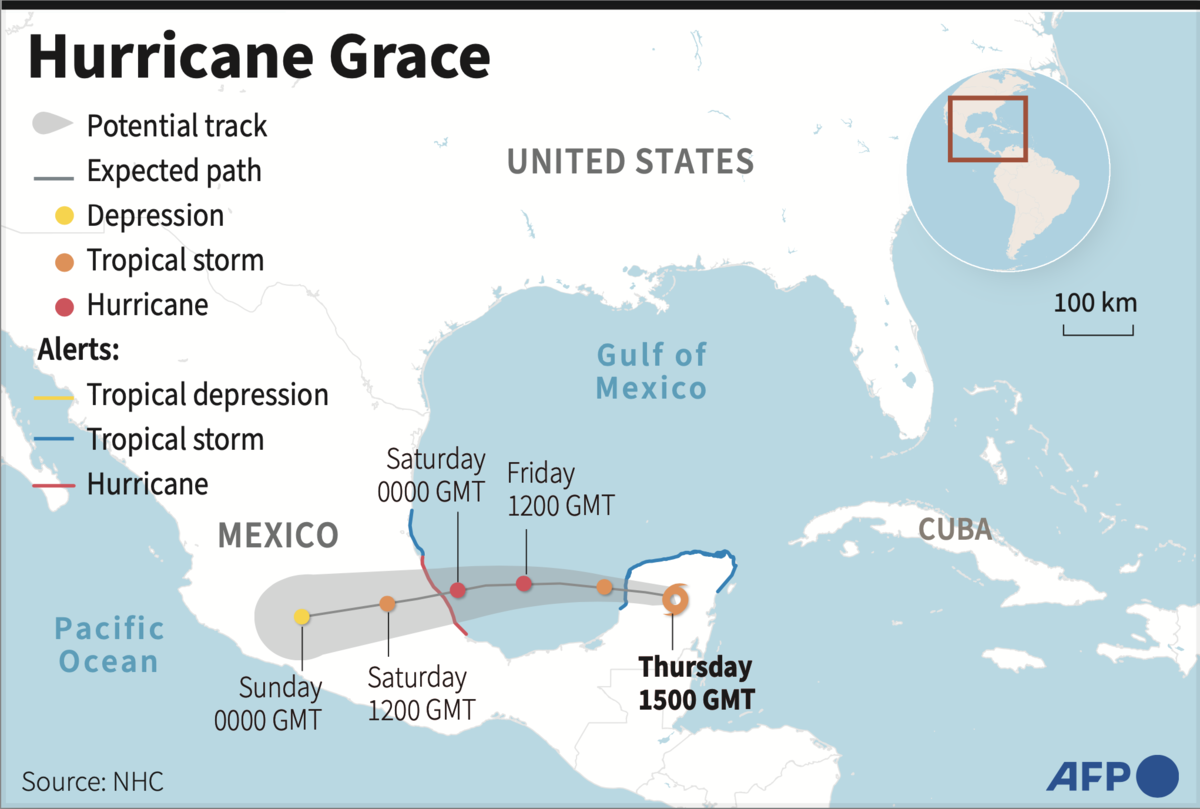
TULUM, Mexico: Hurricane Grace struck Mexico’s Caribbean coast just south of the ancient Mayan temples of Tulum on Thursday, tearing the roofs off some homes, knocking out power to thousands and keeping tourists off white sand beaches as it crossed the Yucatan Peninsula.
The push across land weakened the storm, but by evening it was centered back over water — the Gulf of Mexico — and the US National Hurricane Center said it was again regaining strength as it headed for a collision with the Mexican mainland late Friday or early Saturday.
The Category 1 storm had already soaked earthquake-damaged Haiti, Jamaica and the Cayman Islands en route to a direct hit on the Riviera Maya, the heart of Mexico’s tourism industry. Grace’s center struck just south of Tulum with maximum sustained winds of 80 mph (130 kmh), according to the Hurricane Center.
By nightfall, tropical storm-force winds were back up to 60 mph (95 kph) and rising. It was centered about 350 miles (565 kilometers) east-northeast of Veracruz and was heading werst at 15 mph (24 kph).
in Tulum, some families passed harrowing hours sheltering from cracking trees and flying debris.
Around 2 a.m. Thursday, as Grace’s eye spun just offshore, Carlos González grabbed his 1 1/2-year-old son and ran from his home with his wife to a public school converted into a shelter for dozens of families. The light from his cell phone helped them find their way through the dark streets.
“The only thing I have left is what I’m wearing,” the 35-year-old construction worker said. “I knew my house wasn’t going to stand it because it’s made of cardboard. When the wind came I was really scared and decided to leave.”
Miguel Ángel Garcia decided to stay. On Thursday, he used a machete to hack at a tree trunk that had fallen onto his home’s roof.
“The wind came and they told us we should get to the school, but we didn’t have time because the trees started coming,” said the 33-year-old waiter. “We decided to stay and not go out into the street and leave it up to God.”
Many streets were blocked by fallen limbs and trees that pulled down power lines, leaving thousands in the dark.
Most businesses remained closed, but the few that opened saw long lines of residents waiting to buy tortillas and other food.
Quintana Roo Gov. Carlos Joaquín said the storm had knocked out power to some 84,000 customers in Cancun and 65,000 in Playa del Carmen, Cozumel, Puerto Aventura and Tulum. But he said there were no reported deaths.
Cancun’s international airport reopened Thursday afternoon.
One lane of the highway between Playa del Carmen and Tulum was blocked by a fallen road sign. A gas station was destroyed when a large pavilion blew down, smashing two cars.
The state had opened shelters and evacuated some hotels and residents ahead of the storm’s arrival. Grace missed the popular cruise ship destination Cozumel and came ashore south of Playa del Carmen, where the downtown, usually thumping with music and clubgoers, was eerily desolate Wednesday night. Authorities had ordered all businesses closed and people inside by 8 p.m.
State authorities said that as of last week, the region was hosting about 130,000 tourists and hotels were more than half full despite the pandemic.


Modi starts Mideast-Africa tour as India-Oman free-trade pact nears completion

Updated 15 December 2025
Follow

Modi starts Mideast-Africa tour as India-Oman free-trade pact nears completion

  • Oman’s Shoura Council approved the trade deal’s draft last week
  • Modi begins trip in Amman, heading to Addis Ababa and Muscat

NEW DELHI: Prime Minister Narendra Modi left New Delhi on Monday for a tour covering Jordan, Oman and Ethiopia, as his government looks to strengthen partnerships with West Asia and Africa and finalize a free-trade deal with Muscat.

Modi’s four-day trip will start in Amman, at the invitation of King Abdullah.

“I am sure this visit will boost bilateral linkages between our nations,” Modi said on social media upon his arrival in Jordan, where he was received by Prime Minister Jafar Hassan.

On Tuesday, he is scheduled to arrive in Addis Ababa for his first state visit to Ethiopia. A day later, he will be in Muscat, where the Shoura Council last week approved the draft Comprehensive Economic Partnership Agreement with India.

“If it is signed during this visit, it will significantly deepen the economic ties between India and Oman. And it will open up a new chapter in the history of India-Oman trade and commercial relationship,” Ministry of External Affairs Secretary Arun Chatterjee told reporters ahead of Modi’s departure.

He said Modi would be accompanied by a high-level delegation for his second visit to Oman, after his last trip in February 2018. It also follows the visit of Oman’s Sultan Haitham bin Tariq to India in December 2023.

Free-trade negotiations between India and Oman began in November 2023, with the first round in New Delhi and the second in Muscat.

When the talks concluded in March 2024, Oman sought revisions on market-access terms and the final signature was postponed.

Announcements of the deal’s possible finalization have been made in the past few months by India’s Commerce and Industry Minister Piyush Goyal and the Omani ambassador to New Delhi, Issa Saleh Al-Shibani.

It would be its second with a GCC country after a 2022 trade deal with the UAE, as India has been trying to reach a similar agreement with the whole bloc.

“The framework is expected to be the same as the UAE’s, that is, a Comprehensive Economic Partnership Agreement. This is significant given that the progress on India-GCC FTA has been slow and non-consequential so far,” said Muddassir Quamar, associate professor at the School of International Studies, Jawaharlal Nehru University.

While Oman is one of Delhi’s smaller GCC trading partners — trailing behind the UAE and Saudi Arabia, with bilateral trade about $10 billion — it remains strategically important, particularly in energy and logistics.

“The FTA is likely to give a boost to India-Oman economic and trade relations, especially of goods and services. (It is) important given India has worked to enhance its trade and economic relations with the Gulf countries that are (among) the most dynamic and fast-expanding global economies,” Quamar told Arab News.

“It is also important because there is immense potential for Indian businesses and industries to partner with their Gulf and Omani partners in contributing to the diversification and economic growth plans.”