

Houthis abduct young journalist in Sanaa amid crackdown on dissent

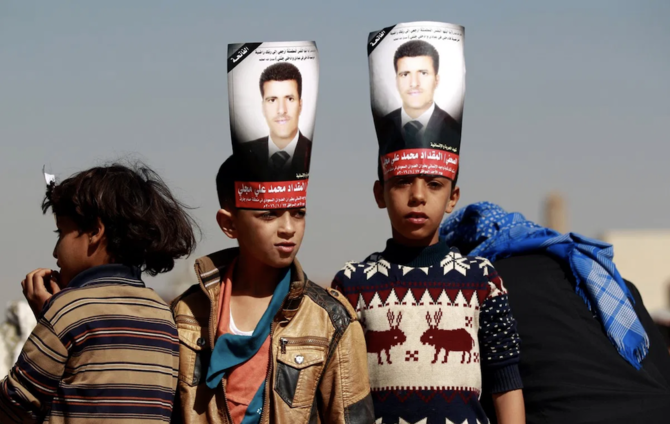
In this photo taken on January 18, 2016, Yemeni boys attend the funeral of journalist Almigdad Mojalli. Yemen is one of the country's considered most dangerous for journalists worldwide. (AFP/File Photo)
Short Url
Updated 19 August 2021
Follow

Houthis abduct young journalist in Sanaa amid crackdown on dissent

  • Relatives were not informed of Younis Abdul Sallam’s whereabouts for more than 10 days after he was taken

ALEXANDRIA: Houthi rebels in Yemen have been holding a young journalist abducted in Sanaa for more than a week, as the militia’s clampdown on outspoken academics, journalists and social media activists intensifies.

After detaining Younis Abdul Sallam, the Iran-backed Houthis waited more than 10 days before informing a local lawyer of his whereabouts, his family told Arab News on Thursday.

“Younis is being held in the intelligence service office,” said a relative who asked to remain anonymous. “We do not know why they detained him and they refuse to answer our calls.”

Abdel Majeed Sabra, a lawyer who defends abductees in Houthi jails, said abducted journalists face mistreatment at the hands of the notorious intelligence agency. He called on local rights groups and activists, including the Yemeni Journalists Syndicate, to put pressure on the Houthis to release Abdul Sallam immediately.

“The journalists’ union should use all means to secure his release,” he said in a message posted on Facebook.

Abdul Sallam, who is from the southern city of Taiz but has lived in Sanaa for several years, graduated from Sanaa University’s College of Media in 2017. He is not a particularly high-profile journalist but has posted messages critical of the Houthis on social media.

“The moment one of their preachers shouts from a nearby mosque, warning of the dangers from America and Israel, the group begins targeting populated areas in Marib,” he said in a message posted on Facebook on June 10, in which he criticizing the Houthis for launching a deadly offensive on the central city of Marib and targeting residential areas in the city. “How can normal human beings coexist with them?” he asked.

Based on his own horrific jail experience, Haytham Al-Shihab, one of five Yemeni journalists released from Houthi prisons during a prisoner swap in October last year, said Abdul Sallam will have been put in solitary confinement, had his name replaced on documents with a number, and been subjected to intense interrogations.

“During the evenings of the first month of his detention, he will be exhausted and tired from many long interrogations, accusations and fabrications that will deprive him of sleep,” Al-Shihab said.

The Houthis are not only targeting journalists. Residents in Houthi-held Sanaa said the militia abducted academic and businessman Osama Al-Shibami weeks ago and refuse to say where he is being held. His friends and students condemned the Houthis for targeting a man they described as a good, apolitical person with no enemies, and called for his immediate release.

On Aug. 4, unidentified assailants shot and killed Mohammed Ali Naeem, a professor at Sanaa University, as he left a friend’s house in the city. It happened shortly after he posted a message on social media demanding the Houthis and the Yemeni government increase the salaries of employees. The Houthis denied they were responsible and said they had captured a man who allegedly confessed to killing the professor over an old feud.

Residents in other Houthi–controlled areas, including Amran and Dhamar, said the militia has abducted several journalists and social-media activists who had criticized the rebels’ crackdown on singing and weddings, and exposed corruption among the movement’s officials.

According to analysts and authorities, Yemen has experienced the biggest displacement of journalists and activists in its history since the Houthis seized power in the country in 2014.

Najeeb Ghallab, an undersecretary at Yemen’s Information Ministry and a political analyst, told Arab News that more than 1,000 journalists were forced to flee the country after the Houthis raided and looted media offices and suppressed their work.

“Due to problems, corruption, sabotage, systematic robberies and mismanagement by the Houthis in Sanaa, opposition began to grow, not only among journalists but intellectuals and academics,” he added.


Israel’s settler movement takes victory lap as a sparse outpost becomes a settlement within a month

Updated 21 January 2026
Follow

Israel’s settler movement takes victory lap as a sparse outpost becomes a settlement within a month

  • Smotrich, who has been in charge of Israeli settlement policy for the past three years, has overseen an aggressive construction and expansion binge aimed at dismantling any remaining hopes of establishing a Palestinian state in the occupied West Bank

YATZIV SETTLEMENT, West Bank: Celebratory music blasting from loudspeakers mixed with the sounds of construction, almost drowning out calls to prayer from a mosque in the Palestinian town across this West Bank valley.
Orthodox Jewish women in colorful head coverings, with babies on their hips, shared platters of fresh vegetables as soldiers encircled the hilltop, keeping guard.
The scene Monday reflected the culmination of Israeli settlers’ long campaign to turn this site, overlooking the Palestinian town of Beit Sahour, into a settlement. Over the years, they fended off plans to build a hospital for Palestinian children on the land, always holding tight to the hope the land would one day become theirs.
That moment is now, they say.
Smotrich goes on settlement spree
After two decades of efforts, it took just a month for their new settlement, called “Yatziv,” to go from an unauthorized outpost of a few mobile homes to a fully recognized settlement. Fittingly, the new settlement’s name means “stable” in Hebrew.
“We are standing stable here in Israel,” Finance Minister and settler leader Bezalel Smotrich told The Associated Press at Monday’s inauguration ceremony. “We’re going to be here forever. We will never establish a Palestinian state here.”
With leaders like Smotrich holding key positions in Israel’s government and establishing close ties with the Trump administration, settlers are feeling the wind at their backs.
Smotrich, who has been in charge of Israeli settlement policy for the past three years, has overseen an aggressive construction and expansion binge aimed at dismantling any remaining hopes of establishing a Palestinian state in the occupied West Bank.
While most of the world considers the settlements illegal, their impact on the ground is clear, with Palestinians saying the ever-expanding construction hems them in and makes it nearly impossible to establish a viable independent state. The Palestinians seek the West Bank, captured by Israel in 1967, as part of a future state.
With Netanyahu and Trump, settlers feel emboldened
Settlers had long set their sights on the hilltop, thanks to its position in a line of settlements surrounding Jerusalem and because they said it was significant to Jewish history. But they put up the boxy prefab homes in November because days earlier, Palestinian attackers had stabbed an Israeli to death at a nearby junction.
The attack created an impetus to justify the settlement, the local settlement council chair, Yaron Rosenthal, told AP. With the election of Israel’s far-right government in late 2022, Trump’s return to office last year and the November attack, conditions were ripe for settlers to make their move, Rosenthal said.
“We understood that there was an opportunity,” he said. “But we didn’t know it would happen so quickly.”
“Now there is the right political constellation for this to happen.”
Smotrich announced approval of the outpost, along with 18 others, on Dec. 21. That capped 20 years of effort, said Nadia Matar, a settler activist.
“Shdema was nearly lost to us,” said Matar, using the name of an Israeli military base at the site. “What prevented that outcome was perseverance.”
Back in 2006, settlers were infuriated upon hearing that Israel’s government was in talks with the US to build a Palestinian children’s hospital on the land, said Hagit Ofran, a director at Peace Now, an anti-settlement watchdog group, especially as the US Agency for International Development was funding a “peace park” at the base of the hill.
The mayor of Beit Sahour urged the US Consulate to pressure Israel to begin hospital construction, while settlers began weekly demonstrations at the site calling on Israel to quash the project, according to consulate files obtained through WikiLeaks.
It was “interesting” that settlers had “no religious, legal, or ... security claim to that land,” wrote consulate staffer Matt Fuller at the time, in an email he shared with the AP. “They just don’t want the Palestinians to have it — and for a hospital no less — a hospital that would mean fewer permits for entry to Jerusalem for treatment.”
The hospital was never built. The site was converted into a military base after the Netanyahu government came to power in 2009. From there, settlers quickly established a foothold by creating makeshift cultural center at the site, putting on lectures, readings and exhibits
Speaking to the AP, Ehud Olmert, the Israeli prime minister at the time the hospital was under discussion, said that was the tipping point.
“Once it is military installation, it is easier than to change its status into a new outpost, a new settlement and so on,” he said.
Olmert said Netanyahu — who has served as prime minister nearly uninterrupted since then — was “committed to entirely different political directions from the ones that I had,” he said. “They didn’t think about cooperation with the Palestinians.”
Palestinians say the land is theirs
The continued legalization of settlements and spiking settler violence — which rose by 27 percent in 2025, according to Israel’s military — have cemented a fearful status quo for West Bank Palestinians.
The land now home to Yatziv was originally owned by Palestinians from Beit Sahour, said the town’s mayor, Elias Isseid.
“These lands have been owned by families from Beit Sahour since ancient times,” he said.
Isseid worries more land loss is to come. Yatziv is the latest in a line of Israeli settlements to pop up around Beit Sahour, all of which are connected by a main highway that runs to Jerusalem without entering Palestinian villages. The new settlement “poses a great danger to our children, our families,” he said.
A bypass road, complete with a new yellow gate, climbs up to Yatziv. The peace park stands empty.