

Hariri warns of sanctions risk as Hezbollah orders Iranian oil for Lebanon

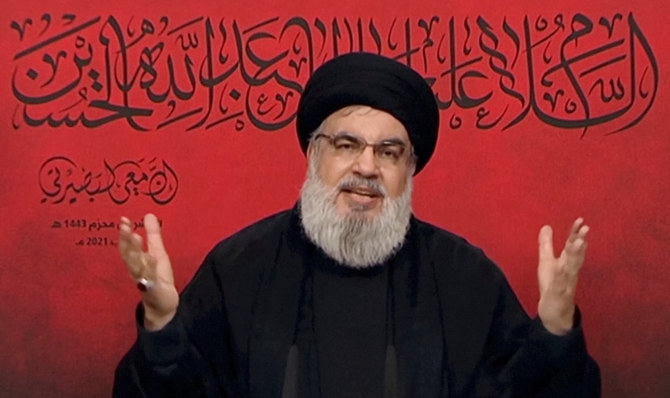
Lebanon's Hezbollah leader Sayyed Hassan Nasrallah speaks through a screen during a religious ceremony on August 19, 2021. (AL-MANAR TV/Handout via REUTERS)
Short Url
Updated 19 August 2021
Follow

Hariri warns of sanctions risk as Hezbollah orders Iranian oil for Lebanon

  • Hassan Nasrallah said the first shipment was due to set sail ‘within hours’ on Thursday and would be followed by more
  • The delivery would violate US sanctions on Tehran, and opponents warned of dire consequences for Lebanon if it goes ahead

BEIRUT: Lebanese political leaders on Thursday warned of dire consequences for the country should Iran make good its supposed promise to deliver oil.

Hezbollah leader Hassan Nasrallah earlier in the day said the group had asked for help from Iran and an oil tanker was set to sail “within hours” on Thursday.

Nasrallah cautioned the US and Israel against making any attempts to halt a delivery he said is intended to ease an acute fuel crisis.

If it goes ahead, the delivery would be a violation of US sanctions imposed on Tehran. But Nasrallah said the tanker, carrying diesel, will be followed by others and accused US authorities of “waging an economic war on Lebanon.”

Saad Hariri,  Lebanon's former prime minister, said “the Iranian ships will expose the Lebanese to more risks and sanctions.”

He criticized Nasrallah for declaring the ships to be Lebanese territory and rejected what he described as Lebanon being treated as an Iranian province. He warned that the country could suffer a fate similar to that of heavily sanctioned Venezuela.
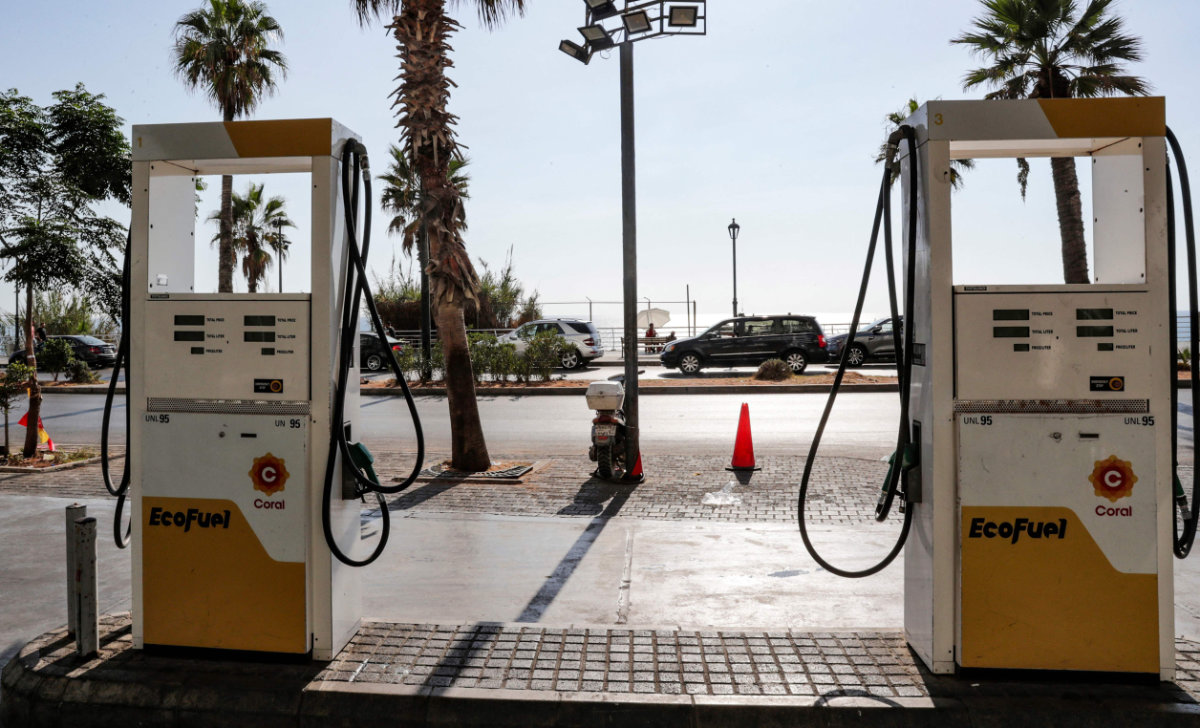


A Coral petrol station in Beirut lays idle on August 19, 2021 amid severe fuel shortages that have brought the crisis-hit country to a halt. (AFP)

Hariri also accused Iran of “obstructing the formation of a government in Lebanon,” saying “otherwise, how does it allow itself to violate the international laws by sending ships to Lebanon without the approval of the Lebanese government?”

Mark Ayoub, an expert on energy affairs in Lebanon and the Middle East, told Arab News: “We still don’t know the process that is going to be adopted to get the Iranian ships to Lebanon; will the Lebanese state be a part of it and choose international sanctions, or will Hezbollah assume responsibility?”

Leaked information, said to be from sources at the Energy Ministry, indicates that “no official request has been made to the ministry to obtain permission to import Iranian oil to Lebanon, by land or by sea, or for its discharge, storage and distribution.”

In comments directed at Lebanese president Michel Aoun, who is an ally of Hezbollah, Samir Geagea, president of the Lebanese Forces party, asked: “Will you leave Hezbollah, which has already usurped government authorities in security, military and strategy affairs, to take over the economic decision making as well?”

Samy Gemayel, the president of the Kataeb party, said: “There is no siege on Lebanon, as Nasrallah claims — but there will be soon, because of him, and he will also bring us sanctions.”

Meanwhile Aoun received a phone call from Dorothy Shea, the US ambassador to Lebanon, on Thursday informing him of Washington’s decision to support Lebanon by providing Egyptian natural gas to Jordan. It will be used to generate additional electricity that can be distributed to Lebanon via Syria.

Shea said her country is making “tremendous efforts” to achieve this and added that negotiations with the World Bank are continuing in an effort “to secure financing for the cost of the gas, as well as repairing, reinforcing and maintaining power lines and gas pipes.”

Najat Rushdie, the UN’s deputy special coordinator for Lebanon, spoke of her “deep concern over the potential impacts of the fuel crisis on access to healthcare and water supplies for millions of people in Lebanon.”

She warned: “The bad situation will only get worse unless an immediate solution is reached.”

Hamad Hassan, Lebanon’s health minister and a representative of Hezbollah in the caretaker government, announced the “granting of four emergency permissions to licensed pharmaceutical companies to import medicine, to compensate for shortages.”

Recent developments in Lebanon have slowed the latest attempts to form a new government. Prime Minister-designate Najib Mikati said his efforts to achieve this will continue. This came after Aoun complained that unnamed parties were seeking to delay the process and force Mikati to resign.


Trump says Iran government change ‘best thing that could happen’

Updated 14 February 2026
Follow

Trump says Iran government change ‘best thing that could happen’

  • US president's comments come after he ordered a second aircraft carrier to head to the Middle East

FORT BRAGG, United States: US President Donald Trump said a change of government in Iran would be the “best thing that could happen,” as he ordered a second aircraft carrier to head to the Middle East.
“Seems like that would be the best thing that could happen,” Trump told reporters at the Fort Bragg military base in North Carolina when a journalist asked if he wanted “regime change” in Iran.
“For 47 years, they’ve been talking and talking and talking. In the meantime, we’ve lost a lot of lives while they talk,” he told reporters.

Trump declined to say who he would want to take over in Iran from supreme leader Ayatollah Ali Khamenei, but he added that “there are people.”
He has previously backed off full-throated calls for a change of government in Iran, warning that it could cause chaos, although he has made threats toward Khamenei in the past.
Speaking earlier at the White House, Trump said that the USS Gerald R. Ford — the world’s largest warship — would be “leaving very soon” for the Middle East to up the pressure on Iran.
“In case we don’t make a deal, we’ll need it,” Trump said.
The giant vessel is currently in the Caribbean following the US overthrow of Venezuela’s Nicolas Maduro. Another carrier, the USS Abraham Lincoln, is one of 12 US ships already in the Middle East.

When Iran began its crackdown on protests last month — which rights groups say killed thousands — Trump initially said that the United States was “locked and loaded” to help demonstrators.
But he has recently focused his military threats on Tehran’s nuclear program, which US forces struck last July during Israel’s unprecedented 12-day war with Iran.
The protests have subsided for now but US-based Reza Pahlavi, the son of Iran’s last shah, urged international intervention to support the Iranian people.
“We are asking for a humanitarian intervention to prevent more innocent lives being killed in the process,” he told the Munich Security Conference.
It followed a call by the opposition leader, who has not returned to his country since before the revolution, for Iranians at home and abroad to continue demonstrations this weekend.
Iran and the United States, who have had no diplomatic relations since shortly after the revolution, held talks on the nuclear issue last week in Oman. No dates have been set for new talks yet.
The West fears the program is aimed at making a bomb, which Tehran denies.
The head of the UN nuclear watchdog, Rafael Grossi, said Friday that reaching an accord with Iran on inspections of its processing facilities was possible but “terribly difficult.”

Trump said after talks with Israeli Prime Minister Benjamin Netanyahu earlier this week that he wanted to continue talks with Iran, defying pressure from his key ally for a tougher stance.
The Israeli prime minister himself expressed skepticism at the quality of any agreement if it didn’t also cover Iran’s ballistic missiles and support for regional proxies.
According to the US-based Human Rights Activists News Agency, 7,008 people, mostly protesters, were killed in the recent crackdown, although rights groups warn the toll is likely far higher.
More than 53,000 people have also been arrested, it added.
The Norway-based Iran Human Rights (IHR) NGO said “hundreds” of people were facing charges linked to the protests that could see them sentenced to death.
Figures working within the Iranian system have also been arrested, with three politicians detained this week from the so-called reformist wing of Iranian politics supportive of President Masoud Pezeshkian.
The three — Azar Mansouri, Javad Emam and Ebrahim Asgharzadeh — were released on bail Thursday and Friday, their lawyer Hojjat Kermani told the ISNA news agency.