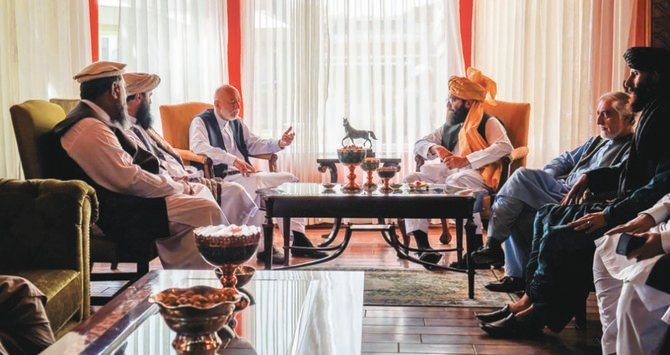
KABUL: Former Afghan President Hamid Karzai met with Anas Haqqani, a key member of the Taliban, on Wednesday, as top Taliban leaders arrived in Afghanistan to begin crucial talks for the formation of a new government.
The Haqqani Network, which was branded a terrorist group by the US in 2012, is an important faction of the Taliban who captured the Afghan capital, Kabul, in a stunning takeover on Sunday, returning to power nearly 20 years after being toppled in a US-led invasion.
As the Taliban encircled Kabul, President Ashraf Ghani flew out of the country and later posted on Facebook that he left to avoid bloodshed in the capital, without saying where he had gone.
Since then, an Afghan government council comprising Karzai, Gulbudin Hekmatyar, leader of the Hizb-e-Islami political and paramilitary group, and Abdullah Abdullah, the old administration’s main peace envoy, have been seeking to draw out a future roadmap for Afghanistan.
The Taliban delegation led by Baradar, head of the group’s political office in Qatar, arrived in Afghanistan on Tuesday evening, onboard a Qatari military plane that landed in southern Kandahar province, the group’s stronghold.
During an overnight press conference in Kandahar, Mullah Khairullah Khairkhaw, a member of the Taliban team, said that the delegation “will hold consultations and discussions with local and other leaders about the formation of an inclusive government.”
Meanwhile, Mohammad Yusof Saha, a spokesman for Karzai, told the Associated Press that preliminary meetings with the Taliban team would facilitate talks with Mullah Abdul Ghani Baradar, the Taliban’s top political leader.
No other details were available.
A Taliban source in Kandahar, requesting anonymity as he is not authorized to speak to the media, told Arab News that the Taliban delegation is expected to travel to Kabul later in the day, where Baradar “will also meet with a group of ethnic Afghan strongmen,” who have served in key government positions in the past.
The start of crucial talks between the Taliban and government officials comes amid warnings from major world powers opposing the Taliban’s reinstatement of an Islamic Emirate when they ruled Afghanistan from 1996 to 2001 and were accused of imposing harsh and repressive policies.
The Taliban insist they have changed and, in recent days, have vowed not to seek revenge, uphold women’s rights in the framework of Islamic law, ensure media freedom and offer amnesty for government officials in Afghanistan.
Unlike their past regime, which lived in global isolation — with only Pakistan, the UAE and Saudi Arabia recognizing their government — the Taliban, in recent months, have repeatedly said they are not after a “monopoly of power” and would form a government “acceptable to all ethnic groups.”
Since the Taliban’s takeover on Sunday, the US has frozen billions in Afghan revenues, blocking the Taliban from accessing money, while several countries have warned against holding back much-needed aid for the war-torn and cash-strapped nation until the Taliban sees through its promise for an “all-inclusive” government.
A source close to the Taliban told Arab News that Baradar — in his early 50s and whose name means “brother” — was most likely to head an interim government and take charge of the country.
However, a Kabul-based analyst, Wahidullah Ghazikhail, told Arab News that he was not “optimistic” of the two sides reaching an agreement soon.
“There will be meetings and discussions, but there won’t be any quick breakthrough as all sides will bargain because this is not a simple issue,” he said.
“They would talk about changing the constitution among other matters that would highly likely be very difficult. I am not very optimistic that they will reach an agreement soon,” he added.
Amid the uncertainty, thousands of Afghans have tried to flee the country in recent days, with the Taliban taking over the civilian side of the Kabul international airport on Tuesday.
Hundreds of people were gathered outside the airport on Wednesday, according to media reports.

Taliban leader, former Afghan president begin crucial talks on new government
Short Url
https://arab.news/w4wpd
Taliban leader, former Afghan president begin crucial talks on new government
- Haqqani meets with Karzai, who is part of a council formed after Kabul fell
- Taliban delegation led by Mullah Baradar arrived in Afghanistan Tuesday evening
Russia awaits an answer from the US on New START as nuclear treaty ticks down
- Russian leader Vladimir Putin has proposed keeping the treaty’s limits
- US President Donald Trump has said Putin’s proposal sounded ‘like a good idea’
MOSCOW: Russia on Wednesday said it was still awaiting a formal answer from Washington on President Vladimir Putin’s proposal to jointly stick to the last remaining Russian-US arms control treaty, which expires in less than two months.
New START, which runs out on February 5, caps the number of strategic nuclear warheads that the United States and Russia can deploy, and the deployment of land- and submarine-based missiles and bombers to deliver them.
Putin in September offered to voluntarily maintain for one year the limits on deployed strategic nuclear weapons set out in the treaty, whose initials stand for the (New) Strategic Arms Reduction Treaty.
Trump said in October it sounded “like a good idea.”
“We have less than 100 days left before the expiry of New START,” said Sergei Shoigu, the secretary of Russia’s powerful Security Council, which is like a modern-day politburo of Russia’s most powerful officials.
“We are waiting for a response,” Shoigu told reporters during a visit to Hanoi. He added that Moscow’s proposal was an opportunity to halt the “destructive movement” that currently existed in nuclear arms control.
Nuclear arms control in peril
Russia and the US together have more than 10,000 nuclear warheads, or 87 percent of the global inventory of nuclear weapons. China is the world’s third largest nuclear power with about 600 warheads, according to the Federation of American Scientists.
The arms control treaties between Moscow and Washington were born out of fear of nuclear war after the 1962 Cuban Missile Crisis. Greater transparency about the opponent’s arsenal was intended to reduce the scope for misunderstanding and slow the arms race.
US and Russia eye China’s nuclear arsenal
Now, with all major nuclear powers seeking to modernize their arsenals, and Russia and the West at strategic loggerheads for over a decade — not least over the enlargement of NATO and Moscow’s war in Ukraine — the treaties have almost all crumbled away. Each side blames the other.
In the new US National Security Strategy, the Trump administration says it wants to reestablish strategic stability with Russia” — shorthand for reopening discussions on strategic nuclear arms control.
Rose Gottemoeller, who was chief US negotiator for New START, said in an article for The Arms Control Association this month that it would be beneficial for Washington to implement the treaty along with Moscow.
“For the United States, the benefit of this move would be buying more time to decide what to do about the ongoing Chinese buildup without having to worry simultaneously about new Russian deployments,” Gottemoeller said.
New START, which runs out on February 5, caps the number of strategic nuclear warheads that the United States and Russia can deploy, and the deployment of land- and submarine-based missiles and bombers to deliver them.
Putin in September offered to voluntarily maintain for one year the limits on deployed strategic nuclear weapons set out in the treaty, whose initials stand for the (New) Strategic Arms Reduction Treaty.
Trump said in October it sounded “like a good idea.”
“We have less than 100 days left before the expiry of New START,” said Sergei Shoigu, the secretary of Russia’s powerful Security Council, which is like a modern-day politburo of Russia’s most powerful officials.
“We are waiting for a response,” Shoigu told reporters during a visit to Hanoi. He added that Moscow’s proposal was an opportunity to halt the “destructive movement” that currently existed in nuclear arms control.
Nuclear arms control in peril
Russia and the US together have more than 10,000 nuclear warheads, or 87 percent of the global inventory of nuclear weapons. China is the world’s third largest nuclear power with about 600 warheads, according to the Federation of American Scientists.
The arms control treaties between Moscow and Washington were born out of fear of nuclear war after the 1962 Cuban Missile Crisis. Greater transparency about the opponent’s arsenal was intended to reduce the scope for misunderstanding and slow the arms race.
US and Russia eye China’s nuclear arsenal
Now, with all major nuclear powers seeking to modernize their arsenals, and Russia and the West at strategic loggerheads for over a decade — not least over the enlargement of NATO and Moscow’s war in Ukraine — the treaties have almost all crumbled away. Each side blames the other.
In the new US National Security Strategy, the Trump administration says it wants to reestablish strategic stability with Russia” — shorthand for reopening discussions on strategic nuclear arms control.
Rose Gottemoeller, who was chief US negotiator for New START, said in an article for The Arms Control Association this month that it would be beneficial for Washington to implement the treaty along with Moscow.
“For the United States, the benefit of this move would be buying more time to decide what to do about the ongoing Chinese buildup without having to worry simultaneously about new Russian deployments,” Gottemoeller said.
© 2025 SAUDI RESEARCH & PUBLISHING COMPANY, All Rights Reserved And subject to Terms of Use Agreement.


