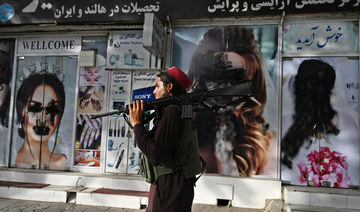
Niloofar Rahmani, Afghanistan’s first female pilot, said that she is extremely concerned about the sudden takeover of her country by the Taliban, who once ruled with brutality, oppressed women and provided a haven for Al-Qaeda terrorism against the US.
Rahmani joined Arab News Afghanistan reporter Baker Atyani on Wednesday to discuss the uncertainty over the nation’s future now that the Taliban have taken control following the total withdrawal of US and Western forces.
Both Rahmani and Atyani said that only time will tell if the new Taliban regime returns to its brutal past or turns over a new leaf to respect the rights that were restored to women and Westerners after the militants were driven from the country following the Sept. 11, 2001 terrorist attacks on the US.
“If I said it is going in the right direction, I would be lying because that is not the case. As a little girl, I grew up during the Taliban regime back before 2001. I have seen and been witness to everything that has been taken away from women. And that situation has always been a nightmare to me,” Rahmani recalled.
“And, growing up, I just wanted to do something for my country, give women a voice, and help them to raise their voices. How long? We are living in the 21st century. Why should we be abandoned? Why shouldn’t we have the right to speak? And, of course, me being a symbol of freedom for Afghan women, doing what I have done, and flying and wearing the uniform, it has never been easy. I had to overcome so many barriers, obstacles, to be able to find my place,” she said.
“Now to be honest I am very afraid for the freedom of women, and all the rights that have been given to women in the past 20 years. Young girls during these 20 years were raised and they grew up, and all they saw was freedom, and having the freedom of going to school and being educated. Do what they dream to do and there wouldn’t be anything against them. Now, I can openly say it is all gone.”
Atyani said that the question on everyone’s minds is over the new Taliban regime, which swiftly seized control of Afghanistan as US forces made their final departure and the former Afghan leadership fled.
“The main challenge now in front of the world is, will the Taliban walk the walk? Will they really respect human rights? Will they actually preserve all of these 20 years’ achievements, mainly for women, freedom of expression?” Atyani said.
“The signals the Taliban have been giving for the past few days since they have taken control of Kabul seems to be OK, but we need to wait and see if they will be able to bring all the other Afghan factions into the interim government or the next set-up in Afghanistan.”
On Monday, the Taliban declared an end to the 20-year war that began after Al-Qaeda terrorists hijacked four US commercial jets and flew them into major American targets on Sept. 11, 2001, destroying the Twin Towers of the World Trade Center and damaging the Pentagon, the center of US military superiority. The Taliban had given sanctuary to Al-Qaeda and its leader Osama bin Laden, who was killed in a US strike on May 2, 2011.
Although there have been many deaths, most were the result of panic by Afghan citizens who feared the Taliban’s return. Several were trampled to death as frantic crowds sought to escape the country via Kabul airport, while others died trying to cling to flights as they took off.
Afghanistan President Ashraf Ghani left the country on Sunday before the Islamist militants entered the capital and most of Afghanistan’s major cities unopposed and unchallenged.
Rahmani, who fled Afghanistan after being threatened by what she referred to as leaders of the Afghan government, said that friends and relatives who remained reported a wave of brutality that has received little attention amid the tumultuous and confusing events.
“I don’t know how it seems everything is OK in Kabul right now. That is not what my family, my friends back in Afghanistan are seeing. I get text messages and calls from them. They are screaming, they are crying, they are begging for help. They are saying they are going to be killed, please help me,” she said.
Atyani said he understands Rahmani’s concerns and her experiences.
“Certainly, everyone is hoping for the best. At the same time I know what Niloofar is talking about. This is the common feeling and the fear that every Afghan woman, and young men and women in Kabul, and even in northern parts of the country are feeling,” Atyani said.
“That is because they have experienced how the Taliban governed the country from 1996 to 2001. So, I don’t blame them. However, I believe that, politically, the Taliban now are more mature. I think they want the international support. They don’t want to live in isolation. They have changed, they have changed, yes. But have they changed enough to say they can actually respect human rights, even the people’s rights in the country? I guess this is a big question.”
Atyani noted that the US departed Afghanistan with the belief that the Taliban “will live up to their promises” despite some “legitimate concerns.”
Many of Afghanistan’s biggest cities have “fallen in just a few hours” and “the army that the US invested in completely melted and disappeared in only a few weeks,” he said.
The US invested more than $1 trillion, Atyani added, spending more than $40 billion each year in infrastructure for the army, law enforcement and building the government that collapsed in less than 24 hours.
“What the US was able to secure from the Taliban is that they won’t use Afghan territory against any other country. They won’t allow militant groups to work from Afghanistan against the US or any other country in the world. This is what the US has secured from the Taliban over the past 20 years,” Atyani said.
“They will impose their own way of rule in the country. The US concerns will be addressed by the Taliban. I don’t think the human rights issue, women’s rights issue, will be that pressing for the US or the International community. We could have another North Korea, maybe, another Iran, another Myanmar in Afghanistan in the near future.”
Rahmani, who co-authored a book with writer Adam Sikes, entitled “Open Skies: My Life as Afghanistan’s First Female Pilot”, said she fears for the future of Afghanistan.
“But it gets worse and worse. Honestly, as an Afghan woman growing up during this 20 years of freedom, having the right to do what I want to do, and speak for myself, I never thought this would be the end of it,” Rahmani said.
“This is really scary. I never thought. And I am just putting myself in the position of the young girls who are shocked by the situation at the moment. How can I be positive? My heart does not let me to be positive.”
Rahmani and Atyani made their comments during an appearance on “The Ray Hanania Radio Show” broadcast on Wednesday, Aug. 18, on WNZK AM 690 Radio in Detroit and WDMV AM 700 Radio in Washington D.C. on the U.S. Arab Radio Network and sponsored by Arab News. The program can be viewed on Arab News Facebook page where it was streamed live at Facebook.com/ArabNews.