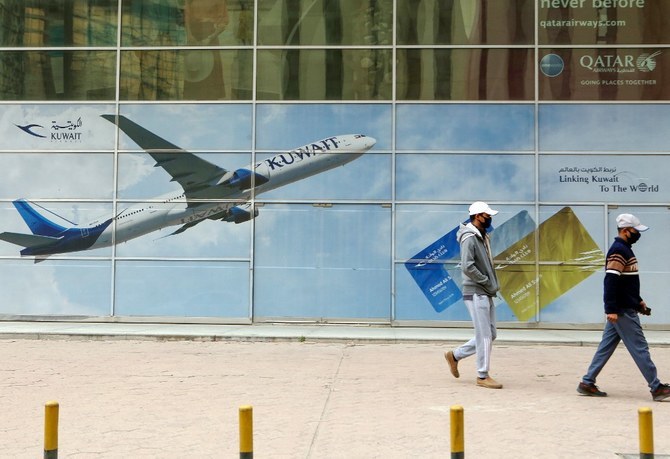
ISLAMABAD: Kuwait on Wednesday allowed the resumption of commercial flights with Pakistan and five other countries while adhering to COVID-19 measures set by a ministerial committee, Kuwait’s state news agency (KUNA) said on Wednesday.
Kuwait suspended commercial flights from Pakistan and several other countries in May this year amid a surge in coronavirus cases. Wednesday’s decision also includes Egypt, Bangladesh, India, Sri Lanka and Nepal.
“The decision was made in a cabinet meeting which underlined that flights with these countries would be subject to measures identified by Kuwait’s ministerial coronavirus emergency committee,” KUNA said.
Kuwait lifted a bar on visas for Pakistanis after ten years this May. The gulf country had suspended visas for nationals of Iran, Iraq, Syria, Pakistan and Afghanistan in 2011 over what it said were difficult security conditions in the five countries.
Pakistan began visa resumption talks with Kuwait in 2020, after which the first group of 208 nurses, doctors and medical technicians traveled to Kuwait on October 22, 2020, according to data from the ministry of overseas Pakistan.
In June this year, a fifth group of Pakistani medical professionals arrived in Kuwait, taking the total number of health care workers who have traveled to the state since October last year to 938.


Kuwait to resume commercial flights with Pakistan, five other nations
https://arab.news/v9s2e
Kuwait to resume commercial flights with Pakistan, five other nations

- Kuwait suspended flights from several countries in May this year over a surge in coronavirus cases
- Wednesday’s decision to resume commercial flights includes Egypt, Bangladesh, India, Sri Lanka and Nepal

Pakistan says defense pact with Saudi Arabia elevated brotherly ties to ‘new heights’
- Pakistan, Saudi Arabia signed strategic defense pact last year pledging aggression against one will be treated as attack on both
- Deputy PM Ishaq Dar says enduring bonds with Islamic and Arab nations form vital pillar of Pakistan’s foreign policy
ISLAMABAD: Deputy Prime Minister Ishaq Dar said on Wednesday that Pakistan’s defense pact with Saudi Arabia elevated its brotherly ties with the Kingdom to “new heights,” stressing that close ties with Arab and Islamic nations form a key pillar of Islamabad’s foreign policy.
Pakistan and Saudi Arabia signed a Strategic Mutual Defense Agreement on Sept. 17 last year, pledging that aggression against one country would be treated as an attack on both, enhancing joint deterrence and formalizing decades of military and security cooperation.
Both nations agreed in October 2025 to launch an economic cooperation framework to strengthen trade and investment ties.
“In the Middle East, our landmark Strategic Mutual Defense Agreement with Saudi Arabia has elevated our brotherly ties to new heights,” Dar said while speaking at the Pakistan Governance Forum 2026 event in Islamabad.
The Pakistani deputy prime minister was speaking on the topic “Navigating International Relations Amidst Changing Geo-Politics.”
Dar noted that Pakistan has reinforced partnerships with other Middle Eastern nations such as the UAE, Qatar, Jordan, Oman, Egypt and Bahrain. He said these partnerships have yielded “concrete agreements” in investment, agriculture, infrastructure, and energy sectors.
“Our enduring bonds with Islamic and Arab nations form a vital pillar of our foreign policy, and we will continue to expand our partnerships across Asia, Latin America, and Africa,” he said.
Dar pointed out that the presidents of Kazakhstan, Uzbekistan and Kyrgyzstan have undertaken visits to Pakistan in recent months, reflecting Central Asian nations’ desire to boost cooperation with Islamabad.
On South Asia, the Pakistani deputy PM said Pakistan has successfully transformed its fraternal ties with Bangladesh into “a substantive partnership.”
“Similarly, the trilateral mechanism involving China, Pakistan, and Bangladesh has been launched with a view to expanding and deepening regional cooperation and synergy,” the Pakistani minister said.
He said Islamabad has strengthened its “all-weather” partnership with China via the second phase of the multi-billion-dollar China-Pakistan Economic Corridor agreement and “unwavering support” from both sides for each other’s core interests.
Dar said Pakistan had also reinvigorated its partnership with the US, advancing cooperation in trade, technology, investment, and regional stability.
“This calibrated approach has enhanced our ability to navigate complexity with skill and confidence, ensuring that our national interests are served without compromising our core foreign policy principles,” he said.


