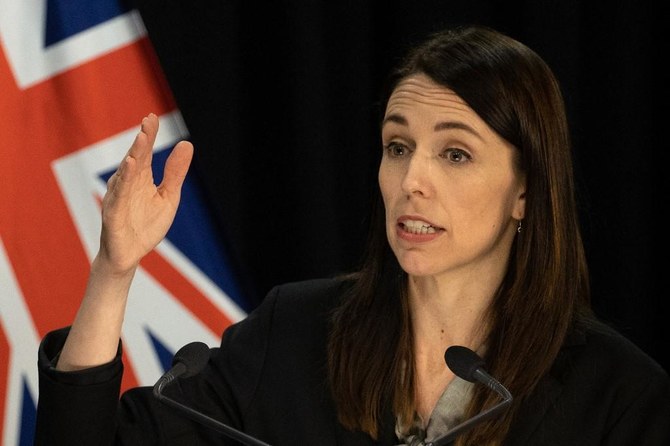
WELLINGTON: New Zealand’s Prime Minister Jacinda Ardern put the nation under strict lockdown on Tuesday after one new case of the coronavirus was reported in its largest city of Auckland, the country’s first in six months.
All of New Zealand will be in lockdown for three days from Wednesday while Auckland and Coromandel, a coastal town that the infected person had also spent time in, will be in lockdown for seven days.
Imposing its toughest level 4 lockdown rules, schools, offices and all businesses will be shut down and only essential services will be operational.
“The best thing we can do to get out of this as quickly as we can is to go hard,” Ardern told a news conference.
“We have made the decision on the basis that it is better to start high and go down levels rather than to go low, not contain the virus and see it move quickly,” she said.
Ardern said authorities were assuming the new case was a Delta variant infection although this has not been confirmed. There may be other cases, she said.
The last reported community case of COVID-19 in New Zealand was in February.
New Zealand has followed a go-hard-and-early strategy that has helped it virtually eliminate COVID-19 domestically, allowing people to live without restrictions although its international borders remain largely closed.
The country has reported about 2,500 confirmed cases of coronavirus and 26 related deaths.
The New Zealand dollar tumbled on the announcement, falling 1.5 percent to $0.6926 after the lockdown was announced.
The news came a day before the Reserve Bank of New Zealand is expected to become the first central bank among developed countries to raise interest rates since the pandemic as the economy booms.


![]()


New Zealand in national lockdown after single COVID-19 case
Short Url
https://arab.news/mbj7x
New Zealand in national lockdown after single COVID-19 case
- All of New Zealand will be in lockdown for three days from Wednesday
- New Zealand has followed a go-hard-and-early strategy that has helped it virtually eliminate COVID-19


China positions itself as force for global stability at its annual Congress
BEIJING: While much of the world’s attention is on the Iran war, that hasn’t stopped China from moving ahead with national priorities with global repercussions.
Not that China doesn’t care about the war and its impact on energy supplies and geopolitics. But for the world’s second largest economy, its growing rivalry with the United States revolves around a different battle: the development of the cutting-edge technologies shaping the 21st century.
That message came through in a five-year plan formally endorsed Thursday by the National People’s Congress at the end of its annual meeting, the nation’s biggest political event of the year. If anything, China is doubling down on a push to transform its economy and be at the forefront of technology. State media described China’s determination to stay the course on economic development as a force for stability in an uncertain world.
“A stable and developing China injects more stability and certainty into a world fraught with change and turbulence,” the official People’s Daily newspaper said in a front-page column on Wednesday. Other state-media echoed that view.
The commentaries and official statements didn’t mention US President Donald Trump, whose tariffs and use of military force from Venezuela to Iran are shaking up the global order that has governed international relations in the post-World War II era. China publicly defends that system, while calling for making it more equitable to reflect the interests of developing countries as well as rich ones.
Trump is due to visit Beijing in three weeks to hold talks with his counterpart, Chinese leader Xi Jinping.
The National People’s Congress also rubber-stamped three laws, including one governing ethnic minorities, at its closing session. The votes are ceremonial and nearly unanimous, designed to show unity behind the ruling Communist Party’s vision for the nation. The five-year plan was approved with 2,758 votes in favor, one against, and two abstentions.
“We are forging ahead at full speed in building a great country,” Foreign Minister Wang Yi said at an annual news conference during the Congress.
Banking on tech for growth
Many economists believe that China needs to do more to put more money into the hands of consumers to boost domestic spending and reduce its dependence on export-led growth.
China’s leaders agree in concept, but the five-year plan puts technology front and center, confirming it remains the top priority. Analysts expect any steps to boost consumption to happen only gradually, such as expanding social security and health care benefits, while government funds are poured into artificial intelligence, robotics and other areas.
Chinese Premier Li Qiang announced an economic growth target of 4.5 percent to 5 percent for 2026 at the start of the Congress, a level that gives the government more leeway to focus on the longer-term goals of the five-year plan rather than meeting a higher target this year.
Staying conservative on climate
The five-year plan doesn’t pledge to reduce carbon emissions overall, but only to reduce “emissions intensity” — how much pollutants are emitted relative to the size of the economy. That means emissions could still grow as the economy does.
The target for a reduction in intensity was set at 17 percent, a level that could allow emissions to rise 3 percent or more, analysts said. “International good practice is to move away from intensity targets toward absolute emission reduction targets,” said Niklas Hohne of the NewClimate Institute in Germany.
China has a history of setting conservative targets and its rapid expansion in solar and other clean energies may drive emissions down anyway. The country is the world’s No. 1 emitter of greenhouse gases, but leaders have long argued that the size of its population and economy must be considered when evaluating its pollution levels.
Regulating ethnic groups
A sweeping ethnic minorities law endorsed by the Congress solidifies what critics say is a government policy of assimilation, emphasizing the creation of “a common consciousness of the Chinese nation.”
The government said it is meant to foster a stronger sense of community and shared economic development among its ethnic groups. The law encapsulates an approach under Xi that has promoted unity over ethnic cultures and their languages.
“It puts a death nail in the party’s original promise of meaningful autonomy,” said James Leibold, a professor at Australia’s LaTrobe University who has studied China’s changing policies toward its ethnic minorities.
Seeking a “right to rest” for workers
Formal proposals and other suggestions to reduce work hours in a variety of ways were among those that got the most attention on social media during this year’s Congress.
Many focused on a “right to rest,” including calls to give employees the right not to respond to work messages after hours. Many Chinese workers get only five days of paid vacation a year. Yu Miaojie, an economist and deputy to the Congress, proposed raising the minimum statutory annual leave from five to 10 days.
The popularity of the proposals reflects concern about the intense workplace competition in China. Giving workers more leisure time is also seen as a way to boost consumption by giving them more free time to spend.
Not that China doesn’t care about the war and its impact on energy supplies and geopolitics. But for the world’s second largest economy, its growing rivalry with the United States revolves around a different battle: the development of the cutting-edge technologies shaping the 21st century.
That message came through in a five-year plan formally endorsed Thursday by the National People’s Congress at the end of its annual meeting, the nation’s biggest political event of the year. If anything, China is doubling down on a push to transform its economy and be at the forefront of technology. State media described China’s determination to stay the course on economic development as a force for stability in an uncertain world.
“A stable and developing China injects more stability and certainty into a world fraught with change and turbulence,” the official People’s Daily newspaper said in a front-page column on Wednesday. Other state-media echoed that view.
The commentaries and official statements didn’t mention US President Donald Trump, whose tariffs and use of military force from Venezuela to Iran are shaking up the global order that has governed international relations in the post-World War II era. China publicly defends that system, while calling for making it more equitable to reflect the interests of developing countries as well as rich ones.
Trump is due to visit Beijing in three weeks to hold talks with his counterpart, Chinese leader Xi Jinping.
The National People’s Congress also rubber-stamped three laws, including one governing ethnic minorities, at its closing session. The votes are ceremonial and nearly unanimous, designed to show unity behind the ruling Communist Party’s vision for the nation. The five-year plan was approved with 2,758 votes in favor, one against, and two abstentions.
“We are forging ahead at full speed in building a great country,” Foreign Minister Wang Yi said at an annual news conference during the Congress.
Banking on tech for growth
Many economists believe that China needs to do more to put more money into the hands of consumers to boost domestic spending and reduce its dependence on export-led growth.
China’s leaders agree in concept, but the five-year plan puts technology front and center, confirming it remains the top priority. Analysts expect any steps to boost consumption to happen only gradually, such as expanding social security and health care benefits, while government funds are poured into artificial intelligence, robotics and other areas.
Chinese Premier Li Qiang announced an economic growth target of 4.5 percent to 5 percent for 2026 at the start of the Congress, a level that gives the government more leeway to focus on the longer-term goals of the five-year plan rather than meeting a higher target this year.
Staying conservative on climate
The five-year plan doesn’t pledge to reduce carbon emissions overall, but only to reduce “emissions intensity” — how much pollutants are emitted relative to the size of the economy. That means emissions could still grow as the economy does.
The target for a reduction in intensity was set at 17 percent, a level that could allow emissions to rise 3 percent or more, analysts said. “International good practice is to move away from intensity targets toward absolute emission reduction targets,” said Niklas Hohne of the NewClimate Institute in Germany.
China has a history of setting conservative targets and its rapid expansion in solar and other clean energies may drive emissions down anyway. The country is the world’s No. 1 emitter of greenhouse gases, but leaders have long argued that the size of its population and economy must be considered when evaluating its pollution levels.
Regulating ethnic groups
A sweeping ethnic minorities law endorsed by the Congress solidifies what critics say is a government policy of assimilation, emphasizing the creation of “a common consciousness of the Chinese nation.”
The government said it is meant to foster a stronger sense of community and shared economic development among its ethnic groups. The law encapsulates an approach under Xi that has promoted unity over ethnic cultures and their languages.
“It puts a death nail in the party’s original promise of meaningful autonomy,” said James Leibold, a professor at Australia’s LaTrobe University who has studied China’s changing policies toward its ethnic minorities.
Seeking a “right to rest” for workers
Formal proposals and other suggestions to reduce work hours in a variety of ways were among those that got the most attention on social media during this year’s Congress.
Many focused on a “right to rest,” including calls to give employees the right not to respond to work messages after hours. Many Chinese workers get only five days of paid vacation a year. Yu Miaojie, an economist and deputy to the Congress, proposed raising the minimum statutory annual leave from five to 10 days.
The popularity of the proposals reflects concern about the intense workplace competition in China. Giving workers more leisure time is also seen as a way to boost consumption by giving them more free time to spend.
Latest updates


© 2026 SAUDI RESEARCH & PUBLISHING COMPANY, All Rights Reserved And subject to Terms of Use Agreement.