

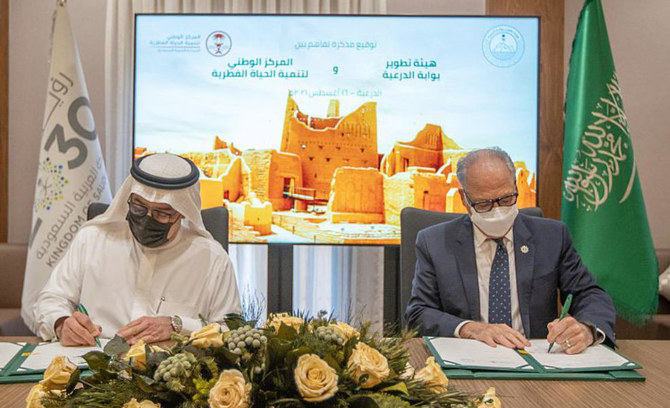
Wildlife reserve to be built in Saudi Arabia’s Diriyah valleys

MoU signed to construct two new nature-related facilities and promote conservation in Saudi Arabia. (SPA)
Short Url
Updated 17 August 2021
Follow

Wildlife reserve to be built in Saudi Arabia’s Diriyah valleys

  • The cooperation comes as part of the center’s support for the conservation of wildlife in Saudi Arabia

RIYADH: The Diriyah Gate Development Authority (DGDA) and National Center for Wildlife Development have signed a memorandum of understanding (MoU) to construct two new nature-related facilities and promote conservation in the Kingdom.

The agreement will include the development of a wildlife reserve in Wadi Safar and a center for visitors to learn about nature in Wadi Hanifa. Both projects will operate in line with local and international standards.

The agreement will also include the launch of special programs related to wildlife and biodiversity regulations in the Kingdom.

Cooperation between the DGDA and National Center for Wildlife Development comes as part of the center’s support for the conservation of wildlife and habitats in the Kingdom.

As part of its mission, the center promotes scientific research related to biodiversity and the discovery of sustainable solutions to environmental challenges.

The DGDA adopts international environmental standards in projects related to heritage, tourism, hotels and cultural centers, with green designs derived from traditional Najdi architecture.

The first phase of the development project includes the restoration of more than two square kilometers of Wadi Hanifa, including palm groves, farms, sidewalks, hiking trails, and parks, in order to make the valley an open space for visitors.


What makes the Taif Rose such a precious fragrance product?

Perfume artisan involvement aligns with Jazan Festival’s initiative repositioning traditional crafts as dynamic. (SPA)
Updated 09 January 2026
Follow

What makes the Taif Rose such a precious fragrance product?

  • These farms produce nearly 550 million roses annually, all harvested during a brief season of no more than 45 days, from early March to the end of April

TAIF: Taif roses, renowned for their exceptional aroma and the meticulous care required in cultivation, harvesting, and processing, are among the Kingdom’s most valuable natural perfume products and stand out as prominent agricultural and cultural symbols deeply connected to the region’s heritage and tourism.

Taif rose farms, numbering over 910 and spread across Al-Hada, Al-Shafa, Wadi Muharram, Al-Wahat, Al-Wahit, and Wadi Liya, are home to approximately 1,144,000 rose bushes covering about 270 hectares of agricultural land. 

FASTFACT

Taif rose farms, numbering over 910 and spread across Al-Hada, Al-Shafa, Wadi Muharram, Al-Wahat, Al-Wahit, and Wadi Liya, are home to approximately 1,144,000 rose bushes covering about 270 hectares of agricultural land.

These farms produce nearly 550 million roses annually, all harvested during a brief season of no more than 45 days, from early March to the end of April.

This harvest yields around 20,000 tolas of Taif rose oil. Producing a single tola requires approximately 12,000 roses, which are picked manually at dawn and distilled within 24 hours to preserve the purity and quality of the scent before reaching the market.