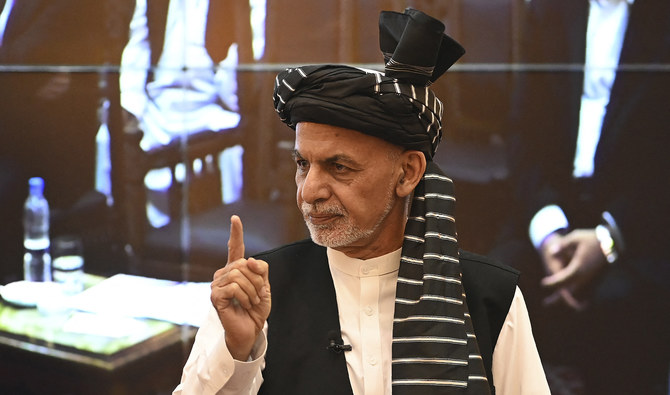
KABUL: Afghanistan’s President Ashraf Ghani fled the country on Sunday as the Taliban moved further into Kabul, officials said. His countrymen and foreigners alike raced for the exit, signaling the end of a 20-year Western experiment aimed at remaking Afghanistan.
Ghani flew out of the country, two officials told the Associated Press, speaking on condition of anonymity as they weren’t authorized to brief journalists. Abdullah Abdullah, the head of the Afghan National Reconciliation Council, later confirmed in an online video Ghani had left.
“He left Afghanistan in a hard time, God hold him accountable,” Abdullah said.
Civilians fearing that the Taliban could reimpose the kind of brutal rule that all but eliminated women’s rights rushed to leave the country, lining up at cash machines to withdraw their life savings.
Helicopters buzzed overhead to evacuate personnel from the US Embassy, while smoke rose near the compound as staff destroyed important documents. Several other Western missions also prepared to pull their people out.
In a stunning rout, the Taliban seized nearly all of Afghanistan in just over a week, despite the billions of dollars spent by the US and NATO over nearly two decades to build up Afghan security forces. Just days earlier, an American military assessment estimated it would be a month before the capital would come under insurgent pressure.
Instead, the Taliban swiftly defeated, co-opted or sent Afghan security forces fleeing from wide swaths of the country, even though they had some air support from the US military.


![]()

Afghan president leaves the country as Taliban move on Kabul
Short Url
https://arab.news/gdpd7
Afghan president leaves the country as Taliban move on Kabul
- Taliban seized nearly all of Afghanistan in just over a week and entered Kabul on Sunday
- Several Western embassies, including the US, started pull their people out of Afghanistan
Latest updates




© 2026 SAUDI RESEARCH & PUBLISHING COMPANY, All Rights Reserved And subject to Terms of Use Agreement.