



TEHRAN/JEDDAH: Iran will impose a six-day national lockdown from Monday amid a soaring death toll from a fifth wave of the COVID-19 pandemic.
The national coronavirus taskforce ordered all markets, public offices, banks, cinemas, gyms, restaurants and nonessential businesses in every city to be closed until next Saturday, and banned travel between all cities from Sunday to Friday.
Iran has suffered the worst COVID-19 outbreak in the Middle East, driven recently by the highly infectious delta variant of the coronavirus. On Saturday, it reported 466 deaths and 29,700 new cases of coronavirus patients in a single day. That brought the total pandemic death toll to 97,208, and total confirmed cases to 4,389,085.
Last week, Iran hit a record in both its single-day death toll and confirmed new cases of COVID-19, with 42,541 new coronavirus cases and a daily death toll of 588. Health authorities acknowledge that the official figures underestimate the country’s real toll.
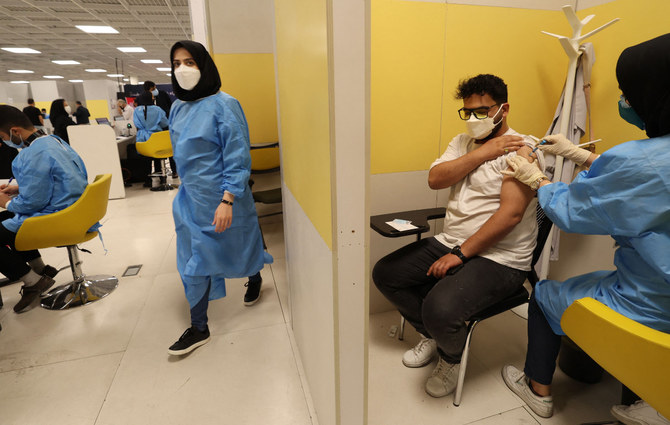
Authorities have tried to speed up the country’s inoculation campaign amid criticism that it began too late, and as Iran’s exhausted healthcare system struggles to cope with rising case numbers. Only 3.8 million have received the necessary two vaccine doses, out of a population of 83 million.
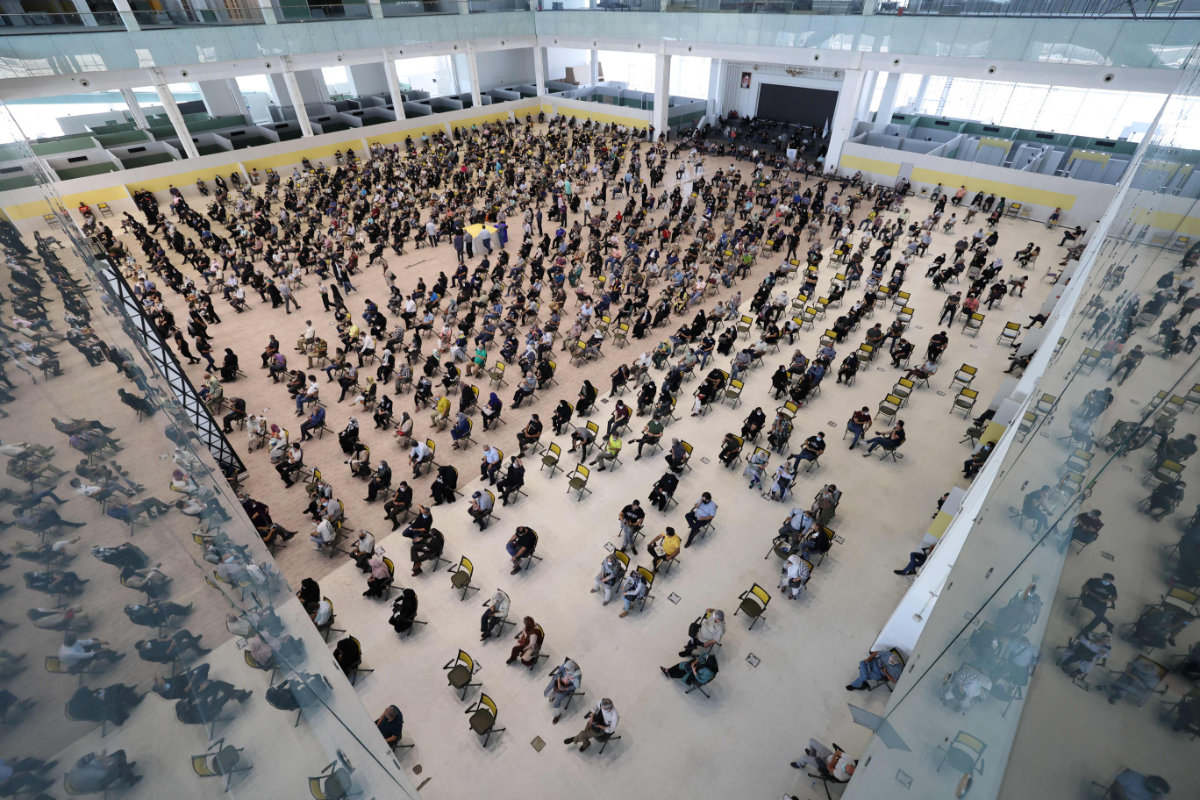
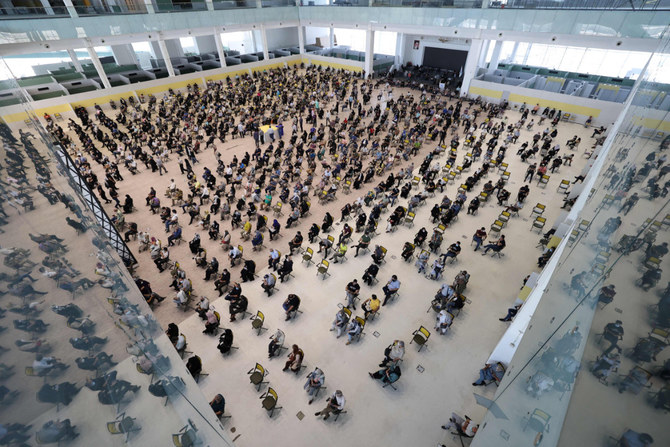
Iranians wait for their turn to be inoculated at a COVID-19 vaccination center set up inside the Iran Mall in Tehran on August 14, 2021. (Photo by Atta Kenare / AFP)
Several thousand people lined up on Saturday at a vaccination center at the Iran Mall in Tehran, where Health Ministry representative Bahare Karimi said health workers were “very tired now.”
She said the center was administering the Chinese-made Sinopharm vaccine, but the type of jab might differ from day to day. As well as Sinopharm, Iran is also using Russia’s Sputnik V, India’s Bharat Biotech and the AstraZeneca/Oxford vaccines.
Authorities have approved the emergency use of two locally made vaccines, but the only mass-produced one, COVIran Barekat, is in short supply.
Pharmacy worker Hamed Rahmati complained as he waited in line for his jab. “They didn’t import vaccines when they were supposed to and now it’s too late,” he said.
President Ebrahim Raisi said that Iran needed an additional 60 million vaccine doses to “control the unfavorable coronavirus situation.” Raisi told a COVID-19 taskforce meeting on Saturday that 30 million doses would be imported and made available “in a short time,” but he did not explain where they were coming from.
Choked by US sanctions that have made it difficult to transfer money abroad, Iran has said that it has struggled to import vaccines.
In January, Supreme Leader Ayatollah Ali Khamenei banned the use of vaccines made by the US and Britain, which he described as “completely untrustworthy” — despite the fact that vaccine campaigns in both countries have dramatically reduced the spread of COVID-19.
(With AFP)


