



DUBAI: Customer experience (CX) platform Emplifi has released its “State of Social Media and CX” report highlighting key social media metrics.
The time spent on digital platforms increased significantly during the pandemic, resulting in advertisers increasing their digital — especially social media — investments.
“The ongoing increase in social media ad spend is proving to be more than just a pandemic-related ‘bounce-back’ scenario,” said Zarnaz Arlia, chief marketing officer at Emplifi.
“What we’re seeing is that an engaging and responsive social media presence is no longer just a ‘nice-to-have’ for consumer-facing brands, it’s a key point of differentiation,” she said.
Overview of the Middle East's social media landscape. (Supplied)
During the second quarter, most of the relative ad spend by brands went to Facebook feeds (53.4 percent), followed by Instagram feeds (17.7 percent), and Instagram Stories (11 percent), in the Middle East.
“As more and more consumers begin to expect a brand’s social media channels to facilitate outstanding customer experiences across many stages of the customer journey, the importance of engagement and interaction data is taking on a greater significance,” Arlia said.
The report found that when it comes to organic content, live videos on Facebook and carousel posts on Instagram are the best performers. Live Video performs the best with 52 median post interactions, which is 44 more than the second-highest post type, Photo; while Carousels perform the best with 70 median post interactions, which is 20 more than the second-highest post type, Image.
Despite Live Videos earning the highest number of organic post interactions and delivering three times the engagement rates of standard videos, they account for less than 1 percent of branded posts.
Arlia stressed the importance of a “strong and engaging social media presence” for brands, especially in the Middle East, which is home to a young and tech-savvy population that uses social media “for everything from shopping to socializing.”
Among brands in the Middle East, the top-performing Facebook page belongs to Qatar Airways, with 3,197,457 interactions on 157 posts, while on Instagram, Filimo took the top spot with 5,218,243 interactions on 395 posts.
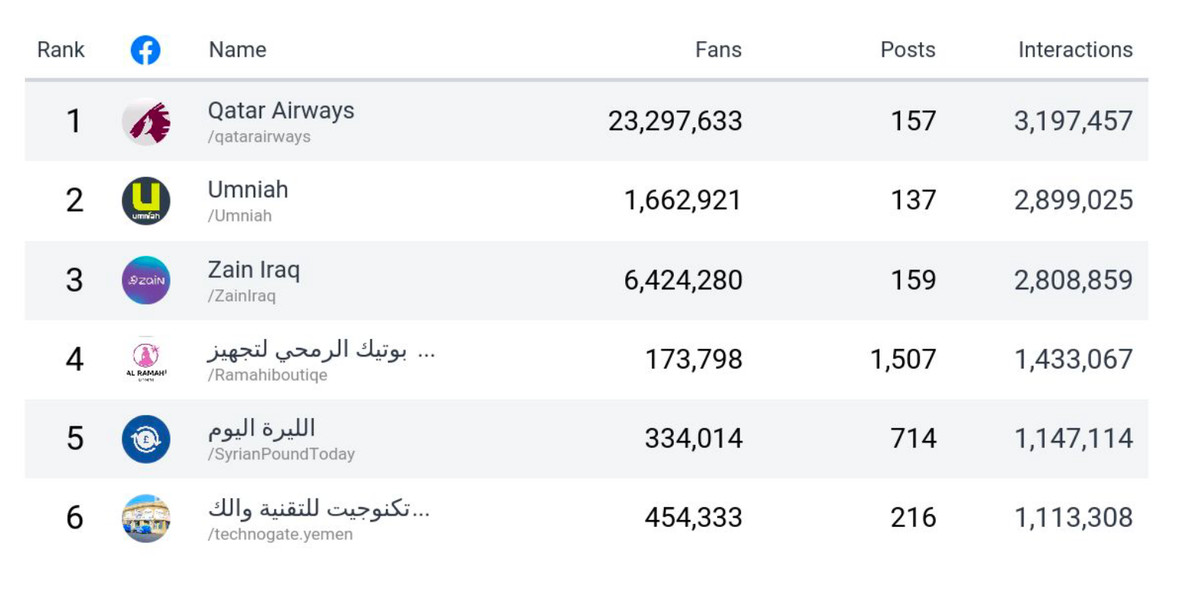
Top-performing pages on Facebook. (Supplied)
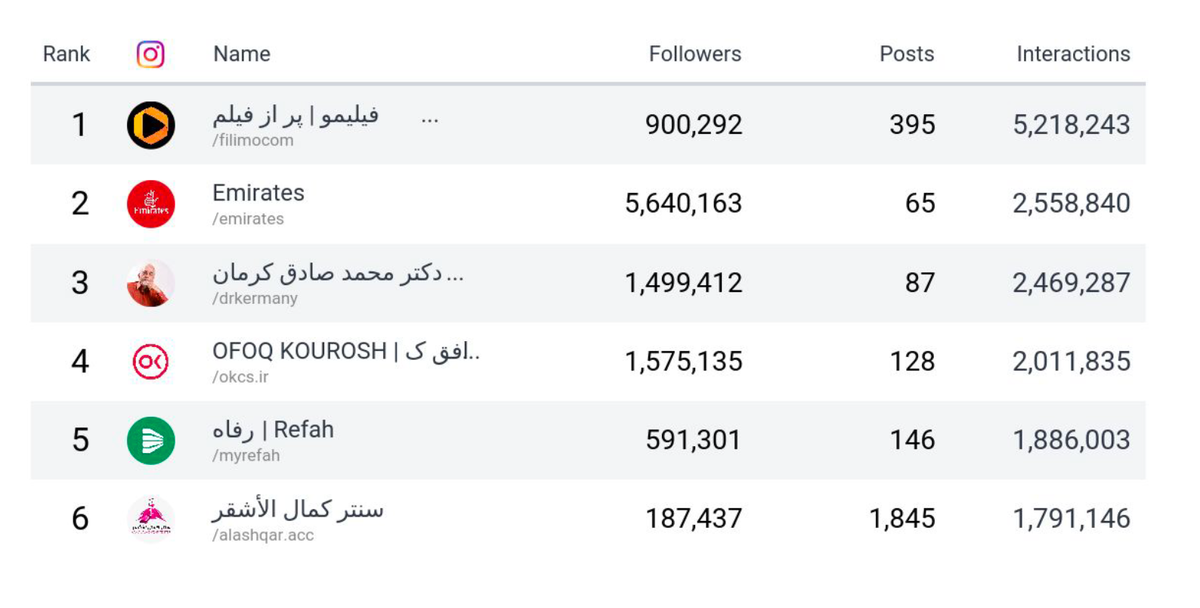
Top-performing profiles on Instagram. (Supplied)
Although the median number of followers for brands’ Instagram accounts is lower than the number of fans for Facebook accounts, activity volume and user engagement are both higher on Instagram than on Facebook.
Overall, the report suggests that globally the gap between engagement on Instagram profiles (“likes” and “comments” on posts published by brands on their profiles) and Facebook profiles is continuing to widen.
In Q2 2020, interactions generated by Instagram profiles were 4.4 times higher than on Facebook profiles. This gap has only increased in Q2 2021 — to 6.35 times higher. The data indicates a similar trend in the Middle East over the past year, with Instagram profiles leading with 5.4 times higher engagement compared to Facebook profiles, despite having a smaller audience overall.
“As the growth of social commerce continues to rise, brands that leverage the opportunities social media presents to offer their customers interactive experience are more likely to win the hearts and minds of consumers and see a stronger impact on their business in the long term,” Arlia said.


