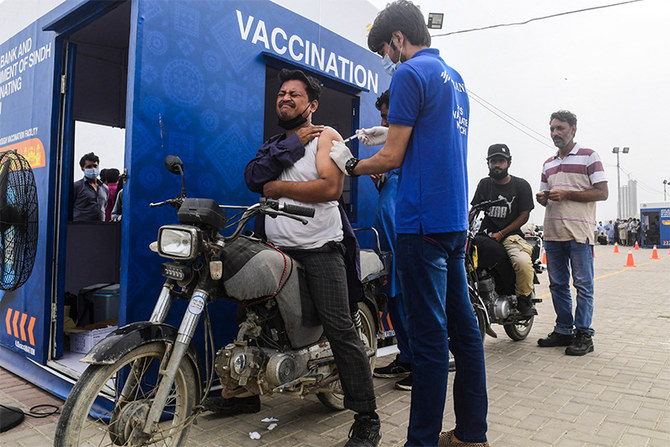
KARACHI: Traders in Pakistan’s financial capital of Karachi have launched a special COVID-19 vaccination campaign for merchants and employees in the city in collaboration with the provincial government of Sindh with the aim of avoiding strict market lockdowns in the future, a prominent member of the business community said on Wednesday, saying a lockdown imposed last month led to about Rs50 billion in business losses.
In July, the government of the southern Sindh province announced a complete lockdown until August 8 as doctors reported an alarming spread of the Delta variant of the coronavirus in the provincial capital. Traders and employers’ associations said the curbs would put at risk the livelihoods of at least four million daily wage laborers in the port city.
The provincial government lifted the 10-day lockdown this week, though coronavirus infections have not subsided. Sindh province reported 2,174 new coronavirus infections on Wednesday, with 57 percent of them in Karachi.
“We consider vaccination of traders and their employees as the only way to counter the possibility of future lockdowns of the city’s markets which have suffered great economic setbacks due to these virus restrictions,” said Atiq Mir, chairman of Karachi Tajir Ittehad and the Atiq Mir Foundation that has launched the vaccination drive for traders.
The initiative aims to immunize 50,000 traders, employees and daily workers in the first phase of the campaign, Mir said, beginning by targeting people working at the Arambagh Furniture Market and turning that exercise into a model for other markets to follow.
“We are also targeting residents of these market areas,” he said.
Mir said a majority of 600 big and small markets would be covered under the vaccination drive, saying other market associations were also inspired by the initiative and gearing up to launch similar projects.
“With hundred percent vaccinated traders, we will be in a position to present a strong case against market lockdowns and restrictions to the government,” he added.
Last year, after the coronavirus struck in Pakistan in February, the government imposed strict lockdowns but began lifting them by May over fears for the economy. The government of Prime Minister Imran Khan has always opposed imposing a complete nationwide lockdown due to its economic side effects and has preferred smart, localized lockdowns in disease hotspots with a focus on implementation of social distancing rules and other health guidelines.
A countrywide lockdown last year reduced the active working population of Pakistan from 55.74 million to 35.04 million, or 22 percent. The most affected province was Sindh where the working population reduced to 23 percent, according to the Pakistan Bureau of Statistics.
Traders say the last lockdown too has inflicted billions of rupees in losses.
“Traders have suffered financial losses of about Rs50 billion during the most recent lockdown imposed by the Sindh government,” Mir said. “The aim of our vaccination drive is to avoid further losses because the virus is continuing to infect people.”
The administrator of Karachi city, Murtaza Wahab Siddiqui, agreed with Mir, saying vaccination was the only way to live a life free of curbs.
“I think we need to convince the people that if they want to protect themselves from this virus, if they want to continue to live a free life without restrictions, then they will have to get themselves vaccinated,” Siddiqui told Arab News, saying the Sindh administration’s decision to impose the lockdown was made to avoid a “health calamity” in the city.
“Unfortunately, we had to take such a tough decision to prevent a health calamity in the city and in the rest of the province,” he said.


![]()

Karachi traders launch COVID-19 vaccination drive after last market lockdown causes Rs50 billion loss
Short Url
https://arab.news/66gct
Karachi traders launch COVID-19 vaccination drive after last market lockdown causes Rs50 billion loss
- Vaccination campaign aims to cover all merchants and employees in about 600 markets in Pakistan’s commercial capital
- Karachi Administrator says provincial administration imposed recent 10-day lockdown to prevent ‘health calamity’ in the city
Latest updates




© 2026 SAUDI RESEARCH & PUBLISHING COMPANY, All Rights Reserved And subject to Terms of Use Agreement.