

Iran’s Khamenei says halting Covid ‘urgent’ priority

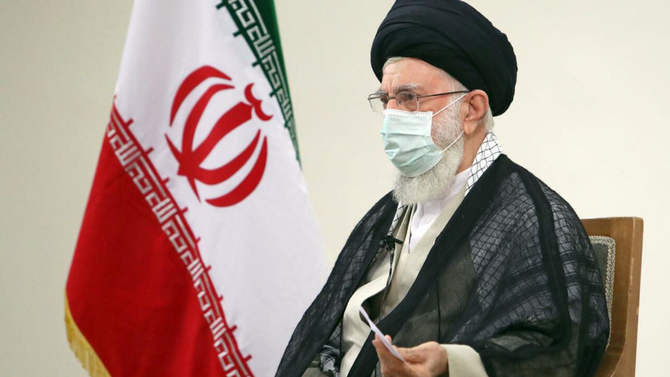
Iran’s supreme leader Ayatollah Ali Khamenei delivering a televised speech on the coronavirus situation in the capital Tehran, on August 11, 2021. (File/AFP)
Short Url
Updated 11 August 2021
Follow

Iran’s Khamenei says halting Covid ‘urgent’ priority

  • Iran is the Middle East country worst hit by the pandemic
  • It has recorded more than 95,600 deaths and over 4.2 million infections

TEHRAN: Iran’s supreme leader Ayatollah Ali Khamenei said on Wednesday that halting Covid-19 is an “urgent” priority and called for more vaccine imports and production, after record deaths and infections.

The Islamic republic’s Covid cases and fatalities have surged in recent weeks, in what officials have said is a “fifth wave” caused by the highly infectious Delta variant.

“Today, the issue of the coronavirus disease is the country’s primary and urgent issue,” Khamenei said in a televised address focused on the health crisis.

Khamenei said the record number of casualties was “truly painful,” and demanded greater efforts to boost vaccine “imports and domestic production.”

Iran is the Middle East country worst hit by the pandemic.

It has recorded more than 95,600 deaths and over 4.2 million infections, with health authorities acknowledging the official casualty numbers underestimate the real toll.

In the past 24 hours, 42,541 people tested positive for the coronavirus — the country’s highest daily caseload since the start of the pandemic.

Iran has pinned its hopes on vaccinations, but the campaign launched in February has progressed slower than anticipated.

Choked by US sanctions that have made it difficult to transfer money abroad, Iran has said it is struggling to import vaccines for its 83 million-strong population.

The authorities have approved the emergency use of two locally produced vaccines, with the only mass-produced one, COVIran Barekat, still in short supply.

The other vaccines used in Iran include Russia’s Sputnik V, China’s Sinopharm, India’s Bharat and AstraZeneca/Oxford, according to the health ministry.

More than 13.8 million people have been given a first vaccine dose, but only 3.7 million have received the necessary two jabs, the ministry said Wednesday.

Khamenei on July 24 received the second Barekat jab, developed by a powerful state-owned foundation known as Setad, his office said.

In January, the supreme leader had banned the use of vaccines made by the United States and Britain, calling them “completely untrustworthy.”

“Part of the problem is lack of observance of health protocols by the people,” Khamenei said on Wednesday, calling on the public to alleviate the “truly great concern” of overburdened health centers by being more careful.

He also pointed to the religious events held during the Islamic mourning month of Muharram as a “blessing” and a necessity for the Islamic republic but urged health protocols to be observed “with the utmost care.”

“Do not let these events be a cause of the virus’ spread so that ... the enemies ridicule them and say (the events) caused the spread,” Khamenei added.

Iran has avoided imposing a full lockdown on the population, and instead resorted to piecemeal measures such as temporary travel bans and business closures.

The national Covid taskforce said it was considering imposing new restrictions as of Saturday, state media reported, following a meeting chaired by President Ebrahim Raisi on Tuesday.


Inaction over UAE’s role is prolonging ‘worst proxy war in the world,’ Sudan justice minister says

Updated 9 sec ago
Follow

Inaction over UAE’s role is prolonging ‘worst proxy war in the world,’ Sudan justice minister says

  • Had international community characterized it as ‘military rebellion’ and countered Emirati sponsorship of ‘terrorist militia’ it would not have endured, he tells UN Human Rights Council
  • He accuses paramilitary Rapid Support forces of ‘targeting basic infrastructure, strategic facilities and public services,’ and ‘atrocities beyond our capacity to describe’

NEW YORK CITY: Sudan’s justice minister on Wednesday blamed the prolongation of the near-three-year conflict in his country on what he described as the failure of the international community to properly label the war as a rebellion.

He also accused the UAE of sponsoring and arming a militia, the Rapid Support Forces, he said was responsible for widespread abuses.

“The war has outstayed its welcome and it should not have gone on for this long had the international community, and particularly the UN and its bodies, fulfilled their responsibility in rightly characterizing this military rebellion,” said Abdullah Mohammed Dirif, “and had they called a spade a spade and countered the Abu Dhabi government, which sponsored this terrorist militia and provided it with high-tech arms and provided it with mercenaries.”

Speaking during the high-level segment of the 61st session of the UN Human Rights Council in Geneva, he warned that “the misleading characterization of this war has given a green light for the militia to keep its flagrant violations.”

The minister, who said he was speaking “on behalf of the government of Sudan and its people,” described the conflict between the Sudanese Armed Forces and the RSF, which began in April 2023, as “one of the worst proxy wars in the world,” which had “targeted the very existence of Sudan and its people.”

The RSF has “continued its methodic targeting of basic infrastructure and strategic facilities and all public services,” Dirif said, adding that “the aim is to displace civilians against whom it has committed atrocities beyond our capacity to describe them.

“The violations and crimes of the militia are going unabated. Yesterday it invaded Moustahiliya region in northern Darfur. It targeted civilians, killed them. It looted. It scorched villages and cities.”

Sudan’s military was “conducting its constitutional responsibility by standing up to the militia, protecting the civilians, preserving the unity of the country and the rule of law,” he said, and it remains “committed to international humanitarian law and the rules governing military engagement, and taking into account proportionality principles in order to protect civilians.”

Khartoum remains “open to genuine efforts which aim to end the war and the rebellion” based on a road map presented by the president of the Transitional Sovereignty Council, and a peace initiative submitted by the prime minister to the UN Security Council on Dec. 22, he added.

Dirif stressed his government’s commitment to continued “cooperation and coordination with human rights mechanisms in Sudan,” including the presence of the UN’s Office of the High Commissioner for Human Rights in the country and the UN special rapporteur on the human rights situation in Sudan.

“We recall, nationally, that achieving justice and redress to victims and ensuring impunity is a top priority for us,” he said, adding that authorities had made progress by investigating violations of national laws and international humanitarian laws.

He also underscored Sudan’s “commitment to continue facilitating and expediting delivery of humanitarian assistance to those affected by the war, including those under the control of the rebellious militia.”

Later, Sudan’s representative to the UN in Geneva exercised his right of reply and responded to prior remarks by the representative from the UAE.

“This is not a mere accusation, it is a well-known fact that is predicated on a number of evidence and documented proofs,” he said, referring to the UAE’s sponsorship of the RSF.

He cited in particular a report by a UN panel of experts on Sudan published on Jan. 15, 2024, which he described as “an official document of the Security Council” that referred to “lines of transferring weapons from Abu Dhabi International Airport” based on “clear-cut evidence.”

Other major international organizations and Sudan’s national commission of inquiry have provided further proof, he added, and Khartoum had submitted “a number of complaints, with proof, to the Security Council of the proven sabotage by the Abu Dhabi authority.”

The Sudanese representative continued: “It is paradoxical that the same authority that is sponsoring criminal militia, that the whole world is seeing and is attesting to its crimes, is now talking about peace in the Sudan. Peace is a noble value, that you have to be full of peace before you talk about it.

“The people of Sudan are only requesting this country stop sponsoring this criminal militia that is killing the innocent people in my country on a daily basis.”

The UAE has denied accusations that it provides military support to armed groups in Sudan, and says it supports efforts to achieve a peaceful resolution to the conflict.