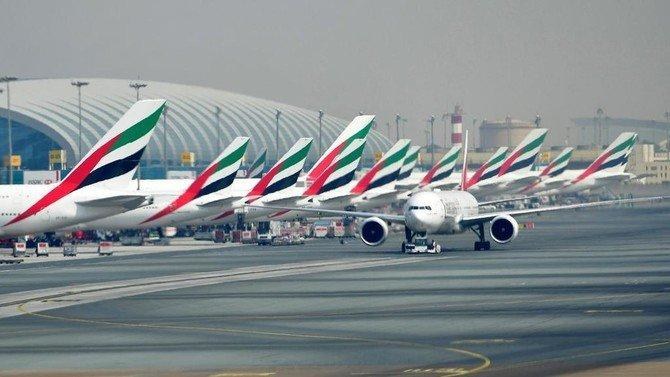
Dubai airport targets 56 million passengers next year, CEO says

10.6 million passengers passed through Dubai International in the first half of this year, down 40.9% on the same period last year. (AFP)
Short Url
Updated 11 August 2021
Follow

Dubai airport targets 56 million passengers next year, CEO says

  • Airport handled 25.9 million passengers last year and 86.4 million in 2019
  • Airport expects to end 2021 close to its 28 million passenger target

DUBAI: Dubai’s state airport operator is forecasting 56 million passengers to pass through Dubai International next year, double its target for this year though still below pre-pandemic levels.
The airport, a major travel hub, has seen a rise in passenger traffic in recent weeks following the start of the peak summer travel season and an easing in travel restrictions for some core markets.
“This gives rise to a more optimistic forecast and we are looking at something like 56 million for the year to come,” Dubai Airports Chief Executive Paul Griffiths told Reuters.
The airport handled 25.9 million passengers last year and 86.4 million in 2019, the year before the pandemic struck.
The operator on Wednesday reported 10.6 million passengers passed through Dubai International in the first half of this year, down 40.9 percent on the same period last year.
Griffiths said passenger traffic in recent weeks had been “much more positive” and the airport was now expected to end the year close to its 28 million passenger target, at around 26-27 million.
He said the operator was being conservative with its forecast for this year given many countries still impose travel restrictions and that it was focused on managing costs, balancing its budget and remaining cash positive.
Dubai International is one of the world’s busiest airports and the hub for state-owned Gulf carrier Emirates. Its operations are reliant on international flights and it has no domestic market to cushion against international border closures or restrictions imposed to stop the spread of COVID-19.
The United Arab Emirates this month eased restrictions on travel from several African and Asian countries, including key market India, while Britain, another important market, has moved the Gulf Arab state from its travel “red list” to “amber.”
“There has been an absolute surge of bookings and huge numbers of people booking to go both directions to London, for example, and I think the UAE easing restrictions to places like India are steps in the right direction,” Griffiths said.


Saudi Cabinet approves regulatory frameworks for 4 SEZs 

Updated 6 sec ago
Follow

Saudi Cabinet approves regulatory frameworks for 4 SEZs 

RIYADH: Saudi Arabia has formalized the regulatory frameworks for four Special Economic Zones located in Jazan, Cloud Computing Zone, King Abdullah Economic City, and Ras Al-Khair.   

These zones are designed to stimulate investment by offering tailored incentives and governance, enhancing the Kingdom’s competitive edge in sectors such as advanced manufacturing, maritime logistics, cloud technology, and energy-related industries, the Saudi Press Agency reported.  

The SEZ initiative is part of Saudi Arabia’s broader economic transformation plan under Vision 2030, which aims to diversify the economy beyond oil revenues and develop new engines of growth through foreign direct investment and infrastructure development.  

Saudi Minister of Investment Khalid Al-Falih expressed his appreciation for the Cabinet’s approval of the SEZ regulations, stating in a tweet: “I extend my sincere thanks and gratitude to the leadership, may God support it, for its continued support of efforts to enhance the business environment, attract investments, and diversify and raise the competitiveness of the national economy, through the essential step embodied in the Cabinet’s approval of the regulatory frameworks for the Special Economic Zones.”  

The session, presided over by King Salman bin Abdulaziz Al Saud, included the approval of a wide range of cooperation agreements and memoranda of understanding.   

These included an MoU on energy cooperation with Pakistan, healthcare collaboration with Iraq, and a digital communication pact with Palestine.   

Additional approvals involved cooperation with the Hungarian judiciary, as well as agreements with UNESCO and the World Economic Forum.  

Notably, the Cabinet approved the establishment of a commercial and economic office for the Hong Kong Special Administrative Region in Riyadh, underlining growing bilateral trade and investment ties between Saudi Arabia and Asian financial hubs.  

On infrastructure, the Council noted the launch of phase three of the major road development program in Riyadh, which aims to enhance connectivity and transform the city into a regional center for sustainable transport and logistics services.  

Other approvals included Saudi Arabia’s accession to the Beijing 2010 Convention on the suppression of unlawful acts relating to international civil aviation, and revisions to the governance of the General Authority for Defense Development.  

The Cabinet also endorsed the closure of the national and regional tourism development councils and approved the final accounts of several government agencies.  

It directed further review on annual performance reports submitted by regulatory bodies and strategic institutes, including those focusing on food security, export development, and communications.  

Several high-level appointments and promotions in the foreign ministry and other government bodies were confirmed during the session, reflecting the Kingdom’s ongoing administrative reforms and leadership renewal across key sectors.