

PM Khan says Pakistan can be major tourist destination for Muslims

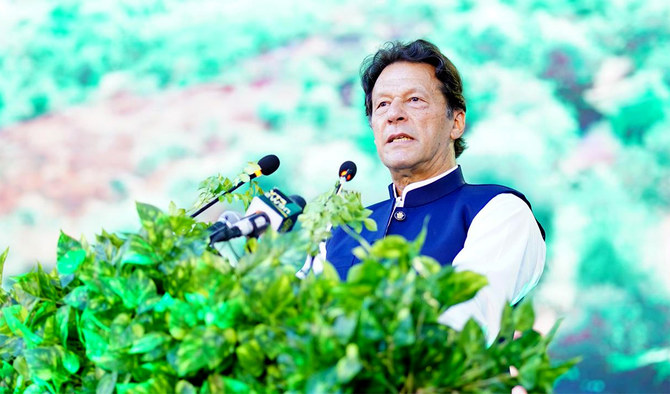
Pakistan's Prime Minister addressing a ceremony on World Environment Day in Islamabad, Pakistan, on June 5, 2021. (Photo courtesy: PID/File)
Short Url
Updated 11 August 2021
Follow

PM Khan says Pakistan can be major tourist destination for Muslims

  • The prime minister inaugurated the tree plantation drive in Balochistan’s Lasbela district and inspected mangrove forests
  • He was also reviewed projects initiated by the federal government under the Karachi transformation plan

KARACHI: Prime Minister Imran Khan said on Tuesday the coastal areas of Balochistan could become a major attraction for tourists from Muslim countries who were reluctant to take their families to Europe and several other global destinations.
Khan arrived in Karachi on a daylong visit to inaugurate the ship lift and transfer system and review the projects initiated by the federal government under the Karachi transformation plan.
Later, he went to Lasbela in Balochistan to inaugurate a tree plantation drive and inspect mangrove forests.
The prime minister said every area in the country had different characteristics, adding that the country should focus on those tourist spots which could attract Muslim population from across the world since western countries were not their preferred destination.
“They don’t want to take their wives and children there,” he said. “So, a place like Pakistan has a great potential to attract people from Muslim countries for tourism.”
Khan added his government had planned to develop beach tourism for which scientific suggestions would be sought from quality consultants.
He recalled how the country’s mountainous regions were developed by the British during the colonial rule, adding that these places had gradually degraded due to heavy construction.
“For the first time, the government is developing new resorts in hill stations while exploring other scenic spots to attract maximum tourists,” he added.
Khan observed that Pakistan’s coastline had largely remained unexplored.
“Balochistan has lagged behind in terms of progress and development since the former federal administrations did not take interest in the province,” he said, adding it was the first time in history a federal government was spending a huge amount of Rs1 trillion ($6 billion) for the development of the region.
Earlier, the prime minister was briefed on the projects launched by his administration in Karachi and was told that Greenline BRTS, the first modern transportation system in Karachi, would become operational in October.
Pakistan’s planning minister Asad Umar listed a number of projects in his Twitter post that the government was hoping to accomplish during the current fiscal year.

Khan also inaugurated the ship lift and transfer system at the Karachi shipyard that, he said, would help improve the efficiency of the shipping sector.
“The government is trying to promote exports, encourage overseas Pakistanis to increase remittances and attract foreign investment,” he continued.
The prime minister said nations became strong when they become self-sufficient and trust their potential to flourish.


Pakistan destroyed seven TTP camps in Afghanistan strikes, 80 militants killed — official

Updated 5 sec ago
Follow

Pakistan destroyed seven TTP camps in Afghanistan strikes, 80 militants killed — official

  • Saturday’s airstrikes followed a series of attacks inside Pakistan amid a surge in militancy
  • The Afghan Taliban authorities accuse Pakistani forces of killing civilians in the airstrikes

ISLAMABAD: Pakistan’s airstrikes in Afghanistan destroyed seven Tehreek-e-Taliban Pakistan (TTP) camps and killed over 80 militants, a Pakistani security official said on Sunday, with the Afghan Taliban accusing Pakistani forces of killing civilians in the assault.

Saturday’s airstrikes followed a series of attacks inside Pakistan amid a surge in militancy. Authorities say the attacks, particularly in Khyber Pakhtunkhwa province and the Pakistani capital of Islamabad, were carried out by the TTP and allied groups that Islamabad alleges are operating from sanctuaries in Afghanistan. Kabul denies this.

According to Pakistan’s information ministry, recent incidents included a suicide bombing at a Shiite mosque in Islamabad, separate attacks in Bajaur and Bannu, and another recent incident in Bannu during the holy month of Ramadan, which started earlier this week. The government said it had “conclusive evidence” linking the attacks to militants directed by leadership based in Afghanistan.

“Last night, Pakistan’s intelligence-based air strikes destroyed seven centers of Fitna Al-Khawarij TTP in three provinces of Nangarhar, Paktika and Khost, in which more than eighty Khawarij (TTP militants) have been confirmed killed, while more are expected,” a Pakistani security official, who spoke on condition of anonymity, told Arab News.

An earlier statement from Pakistan’s information ministry said the targets included a camp of a Daesh regional affiliate, the Islamic State Khorasan Province (ISKP), which claimed a suicide bombing at an Islamabad Shiite mosque that killed 32 people this month.

In an X post, Afghan government spokesperson Zabihullah Mujahid said Pakistani forces had violated Afghan territory.

“Pakistani special military circles have once again trespassed into Afghan territory,” Mujahid said. “Last night, they bombed our civilian compatriots in Nangarhar and Paktika provinces, martyring and wounding dozens of people, including women and children.”
 
The Afghan Taliban’s claims of civilian casualties could not be independently verified. Pakistan did not immediately comment on the allegation that civilians had been killed in the strikes.

In a post on X, Afghanistan’s foreign ministry said it had summoned Pakistan’s charge d’affaires to Afghanistan Ubaid-ur-Rehman Nizamani and lodged protest through a formal démarche in response to the Pakistani military strikes.

“IEA-MoFA (The Islamic Emirate of Afghanistan’s Ministry of Foreign Affairs) vehemently condemns the violation of Afghanistan’s airspace and the targeting of civilians, describing it as a flagrant breach of Afghanistan’s territorial integrity & a provocative action,” it said in a statement.

“The Pakistani side was also categorically informed that safeguarding Afghanistan’s territorial integrity is the religious responsibility of the Islamic Emirate of Afghanistan; henceforth, the responsibility for any adverse consequences of such actions will rest with the opposing side.”

Tensions between Islamabad and Kabul have escalated since the Afghan Taliban returned to power in 2021. Pakistan says cross-border militant attacks have increased since then and has accused the Taliban of failing to honor commitments under the 2020 Doha Agreement to prevent Afghan soil from being used for attacks against other countries. The Taliban deny allowing such activity and have previously rejected similar accusations.

Saturday’s exchange of accusations marks one of the most direct confrontations between the two neighbors in recent months and risks further straining already fragile ties along the volatile border.