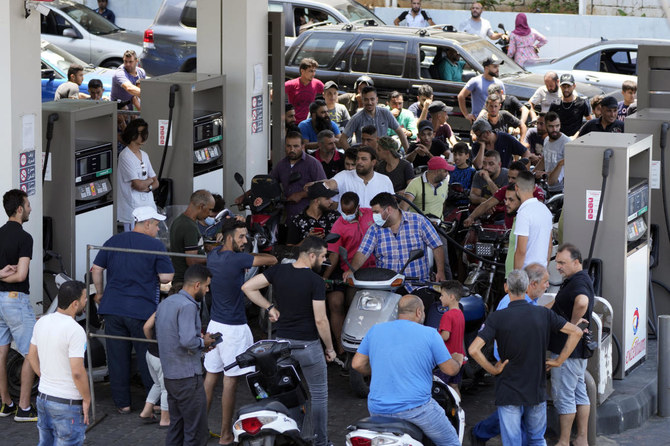
BEIRUT: Two separate brawls over scarce fuel in northern Lebanon have left three people dead, state media and security sources said, as shortages spark a wave of confrontations at gas stations.
Lebanon, grappling with an economic crisis branded by the World Bank as one of the planet’s worst since the mid-19th century, has been gripped by a fuel crisis since the start of summer.
Nearly 80 percent of the country’s population now live in poverty, the UN Office for the Coordination of Humanitarian Affairs (OCHA) said last week — a proportion far higher than last year’s figure of 50 percent or so.
Fuel importers, who blame the fuel crisis on a delay by the dollar-starved central bank in opening credit lines to fund imports, have severely rationed supply, even after the government agreed to raised petrol and diesel prices by more than a third in June.
This has generated hours-long queues at pumping stations, where shouting matches, fist fights and even live fire have often required security forces to intervene.
On Monday, a man was shot at a gas station in the northern Lebanon village of Bakhoun, following a fight that broke out when a motorist tried to cut a long queue, a security source told AFP.
The man later died of his wounds in hospital.
The killer handed himself over to the army, the official National News Agency reported.
A separate fight “related to the sale and purchase of fuel” in the northern city of Tripoli on Friday left another two people dead, NNA said.
A security source told AFP that the killing came days after an initial fight broke out between motorists at a gas station over fuel purchases.
In retaliation, two young men involved in that fight were targeted by live fire and a hand grenade early Friday morning, killing them.
Their families held funerals in Tripoli on Friday.
Shortages have given rise to a vibrant black market, where fuel is sometimes sold at double the price set by the state.
Lebanese officials blame the fuel crisis on smuggling to Syria and stockpiling by distributors seeking to sell at higher prices.
Beside a raft of shortages, Lebanon is also grappling with soaring poverty and a spiralling devaluation of the Lebanese pound, which has lost more than 90 percent of its black market value.


Brawls in Lebanon’s north over rationed fuel leave 3 dead
https://arab.news/44pcu
Brawls in Lebanon’s north over rationed fuel leave 3 dead

- Lebanon has been gripped by a fuel crisis since the start of summer
- A man was shot at a station in Bakhoun Monday following a fight that broke out when a motorist tried to cut a long queue, he later died


Syria announces new currency framework, 2-zero redenomination
- Under the plan, every 100 Syrian pounds will be converted into one unit of the new Syrian Arab Republic’s pound
- Governor calls move ‘pivotal milestone within a comprehensive strategy’
DAMASCUS: Syria’s Central Bank announced executive instructions on Sunday to introduce a new Syrian currency, launching a monetary reform that includes removing two zeros from the pound and allowing a 90-day period of dual circulation.
The announcement was made during a press conference at the bank’s headquarters in Damascus.
Central Bank Gov. Abdulkader Husrieh said the step was part of a comprehensive institutional strategy to restore confidence and achieve sustainable economic stability.
He said: “The launch of the new currency is not a formal measure, but a pivotal milestone within a comprehensive strategy based on solid institutional foundations.”
Under the plan, every 100 Syrian pounds will be converted into one unit of the new Syrian Arab Republic’s pound. The old and new currencies will circulate together for 90 days, a period which may be extended.
All bank balances will be converted to the new currency at the beginning of next year, while the overall money supply will be maintained without increase or reduction.

Husrieh said the economic strategy was based on five pillars: monetary stability, a stable and transparent foreign-exchange market, effective and accountable financial institutions, secure digital transformation, and balanced international economic relations.
He said the move required updating financial laws and regulations, improving data systems, keeping pace with global digital developments, and ensuring sustainable financing and training for the financial sector.
The currency exchange will be provided free of charge, with no commissions, fees, or taxes.
All public and private entities must apply the official conversion standard to prices, salaries, wages, and financial obligations. Official exchange-rate bulletins will be issued in both currencies to ensure transparency and prevent speculation.
The governor said the central bank was closely monitoring markets to stabilize the exchange rate and would supply Syrian pounds if demand for foreign currency rises, adding that citizens will feel the impact more clearly after the exchange process is completed.
“Our policy is financial discipline, with no room for inflation,” Husrieh added.
He confirmed that the decree regulating the exchange limits the process to Syrian territory, and said the measures fell within the bank’s 2026-2030 strategy to align with international standards.
The new banknotes, he added, were being printed by leading international companies to prevent counterfeiting.


