

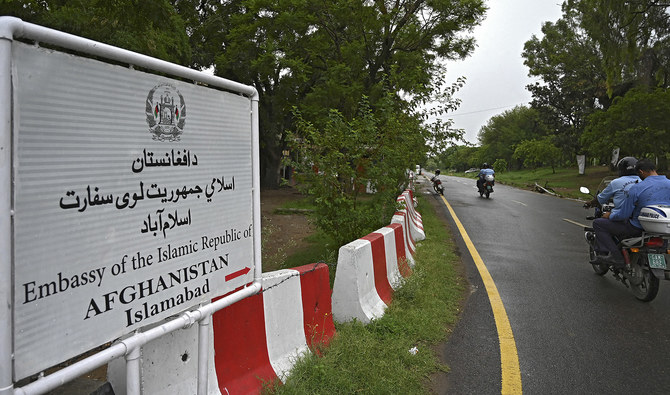

ISLAMABAD: Pakistan's law enforcement officials have informed an Afghan delegation probing the alleged kidnapping of the Afghan envoy’s daughter that the complainant's claims were not supported by evidence, the Foreign Office said on Sunday night.
It follows a complaint lodged by Silsila Alikhil, the 26-year-old daughter of Afghanistan’s ambassador to Pakistan, Najibullah Alikhil, who said she was abducted in the capital, Islamabad, on July 16 and held for several hours before being released.
"A comprehensive witness account led to the conclusion that the findings on the ground did not corroborate the report by the complainant," the Foreign Office said in a statement.
It added that Pakistani officials had "carried out a detailed and thorough investigation of the complaint."
"The Afghan delegation was given a comprehensive briefing on all aspects of investigation conducted by the relevant Pakistani authorities in the reported incident," it added.
Investigators were also taken to the Safe City Office in Islamabad, where "they were shown video footage from various locations of different timings in which the complainant was clearly identifiable moving around the places independently."
“An on-site visit of all the locations visited by the complainant was arranged for the delegation, followed by a presentation of technical data (findings of mobile forensic/geo-fencing) as well,” the statement said.
The four-member team of Afghan investigators, who arrived in Islamabad on August 1 to probe the incident, concluded their visit on Sunday.
Najibullah had lodged a formal complaint about the kidnapping, following which Pakistan’s foreign ministry said security had been tightened for the ambassador and his family.
The incident led to Afghan President Ashraf Ghani recalling Najibullah and other senior diplomats to Kabul “until all the security threats are removed,” according to a statement by the Afghan foreign ministry.
Pakistan termed the decision as "unfortunate and regrettable" and urged Kabul to reconsider the move, with its Foreign Office saying that the case was being investigated "at the highest level" on the instructions of Prime Minister Imran Khan.
"The decision by the Government of Afghanistan to recall its Ambassador and senior diplomats from Pakistan is unfortunate and regrettable," the Foreign Office said, adding that it hoped for the Embassy of Afghanistan in Islamabad to resume operations soon.
"At this critical juncture in the Afghan peace process, it is extremely important to work jointly for the shared objective of a peaceful, stable and prosperous Afghanistan," the statement said.
Pakistan also informed the Afghan delegation on measures being taken to enhance security for Afghanistan's embassy and its consulates, adding that it attaches "high importance to its relations with Afghanistan."


