

OIC human rights team visits Azad Kashmir after India denies entry into Srinagar

A Pakistani army soldier briefs the visiting delegation from the Organization of Islamic Cooperation (OIC) near Line of Control in Azad Kashmir, Pakistan, on August 7, 2021. (Photo courtesy: ISPR)
Short Url
Updated 08 August 2021
Follow

OIC human rights team visits Azad Kashmir after India denies entry into Srinagar

  • The 12-member delegation interacted with locals to assess ‘cease-fire violations’, ISPR says
  • Follows appeal by Azad Kashmir president urging OIC to establish 'humanitarian corridors' to Indian-administered territory

ISLAMABAD: A delegation from the Organization of Islamic Cooperation (OIC) visited the Line of Control in Azad Kashmir on Saturday to assess the human rights situation in Indian-administered Kashmir, the Pakistani military’s media wing said in a statement.

The 12-member delegation of the OIC’s Independent Permanent Human Rights Commission (IPHRC) were “given a comprehensive brief on the prevalent security environment along the LOC,” the Inter-Services Public Relations agency (ISPR) said.

It added that they were also apprised of the “elaborate arrangements made for protection of civilians from hostile fire in any eventuality through the construction of community bunkers.”
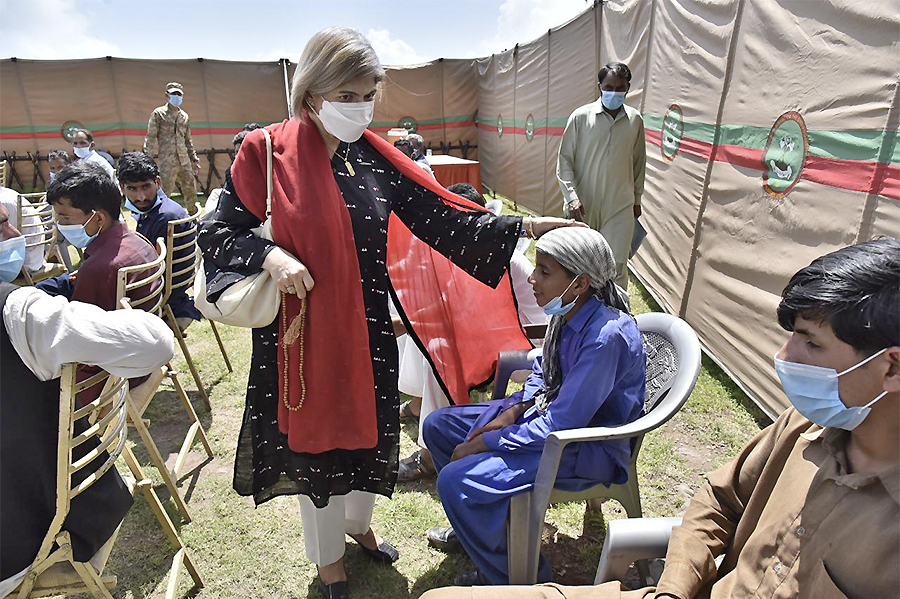


Organization of Islamic Cooperation representatives visit refugees from Indian-controlled Kashmir at a camp in Muzaffarabad, Pakistan's Azad Jammu and Kashmir on August 6, 2021. (Photo courtesy: AJK government)

Kashmir has been a flashpoint between Pakistan and India since the partition of the subcontinent in 1947, with both claiming the region in full but ruling it in part. The LoC is the de facto border that divides Kashmir between India and Pakistan that have fought two of their three wars over the region.

Tensions spiked in August 2019 after New Delhi abrogated Kashmir’s special autonomous status, dividing the region into federally administered territories.

The IPHRC has been urging India since September 2019 to allow its fact-finding mission to Kashmir, but New Delhi has not responded until now.

The commission decided to visit Pakistan-administered Kashmir and assess the situation, starting their six-day trip on Wednesday.

On Saturday, members of the OIC delegation interacted with locals of “cease-fire violations, members of village defense committees and civil administration,” the statement said.

“The delegation thanked the Pakistan Army for providing the opportunity to witness the ground reality and for better understanding of the situation along LOC,” it added.
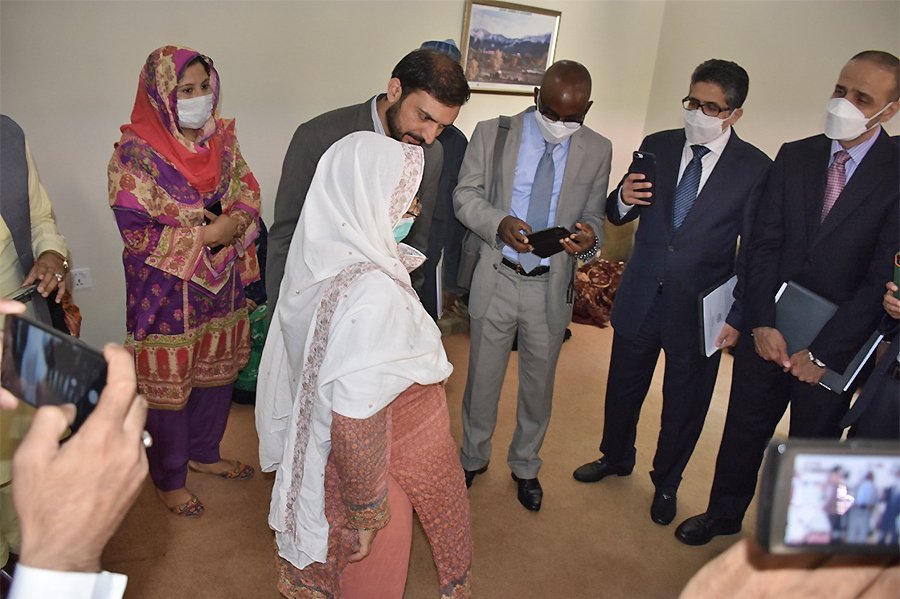


A delegation of the OIC’s Independent Permanent Human Rights Commission (IPHRC) is visiting a refugee camp at Thotha, Muzaffarabad, on August 6, 2021. (Photo courtesy: AJK government) 

Earlier this week, on Friday, Azad Jammu and Kashmir (AJK) President Sardar Masood Khan called upon OIC member states to “establish a humanitarian corridor to aid the people of Indian-administered Kashmir.”

Khan made the appeal while talking to the OIC-IPHRC delegation, which includes diplomats and representatives from the United Arab Emirates, Uganda, Nigeria, Malaysia, Saudi Arabia, Azerbaijan, Gabon, Tunisia, Turkey and Morocco.

He also thanked the OIC for its “courageous and steadfast support for the right of the people of Jammu and Kashmir to self-determination,” adding that there were around 42,000 refugees from across the divide in AJK, with a majority residing in or around the capital, Muzaffarabad.

“He also demanded immediate steps by OIC to provide emergency assistance to the beleaguered Kashmiris who have been suffering for the past two years by providing scholarships to Kashmiri students studying in Occupied Kashmir, AJK, Pakistan and other countries...to continue their education,” a statement issued by his office said.

The OIC is the world’s second-largest intergovernmental body after the UN, comprising 57 member states.


Pakistan engages Saudi Arabia, China in bid to ease surging Middle East tensions 

Updated 10 March 2026
Follow

Pakistan engages Saudi Arabia, China in bid to ease surging Middle East tensions 

  • Pakistan’s foreign minister stresses need for de-escalation in conversations with Chinese, Saudi counterparts
  • Tensions in the Middle East continue to remain high as conflict between US, Israel and Iran intensifies

ISLAMABAD: Pakistan’s Deputy Prime Minister Ishaq Dar spoke to the foreign ministers of Saudi Arabia and China on Tuesday, stressing the importance of diplomatic engagement to de-escalate tensions in the Middle East as the Iran war intensifies. 

Pakistan has constantly engaged regional countries in efforts to broker a ceasefire in the Middle East, after the US and Isreal launched coordinated strikes against Iran on Feb. 28. 

Iran launched fresh attacks on Gulf countries on Tuesday morning, where it has targeted US military bases in recent weeks. In addition to firing missiles and drones at Israel and American bases in the region, Iran has also been targeting energy infrastructure which, combined with its stranglehold on the Strait of Hormuz, has sent oil prices soaring worldwide. 

Dar spoke to Saudi Foreign Minister Prince Faisal bin Farhan to discuss developments in the Middle East and ongoing deliberations at the UN Security Council, Pakistan’s foreign office said in a statement. 

“DPM/FM shared Pakistan’s perspective, underscoring the importance of continued coordination and diplomatic engagement to support de-escalation and promote peace and stability across the region and beyond,” the statement said. 

Dar, who also serves as Pakistan’s foreign minister, spoke to Chinese foreign minister Wang Yi over the telephone separately. The two discussed the evolving regional situation and broader global developments.

Dar underscored the need to ease tensions in the Middle East and the wider region during the conversation, the foreign office said. 

Yi appreciated Pakistan’s constructive efforts aimed at promoting de-escalation and stability in the region, it added. 

“The two leaders stressed the importance of de-escalation and emphasized the need to pursue dialogue and diplomacy in accordance with the principles of the UN Charter,” the foreign office’s statement said. 

The conflict in the Middle East has hit Pakistan hard as well, forcing Islamabad to hike petrol and diesel prices by Rs55 per liter last Friday. 

Pakistan’s government has also announced a set of austerity measures, which include closing schools and cutting down on government expenditures, as it evaluates petrol stocks and looks for alternative supply routes.