

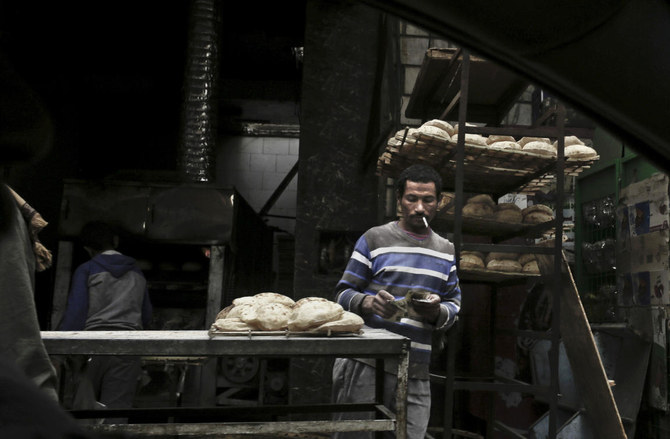

CAIRO: Plans to raise the price of bread for the first time in 44 years have shocked Egyptians already struggling to get by in a country where state-subsidised loaves have kept the poorest basically fed since the 1960s.
In declaring this week that it was time to hike bread prices, President Abdel Fattah El-Sisi aims to curb an expensive subsidy program that serves some two-thirds of Egypt’s 100 million people and helped keep political dissent at bay.
“How will we live? And how will we pay for the children of our deceased brother who live with us?” said Wafaa Bakr in Shubra El-Kheima, a dilapidated working-class district sprawling along the outskirts of Cairo.
“The price of a loaf of subsidised bread is a red line — there are widows and orphans who do not have a fixed income,” said Ahmed Saeed in Sharqia, in the Nile Delta north of Cairo.
Some 30 percent of Egyptians fall beneath the government’s poverty line, with incomes below 857 pounds ($54.73) a month. Many struggle without running water or sanitation.
The minimum monthly wage is 2,400 pounds ($153) but that is sometimes not paid in the informal sector, where roughly two-thirds of Egyptians work. Joblessness was at 7.2 percent at the end of last year, and has been chronically higher among young people.
However, economists have said for years that Egypt, the world’s biggest wheat importer and Arab world’s most populous country, must rein in subsidies to modernize its economy.
Bread subsidies now weigh ever heavier on the budget as supply jitters have driven up global wheat prices during the coronavirus pandemic.
Bread subsidies were set at nearly 45 billion Egyptian pounds ($2.9 billion), just over half of the food subsidy bill, for the fiscal year ending in June. This amounts to roughly 1.8 percent of overall state spending.
“It is time for the 5-piaster (0.32 US cent) loaf to increase in price,” El-Sisi said during televised remarks at the opening of a food production plant on Tuesday, referring to a round 90-gram loaf known as ‘eish baladi’.
El-Sisi said he hoped the news would not be poorly received and that the government was not planning a big increase. “It’s incredible to sell 20 loaves for the price of a cigarette.”
The government has already pared back subsidies on electricity and fuel, ushering in annual increases in their price since 2016 as part of market reforms linked to financing from the International Monetary Fund.
Egyptian governments have long exercised caution when it comes to the price of bread, which in Egyptian colloquial speech derives its name from the Arabic word for ‘life’.
An attempt in 1977 by then-President Anwar Sadat to increase bread prices set off deadly riots across Egypt that did not subside until the decision was rescinded.
PRICE ‘NOT SACROSANCT’
El-Sisi’s government has been gradually laying the ground for change, however, notably by rolling out cash transfer programs that better channel state subsidies to the most needy.
“There’s been a long softening-up process for this step, including the reductions in the weight of the loaf from 130g to 110g and then to 90g last August,” said David Butter, an analyst for the Middle East and North Africa at Chatham House.
“So the message that the 5p loaf is not sacrosanct has been out there for some time.”
Some calculations suggest that simply doubling the price to 10 piasters could save up to 4 billion pounds a year, he said.
Hassan Mohammadi, head of the Bakeries Division at the Grain Chamber of the Federation of Egyptian Industries, said the decision was overdue. “People eat the front and leave the back, and they use it as fodder for birds and livestock,” he said, suggesting a 100g loaf should be sold at 10 piasters.
He also suggested a 140-gram loaf should be reintroduced and sold at 20 piasters.
What this means for the poor — for whom the state-subsidised loaf, accompanied by whatever else they can afford, represents a meal — is the heart of the matter for Sheikh Ibrahim Radwan, a preacher in a mosque in the Nile Delta city of Kafr El-Sheikh north of Cairo.
“Mr. President, the poor man gets anything simple (to eat) with subsidised bread. We cannot dispense with that or afford any increase in the cost,” Radwan said, addressing El-Sisi.


