

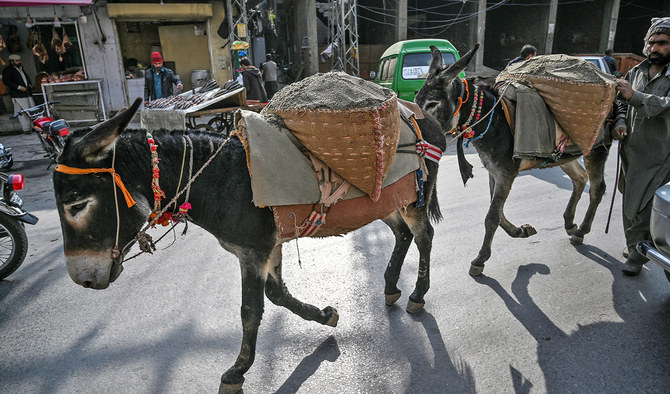

KARACHI: Global equine advocacy group Brooke said this week Pakistan was illegally exporting donkey skins to China despite an official ban on the business.
In recent years, Africa has become the epicenter of a fast-growing industry to supply donkey skins to China which are boiled to produce a gelatin called ejiao used in traditional medicine believed to stop aging and boost libido. But thousands of donkeys in other developing countries are also being killed and their skins sold to China for use in traditional medicine, a report published by the Donkey Sanctuary in 2017 revealed.
“We are aware of activity taking place outside of Africa in Afghanistan, Pakistan and Brazil,” Megan Sheraton, spokesperson of the UK-based group, Brooke, said in an email interview.
The Chinese embassy did not respond to multiple requests for comment for this article.
Brooke is an international charity that protects and improves the lives of horses, donkeys and mules that provide people in the developing world the opportunity to work their way out of poverty. It reaches almost 1.7 million working horses, donkeys and mules across Africa, Asia, Latin America and the Middle East, and employs staff that includes vets, animal welfare experts, and advocacy and development specialists.
“Africa is undoubtedly the epicenter of the donkey skin trade,” Sheraton said listing countries like Ghana, Nigeria, Botswana, Burkina Faso, Mali, Niger, Senegal, Uganda, Ethiopia, South Sudan, Tanzania, Kenya and Egypt.
In 2017, media reported that Pakistan’s provincial government in Khyber Pakhtunkhwa (KP) had decided to set up two donkey farms to fetch foreign exchange by exporting donkeys to China.
However, the country’s ministry of national food security and research categorically denied any such farms existed in Pakistan.
“There is no donkey farm in KP or elsewhere in Pakistan. There is a ban on the export of equine, i.e., horses and donkeys as well as their hides,” the ministry said in a statement to Arab News.
However, Pakistan busted a gang, which included a Chinese national, smuggling donkey skin to China in 2017, and recovered about 5,000 skins from them. The value of the products was estinated at Rs118.4 million.
Donkey owners say the price of the animal has increased in recent days.
Muhammad Irfan, who rears the animal for sale in Kot Addu, Punjab, told Arab News a donkey in good health could fetch between Rs45,000 and Rs60,000 at present.
The global population of donkeys is estimated to be over 44 million, with Ethiopia widely acknowledged to have the highest number of donkeys at 8.5 million. According to data based on the inter-census growth rate of 1996-2006, Pakistan has about 5.6 million donkeys with an annual growth of 100,000 animals.
The current demand for donkey skin is estimated to be 4.8 million per year, which means almost half of the world’s donkeys could be wiped out in the next five years, Brooke estimates show.
“The companies who produce ejiao make millions from the product, pushing it as a long-standing remedy for a number of different uses including, more recently, beauty products,” Sheraton said, calling it “a fairly recent innovation.”
Once a luxury for the elite, ejiao — that comes as a tablet to dissolve in water or in anti-aging cream — is now widely used by China’s increasingly wealthy middle class and diaspora. Prices have surged to over $780 a kilogram from around $30 in 2000, according to Chinese state-run media reports.
“There is no scientific evidence for its effectiveness,” Sheraton said. “Consumers are being misled.”


