Israel launches airstrikes on Lebanon in response to rockets

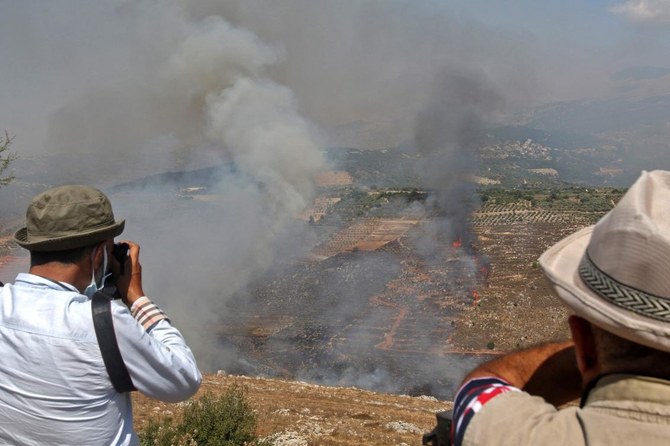
Smoke billows from shelling by Israeli forces in the town of Ibl Al-Saqi, southern Lebanon. (AFP)
Short Url
Updated 05 August 2021
Follow

Israel launches airstrikes on Lebanon in response to rockets

  • Israel blames Lebanon for the shelling and warns ‘against further attempts to harm Israeli civilians and Israel’s sovereignty’

TEL AVIV: Israel on Thursday escalated its response to rocket attacks this week by launching rare airstrikes on Lebanon, the army said.
The army said in a statement that jets struck the launch sites from which rockets had been fired over the previous day, as well as an additional target used to attack Israel in the past. The IDF blamed the state of Lebanon for the shelling and warned “against further attempts to harm Israeli civilians and Israel’s sovereignty.”
The overnight airstrikes were a marked escalation at a politically sensitive time. Israel’s new eight-party governing coalition is trying to keep peace under a fragile cease fire that ended an 11-day war with Hamas’ militant rulers in Gaza in May. Several incidents leading up to this week’s rocket fire from Lebanon have focused attention on Israel’s northern border, and the United States swiftly condemned the attacks on Israel.
The Hezbollah-owned Al-Manar TV reported the strikes at around 2 a.m., saying they hit an empty area in the Mahmoudiya Village in Marjayoun district.
Avichai Adraee, the Israeli army’s Arabic-language spokesman, said the Lebanese government is responsible for what happens on its territories and warned against more attacks on Israel from south Lebanon.
Three rockets were fired from Lebanon into Israeli territory Wednesday and the army responded with sustained artillery fire, Israel’s military said. The announcement came after sirens sounded in northern Israel warning of a possible rocket attack. Two rockets landed inside Israeli territory, the army said.
Channel 12 reported that one rocket exploded in an open area and another was intercepted by Israel’s defense system, known as the Iron Dome. Israeli media reported that the incoming rockets started fires near Kiryat Shmona, a community of about 20,000 people near the Lebanese border.
The Lebanese military reported 92 artillery shells fired by Israel on Lebanese villages as a result of the rocket fire from Lebanon. It said the Israeli artillery shelling resulted in a fire in the village of Rashaya Al-Fukhar. In a statement, the Lebanese army also said it was conducting patrols in the border region and had set up a number of checkpoints and opened an investigation to determine the source of the rocket fire.
Lebanese security officials did not immediately confirm the Israeli airstrikes.
There have been several similar incidents in recent months.
US State Department spokesman Ned Price condemned the rocket fire from Lebanon.
“Israel has the right to defend itself against such attacks,” he told reporters in Washington, adding that the US would remain engaged with partners “in the region in an effort to de-escalate the situation.”
At the United Nations, spokesman Stephane Dujarric said the UN peacekeeping mission in Lebanon, known as UNIFIL, was aware of the rocket fire and Israel’s artillery response. He said the UNIFIL commander, Maj. Gen. Stefano Del Col, appealed for a cease-fire and urged both sides to “exercise maximum restraint to avoid further escalation.”


Refugees, migrants in Lebanon find rare sanctuary from Israeli strikes in Beirut church 

Updated 59 min 20 sec ago
Follow

Refugees, migrants in Lebanon find rare sanctuary from Israeli strikes in Beirut church 

  • Beirut church offers safe haven for displaced migrants, refugees
  • Many refugees lived through 2024 war, but are now more vulnerable

BEIRUT: When Israeli strikes began pummelling Beirut’s southern suburbs early on Monday, Sudanese refugee Ridina Muhammad and her family ​had no choice but to flee home on foot, eventually reaching the only shelter that would accept them: a church.
Eight months pregnant, Muhammad, 32, walked with her husband and three children for hours in the dark streets until they found a car to take them to the St. Joseph Tabaris Parish, which has opened its doors to refugees and migrants.
They are among 300,000 people displaced across Lebanon this week by heavy Israeli strikes, launched in response to a rocket and drone attackinto Israel by the Lebanese armed group Hezbollah.
Just 100,000 of the displaced are in government shelters. Others are staying ‌with relatives ‌or sleeping in the streets. But migrants and refugees say government ​shelters ‌were ⁠never an option ​for ⁠them, saying they were turned away during the last war between Hezbollah and Israel.
Muhammad’s oldest daughter, now seven, stopped speaking after the 2024 war.
This time, they are even more vulnerable: their home was destroyed in this week’s strikes and Muhammad is due to give birth at the end of the month.
“I don’t know if there’s a doctor or not, but I’m really scared about it because I haven’t prepared any clothes for the baby, nor arranged a hospital, and I don’t know where to go,” she told ⁠Reuters as her younger daughter leaned against her pregnant belly.
Muhammad ‌said she was registered with the United Nations’ refugee agency (UNHCR) ‌but had not received support.
“Us, as refugees, why did we ​register with the UN, if they are not ‌helping us in the most difficult times?” she said.
Dalal Harb, a spokesperson for UNHCR ‌Lebanon, said the agency had mobilized but reaching everyone immediately was extremely challenging given the scale and speed of displacement. The UNHCR operation in Lebanon is currently only around 14 percent funded, she said.
The Jesuit Refugee Service (JRS), which helped the church host displaced in 2024, is doing so again.
Michael Petro, JRS’ Emergency Shelter Director, said the church was ‌full within the first day of strikes, with 140 people from South Sudan, Ethiopia, Bangladesh, and other countries sheltering there.
“There are many, many more ⁠people coming than there ⁠were in 2024, and we have fewer and fewer places to put them,” he said.
Petro said he was told weeks ago that government shelters would be open to migrants if war erupted.
But when the strikes began and even Lebanese struggled to find shelter, the policy seemed to change, he said.
“We’re hearing from hotlines up to government officials and ministries that migrants are not welcome,” Petro said.
Lebanon’s Minister for Social Affairs Haneen Sayyed did not respond to a request for comment. On Thursday, Sayyed said Beirut shelters were full.
When Israeli strikes began, Othman Yahyeh Dawood, a 41-year-old Sudanese man, put his two young sons on his motorcycle.
They drove 75 kilometers (46 miles) from the southern Lebanese town of Nabatieh to St. Joseph’s, where they had sheltered in 2024.
“I know the area ​is safe and there are people who ​will welcome us,” he said.
“We don’t know where to go; there’s war there (in the south), war here (in Beirut), war in Sudan, and nowhere else to go,” he said.