


LONDON: Lithuania accused Belarus on Wednesday of using migrants from the Middle East and Africa as a “political weapon” and urged the EU to intervene.
Lithuanian Foreign Minister Gabrielius Landsbergis said Belarusian President Alexander Lukashenko was allowing flights with what he claims are tourists from Iraq, Syria and African countries who then illegally cross the border into Lithuania in an attempt to seek asylum in the EU.
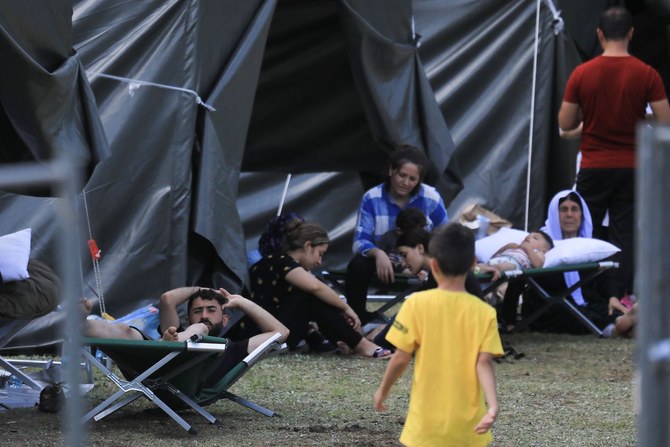
More than 4,000 migrants have already entered Lithuania in this way so far this year, compared with only about 80 in the whole of 2020, Landsbergis told the website Politico.
“This is not the 2015 migration crisis,” he said. “This is not people fleeing the war in Syria. This is actually a hybrid weapon, a political weapon one might say, that is (being) used to change the European policy.”
He warned that a recent decision by Belarus to increase the number flights from Iraq to Minsk could lead to more than 6,000 migrants crossing the border into Lithuania every week.
“There are currently 24 flights to Minsk from Istanbul and eight flights from Baghdad each week,” said Landsbergis. “If you consider that each of these flights can transport up to 170 people, and if you fill all the seats with asylum seekers, the capacity is up to 6,000 people a week — or even more because new flights from Erbil have been announced on Monday. So there is a possibility for Lukashenko to really up the ante.”
The foreign minister called for increased international pressure on Minsk through further sanctions and by lobbying the home countries of migrants to take action.
“The EU could tell countries such as Iraq that there’s a list of instruments — restrictions of visa programs, for example — that we will use if they don’t stop these flights to Minsk,” Landsbergis said.
“We know that these people are not tourists coming to visit Belarus.”
The number of migrants crossing into Lithuania from Belarus could exceed 10,000 by the end of the summer, he warned, and added that this number could dramatically increase as Lukashenko approaches African governments “to build up new routes.”
“So what we are seeing might be just the beginning,” he said.
The foreign minister said he has discussed the issue with EU foreign policy chief Josep Borrell and other EU officials who “understand the situation,” but he stressed that more must be done.
“I think we need to really step up our game,” Landsbergis said. “Because at this point the message that we are sending (is) not sufficient to change the way things are.”
Lithuania has asked for an emergency meeting of EU interior ministers this month to agree assistance for the country, which is on the front line of a new migration crisis in Europe.
On Tuesday, Lithuanian authorities said they reserve the right to use force to prevent illegal immigration, and turned away 180 people attempting to enter the country. However, rights groups said all nations have an obligation to protect vulnerable people.
“Push backs of people seeking asylum are not compatible with the Geneva Convention on Refugee Status, the EU Charter of Fundamental Rights, and other human rights instruments” Egle Samuchovaite, program director for Lithuania's Red Cross, told the Associated Press.
She added that refusing to allow vulnerable people to cross the border leaves them in an unsafe environment, trapped between two countries.
Lithuania has no physical barriers along its almost 700-kilometer border with Belarus.
The row over the latest actions of Belarus’s authoritarian president comes after the EU imposed sanctions on his country over an incident in May that was denounced as “state piracy,” in which a Belarusian warplane was scrambled to intercept an aircraft so that a dissident journalist could be arrested.


