

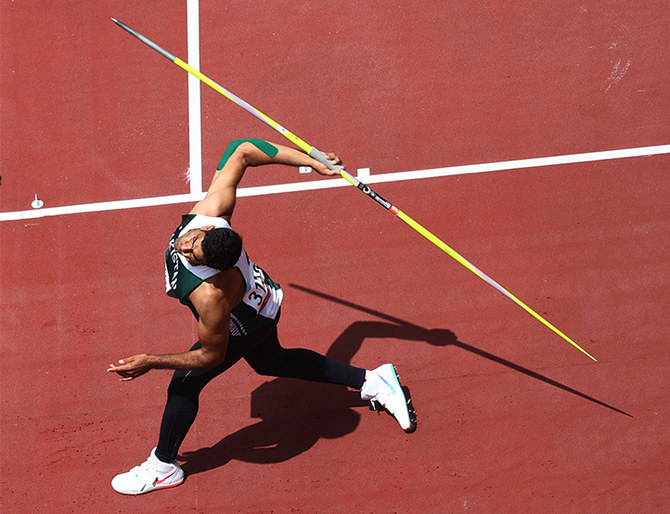
Pakistan’s Arshad Nadeem makes history by advancing to javelin final at Tokyo Olympics 

Pakistan's Arshad Nadeem competes in the men's javelin throw qualification during the Tokyo 2020 Olympic Games at the Olympic Stadium in Tokyo on August 4, 2021. (REUTERS)
Short Url
Updated 04 August 2021
Follow

Pakistan’s Arshad Nadeem makes history by advancing to javelin final at Tokyo Olympics 

  • Nadeem is the first Pakistani athlete in history to qualify for the final of any track and field event at the Olympics
  • He threw to a distance of 86.39m, his personal best, setting national record during Iran’s Imam Reza contest this year

ISLAMABAD: Pakistan’s Arshad Nadeem created history on Wednesday when he went through to the final of the men’s javelin at the Tokyo Olympics, to be held on August 7.
India’s Neeraj Chopra, the 2018 Commonwealth champion, also qualified with his first throw of the morning at 86.65 meters, while world leader Germany’s Johannes Vetter also advanced.
Nadeem is the first Pakistani athlete in history to qualify for the final of any track and field event at the Olympics.
The Pakistan Olympic Association said Nadeem had, with a “tremendous throw of 85.16 meters,” secured third place in the qualifying round.
“Lt. Gen (R) Syed Arif Hasan, President Pakistan Olympic Association congratulates Mr. Arshad Nadeem and his coach Mr. Syed Fiaz Hussain Bokhari for exceptional performance securing third position in the qualifying round and expressed best wishes for the finals,” POA said in a tweet.

“He was placed in group B for the contest in which the athlete had to throw a minimum of 83.5m to directly qualify for the final,” Geo News reported. “Only six athletes could do so, and Arshad was one of them while the rest of the six athletes advanced to the finals on basis of their respective farthest throw.”
In his first attempt, the 24-year-old Pakistani athlete could reach the 78.5m mark but in the second attempt, he “created history with a throw of 85.16m that also placed him on top of group B.”
Earlier this year, Arshad threw the javelin to a distance of 86.39m, his personal best, setting a national record during the Imam Reza championship in Iran. Earlier in 2019, he threw 86.29m at the South Asian Games in Nepal.
“So, one can safely say that Arshad’s best is yet to come and hope that the best comes at the final on 7th August, which is scheduled to commence at 4:00pm Pakistan time,” Geo News said.
The javelin world record at the Olympics is 90.57m by Norway’s Andreas Thorkildsen.



Pakistan high court pauses tree-cutting in Islamabad until Feb. 2

Updated 10 sec ago
Follow

Pakistan high court pauses tree-cutting in Islamabad until Feb. 2

  • Islamabad High Court asks CDA to ‘explain and justify’ tree-cutting at next hearing
  • CDA officials say 29,000 trees were cut due to allergies, deny felling in green belts

ISLAMABAD: The Islamabad High Court has ordered an immediate halt to tree-cutting in the federal capital until Feb. 2, seeking justification from civic authorities over the legality of a large-scale felling drive that has seen thousands of trees removed in recent months.

The interim order, issued by a single-judge bench led by Justice Khadim Hussain Soomro, came during proceedings on a petition challenging the Capital Development Authority’s (CDA) tree-cutting operations in Islamabad’s Shakarparian area and H-8 sector.

At the outset of the hearing, the petitioner’s counsel argued that trees were being felled in violation of the Pakistan Environmental Protection Act 1997, the Islamabad Wildlife Ordinance 1979 and the city’s master plan.

“Respondents shall not cut trees till the next date of hearing,” Justice Soomro said in the court order released on Friday while referring to CDA officials.

“Respondents are directed to come fully prepared and to file paragraph-wise comments before the next date of hearing, along with a comprehensive report explaining the justification and legal basis for the cutting of trees,” he added.

According to the court order, the petitioner maintained that the CDA had not made any public disclosure regarding the legal basis for the operation and that the felling was causing environmental harm.

The petition sought access to the official record of tree-cutting activities and called for the penalization of CDA officials responsible for the act under relevant criminal and environmental laws.

It also urged the court to impose a moratorium on infrastructure projects in Islamabad, order large-scale replanting as compensation and constitute a judicial commission headed by a retired Supreme Court judge to probe the alleged violations.

CDA officials acknowledge around 29,000 paper mulberry trees have been cut in the capital in recent months, arguing that the species triggers seasonal allergies such as sneezing, itchy eyes and nasal congestion.

They also maintain that no trees have been removed from designated green belts and that the number of replacement trees planted exceeds those felled.

Designed in the 1960s by Greek architect Constantinos Doxiadis, Islamabad was conceived as a low-density city with green belts and protected natural zones at its core.

Critics, however, say the recent felling has extended beyond paper mulberry trees and question whether authorities are adhering to the city’s master plan and the legal protections governing forested and green areas.

The court has adjourned its hearing until Feb. 2, 2026.