Pakistan army completes 90 percent of fence along Afghan border

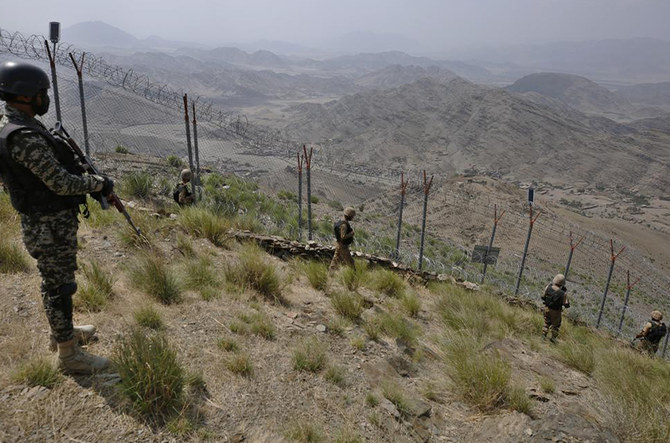
Pakistan Army troops patrol along the fence on the Pakistan Afghanistan border at Big Ben hilltop post in Khyber district, Pakistan, Tuesday, Aug. 3, 2021. (AP)
Short Url
Updated 04 August 2021
Follow

Pakistan army completes 90 percent of fence along Afghan border

  • The announcement by the Pakistan army comes amid increasing violence in neighboring Afghanistan
  • Double fence is about 4 meters high, surveillance cameras installed to check any movement along border

TORKHAM: Pakistan’s military said Tuesday it has completed 90 percent of a fence being constructed along the border with Afghanistan, vowing to complete the project this summer.
Pakistan says it is constructing the fence to prevent cross-border militant attacks.
The announcement by the Pakistan army comes amid increasing violence in neighboring Afghanistan, where the Taliban have stepped up attacks ahead of a complete withdrawal of American troops from the war-torn country.
Pakistan started the fence along the 2,611-kilometer (1,622-mile) border with Afghanistan — known as the Durand Line — in 2017 when militants repeatedly launched cross-border attacks on Pakistani posts.
On Tuesday, a Pakistani military official, Col. Rizwan Nazir, told a group of foreign journalists at the key Torkham border crossing that the remaining 10 percent of the fence at the western border will be complete this year.
The border barrier between the two countries consists of two sets of chain-link fences separated by a 2-meter (6.5-foot) space that has been filled with concertina wire coils. The double fence is about 4 meters (13 feet) high. The military has installed surveillance cameras to check any movement along the border.
Afghanistan has never recognized the porous border that runs through the Pashtun heartland, diluting the power of Afghanistan’s largest ethnic group on both sides.
Pakistan and Afghanistan often accuse each other of turning a blind eye to militants operating along the frontier. Both deny the charges.
On Tuesday, Pakistani soldiers were seen patrolling one of the most dangerous regions in the county, where Pakistani Taliban and other local and foreign militants have a presence.


After mosque bombing, Islamabad intensifies patrols, surveillance during Ramadan prayers, iftar

Updated 7 sec ago
Follow

After mosque bombing, Islamabad intensifies patrols, surveillance during Ramadan prayers, iftar

  • Police chief orders enhanced screening at capital city’s entry and exit points after Feb. 6 blast
  • Safe City cameras to monitor Islamabad round the clock as special pre-iftar traffic plan enforced

ISLAMABAD: Police in the federal capital have been instructed to step up patrols, surveillance and checkpoint inspections during Ramadan prayers and iftar hours, an official statement said on Wednesday, as the city’s police chief chaired a security meeting following a deadly mosque bombing earlier this month.

Inspector General of Police Syed Ali Nasir Rizvi directed senior officers to ensure “foolproof security” across the city, with special focus on mosques during peak congregational times.

The meeting comes after a suicide bombing at a mosque on the outskirts of Islamabad on Feb. 6 that killed at least 32 people. The blast targeted the Qasr-e-Khadijatul Kubra mosque and imambargah during Friday prayers and was claimed by Daesh that said one of its militants detonated an explosive vest inside the congregation.

“All officers must ensure their presence in the field and properly brief personnel about their duties,” Rizvi said, according to a statement issued by the police.

“Strict security arrangements should be ensured at mosques, imambargahs and Ramadan bazaars,” he continued. “Special patrols should be conducted during Fajr, iftar and Taraweeh hours.”

The police chief said Safe City cameras would be used for round-the-clock effective monitoring across the capital.

In addition to security measures, he reviewed traffic arrangements and directed strict implementation of a special traffic plan during pre-iftar rush hours, calling for additional deployment on major roads and at commercial centers.

Islamabad, which has generally seen fewer large-scale militant attacks than some other parts of Pakistan, has faced sporadic security incidents in the past, prompting authorities to tighten monitoring during religious gatherings and other high-risk events.