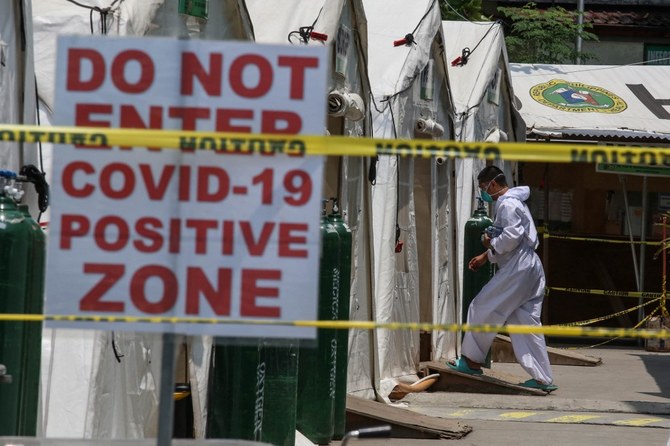
DUBAI: The Philippine national capital region will implement longer curfew hours when it shifts to an enhanced community quarantine on Friday, as a precaution to rising infections of the Delta variant of the coronavirus.
Movement limits in Metro Manila would be in place between 8 p.m. to 4 a.m., from the current curfew hours of 12 a.m. to 4 a.m., after a unanimous decision from mayors, Metropolitan Manila Development Authority chairperson Benhur Abalos said in a press briefing on Monday.
Metro Manila is currently under general community quarantine with ‘heightened and additional’ restrictions but will shift to ECQ, the strictest status, from Aug. 6 to Aug. 20 due to the threat of rising COVID-19 cases fueled by the Delta variant.
The shift to the strictest quarantine mode means indoor and al fresco dining would be disallowed and businesses and costumers can only have take-out and delivery services.
Indoor sports venues and tourist attraction would be closed, but outdoor tourist spots, as defined by the Department of Tourism, may continue to operate, but at a 30 percent capacity.
Presidential spokesman Harry Roque Jr. earlier said the two-week lockdown may be sufficient to reduce the COVID-19 caseload in Metro Manila.
Metro Manila residents such as Emmanuel S. Geslani says they are comfortable with the impending lockdown, and are preparing for it by stocking up on medicines and food.
“The Delta variant is really worrying because we do not know who (among those in public) have it,” Geslani told Arab News.
“So it is better [to implement the lockdown] as a precaution against it.”
Jaime Mendoza, a government nurse, meanwhile told Arab News that coronavirus transmission could be controlled only if there would be strict monitoring in the porous borders between cities.
“There should also be strict compliance among the residents, whose livelihood have been affected by the pandemic.”
Infectious disease expert Dr. Edsel Maurice Salvana, said in a social media post that “the lockdown was preemptive response to Delta and is premised on an accelerated vaccination program to get as many people vaccinated as possible.”
“We recommended putting many areas in the country under ECQ when Delta started showing up in July, areas that were already for escalation anyway because of increasing HCUR and other parameters,” according to Salvana, who is among selected experts working with government to address the coronavirus pandemic.
“The biggest objective of this impending ECQ is to vaccinate as many people as possible in NCR. We are only tempering the anticipated increase in Delta to protect as many people as possible.”


![]()

Philippine national capital region to implement longer curfew hours as COVID-19 precaution
Short Url
https://arab.news/2ndmv
Philippine national capital region to implement longer curfew hours as COVID-19 precaution
- Metro Manila is currently under general community quarantine with ‘heightened and additional’ restrictions but will shift to a stricter one on Friday


Latest updates




© 2026 SAUDI RESEARCH & PUBLISHING COMPANY, All Rights Reserved And subject to Terms of Use Agreement.