

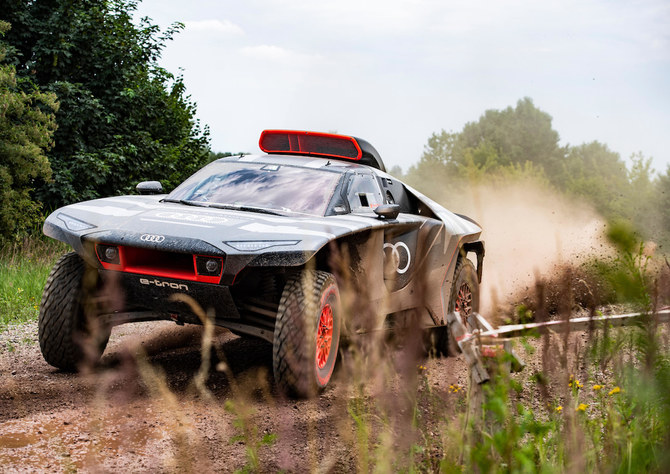

DUBAI: Audi Sport has started testing the new Audi RS Q e-tron, with which it will take on one of the greatest challenges there is in international racing, the Dakar Rally 2022 in Saudi Arabia next January.
Audi is set to be the first car manufacturer to use an electrified drivetrain in combination with an efficient energy converter in its rally SUVs to compete against traditional, diesel-powered vehicles in the world’s toughest rally.
“The quattro was a game-changer for the World Rally championship. Audi was the first brand to win the Le Mans 24 Hours with an electrified drivetrain. Now, we want to usher in a new era at the Dakar Rally, while testing and further developing our e-tron technology under extreme conditions,” said Julius Seebach, managing director of Audi Sport GmbH and responsible for motorsport at Audi. “Our RS Q e-tron was created on a blank sheet of paper in record time and stands for Vorsprung durch Technik.”
Less than a year after the initial concept idea, the new laboratory set up for the Dakar Rally has begun testing on the RS Q e-tron, and all eyes will be on its progress ahead of the event at the start of 2022.
“The Dakar Rally has become one of the most renowned motoring events globally for its rich history and prestige among international racing communities and we are very proud that it is hosted in the Middle East,” said Carsten Barden, Audi Middle East managing director. “We’re looking forward to being part of this flagship event where the Audi RS Q e-tron can showcase its unmatched innovation in the unique climate presented by the region.”
The conditions and terrain of the Dakar Rally present the engineers with special challenges. The marathon event lasts two weeks and the daily stages are up to 800 km in length. “That’s a very long distance,” said Andreas Roos, head of the Dakar project at Audi Sport. “What we are trying to do has never been done before. This is the ultimate challenge for an electric drivetrain.”
Because there are no charging opportunities in the desert, Audi has chosen an innovative concept: On board of the Audi RS Q e-tron there is a highly efficient engine that is part of an energy converter that charges the high-voltage battery while driving.
Visually, the Audi RS Q e-tron also differs significantly from conventionally powered Dakar prototypes. “The vehicle looks futuristic and has many design elements that are typical of Audi,” said Juan Manuel Diaz, team leader of motorsport design at Audi. “Our aim was to symbolize Vorsprung durch Technik and the future of our brand.”
The Dakar Rally entry is being run in conjunction with Q Motorsport.
“Audi has always chosen new and bold paths in racing, but I think this is one of the most complex cars that I have ever seen,” said team principal Sven Quandt. “The electric drivetrain means that a lot of different systems have to communicate with each other. Besides reliability, which is paramount in the Dakar Rally, that’s our biggest challenge in the coming months.”
Quandt compares Audi’s Dakar project to the first moon landing: “Back then, the engineers didn’t really know what was coming. It’s similar with us. If we finish the first Dakar event, that’s already a success.”
The prototype of the Audi RS Q e-tron had its first roll-out in Neuburg at the beginning of July. An intensive test program and the first test entries at cross-country rallies are on the agenda from now until the end of the year.


